Wonderful Bhutan Tour- 8 Nights 9 Days
Active
9d
All sales are final. No refund is available for cancellations.
Manual confirmation
Mobile or paper ticket accepted
About this experience
This cultural tour explores the wonderfully diverse environment of Bhutan’s western valleys as well as their cultural heritage. Drive over high mountain passes and through rapidly changing vegetation from pine forests to hills covered in rhododendrons, magnolias and dwarf bamboo – abundant with birds and wildlife. The centerpiece to this tour is time spent exploring the beautiful Phobjikha Valley, winter home to the rare Black-Necked Crane. This tour also visits ancient fortresses, temples, monasteries, markets, farm houses and museums in Paro, Thimphu and Punakha. Highlights include the Ta Dzong Museum, Rimpong Dzong,The National Memorial Chorten, 12th century Changangkha Temple, the National Library exhibiting ancient scriptures, Phobjikha Sanctuary and Punakha Dzong.
Available options
Tour Price
Accommodation in 3 Star Hotel: Accommodation in twin Sharing in 3 Star Hotel/Resort.(4 & 5 star may require an additional premium).<br/>All Meals: All meals (buffet system /include evening tea/snacks per pax each day).<br/>SUV Vehicles: Inland transfers by private car: SUV Vehicles<br/>Pickup included
What's included
Hotel pickup and drop-off
Local guide
All taxes, fees and handling charges
Professional guide
Bottled water
Lunch
Dinner
Breakfast
Meals as per itinerary (B=breakfast, L=lunch, D=dinner)
Sustainable Development Fee (SDF)
Coffee and/or Tea
Visa fee
Transport by private vehicle
Detailed itinerary
1
Day 1: Paro Airport to Thimphu City.
After clearing immigration and customs you will be greeted by your World Tour Plan guide and driver and transferred to Bhutan’s capital Thimphu, travelling through the spectacular countryside en route. All the houses and buildings in the Kingdom are painted and constructed in traditional Bhutanese style.
On arrival into Thimphu check-in to your hotel and take lunch. Enjoy the remainder of the day to explore Thimphu, both by vehicle and on foot. Your options include visits to the National Memorial Stupa; and the Takin Preserve – home to Bhutan’s most unusual national mammal. Overnight Thimphu – Bhutanese Style 3* Hotel.
2
Day 2: Sightseeing in the Thimphu Valley today.
This morning, visit awesome Golden Buddha, visit Zorig Chusum – the Institute of the 13 Arts & Crafts of Bhutan (sometimes closed for visitors), the National Library, which holds a vast collection of ancient Buddhist manuscripts; the hand-made paper making factory & the weekend market (Fri-Sun) where everyone goes to buy an array of fresh fruits & vegetables; home-wares, handicrafts and clothes.
After Lunch, don’t forget to go for shopping spree. Visit Green Weaving Center and Royal Textile Academy to buy authentic Bhutanese handicrafts. Take a wander along Thimphu’s main street, Norzin Lam, which offers good shopping and the Craft Bazaar. The city bars are also worth a visit. Your guide will advise you the best options. Please note Tuesday is ‘dry day’ in Bhutan and most bars in the city will remain closed. Overnight Thimphu – Bhutanese Style 3* Hotel.
3
Day 3: Thimphu to Phobjikha Valley.
This morning you will be transferred by road eastwards to the Phobjikha Valley. En-route passing the Semtokha Dzong, built in 1629 & the oldest fortress of its kind that guarded the Thimphu valley, which today it is a monastery. Continue ascending to Dochu La (pass) to view the 108 Stupas, commissioned by a former Queen as a memorial to those who lost their lives during the low intensity conflict in late 2002 when Bhutan evicted Indian rebels camped in the jungle on the Bhutan – Indian border.
On a clear day you will witness a breathtaking view of the eastern Himalaya and depending on the time of the year the vista can vary from alpine snow (November – March) to a profusion of blossoms (March – May) splashed among the soft green of the wild herbs and forest trees.
When the ruins of the Wangdue Phodrang Dzong (tragically destroyed by fire in June 2012) come into view, notice the large cacti that cover the hillside below which, were planted long ago to discourage invaders from climbing the steep slope to the Dzong. From the road view Rinchengang, one of Bhutan’s oldest villages, which did not have access to water, electricity or schooling until the early 1990’s.The craftsmen of Rinchengang are sought after for their skills in construction of Dzongs and Lhakhangs (temples).
Until recently the Phobjikha valley’s only electricity came from solar or mini hydro plants. In 2011 underground cabled electricity is gradually connecting the valley to the national grid. Potatoes are this region’s primary cash crop and mainly exported to India. Phobjikha is a glacial valley on the western slopes of the Black Mountains and is one of the most beautiful open valleys in Bhutan.
It is also one of the most important wildlife preserves in the country and the winter home (late October to early February) of the rare black necked crane, which annually flies in from Tibet. There are also muntjaks (barking deer), wild boar, sambar, Himalayan black bear, leopard and red foxes. Overnight Phobjikha Valley – Bhutanese Style 3* Hotel.
4
Day 4: Sightseeing in the Phobjikha Valley.
While you are in Phobjikha you will visit the Black Crane nature information centre and the sacred Gangtey Monastery plus enjoy time to wander through Gangtey village and hike the Gangtey Nature Trail. There are many additional hikes available in this beautiful valley and your guide will advise you the best options. Overnight Phobjikha Valley – BhutaneseStyle 3* Hotel.
5
Day 5: Phobjikha Valley to Punakha Valley.
Depart early this morning to the Punakha Valley which holds the title as the winter capital because of its more temperate climate. Arriving into the Punakha valley visit Chimi Lhakhang, a monastery built by Lama Drukpa Kuenley (also known as the Divine Madman or Mad Monk), which is a pleasant, easy 20 minute walk across paddy fields. It is believed that childless women who visit the temple will conceive after receiving a “wang” (blessing) from the resident monk.
After lunch enjoy an orientation tour of the valley including the nunnery and, time permitting, consider a visit to the small village of Nobgang, original home to the 4 former Queens (all sisters) of the previous 4th King or to the small village of Talo where you can wander through the serene grounds of the monastery with its beautiful gardens. Overnight Punakha Valley – Bhutanese Style 3* Hotel.
6
Day 6: Sightseeing & hiking in Punakha.
This morning visit the dramatic Punakha Dzong, which formerly served as the seat of the government and is still the winter residence of the Dratsheng (Central Monk Body). This is Bhutan’s most spectacular Dzong and an excellent example of how a medieval fortress and a centre of both monastic and administrative functions, has adapted and evolved for modern day use. Don’t forget the local market if you are in Punakha on a Saturday morning.
This afternoon we recommend a fascinating drive to Khamsum Yulley Namgyel Chorten through fields of vegetables, rice paddies and tiny hamlets. This Chorten holds very special significance being consecrated in 1999 and dedicated to the protection of the former Crown Prince – today’s current King Jigme Khesar Namgyel Wangchuck. Overnight Punakha Valley – Bhutanese Style 3* Hotel.
7
Day 7: Punakha Valley to Paro Valley.
Depart Punakha early morning for your transfer westwards to the Paro Valley, once again traversing Dochu La, and arriving in Paro town in time for a late lunch at one of the local restaurants.
This afternoon enjoy an orientation tour of the major features in Paro town including Paro Dzong with its cantilever bridge; Kyichu Lhakhang – one of Bhutan’s oldest and most beautiful temples boasting an orange tree that perpetually bears fruit followed by a visit to the old ruined fortress of the Drugyel Dzong (14km from Paro). This is the historical site of the Fort of Drukpa Victory, from which the Bhutanese used to repel the Tibetan invaders again and again. On a clear day views of the 7314 m snow domed peaks of sacred Mt Chomolhari can be seen. Overnight Paro Valley – Bhutanese Style 3* Hotel.
8
Day 8: Paro Taktshang Hike – Hike to Tiger’s Nest Monastery.
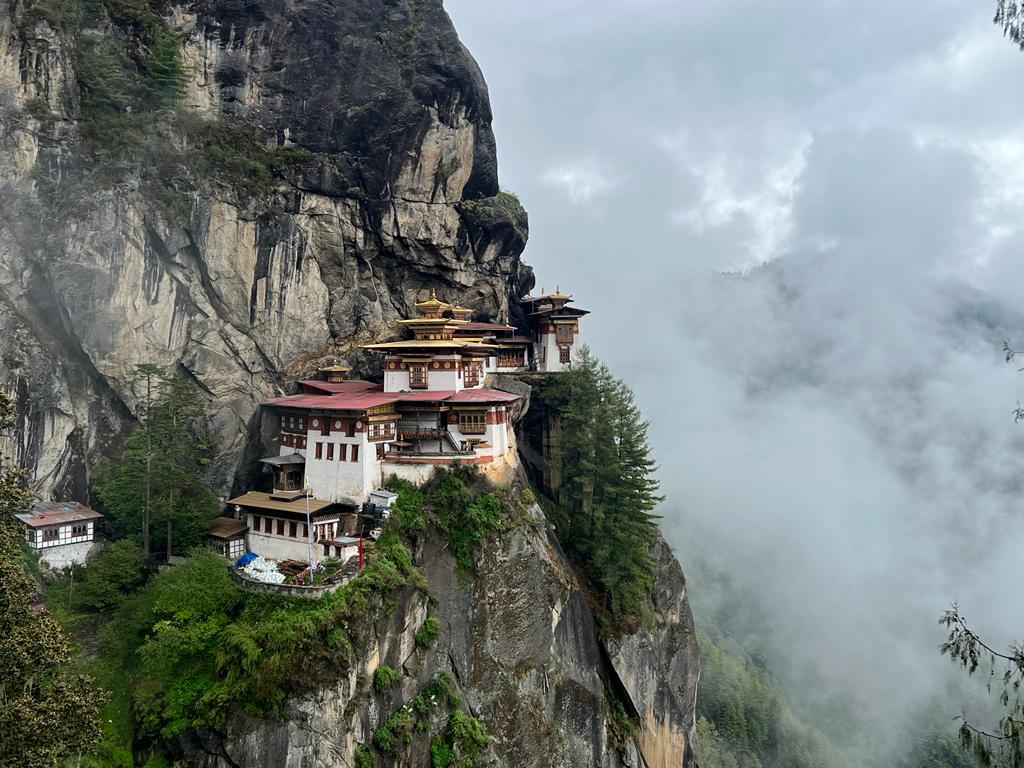
After breakfast, hike up to Taktshang Monastery, also known as ‘Tiger’s Nest Monastery’. The climb up to the viewpoint will take around 1 ½ hours and from there you will enjoy a spectacular view of the monastery clinging to the side of the cliff. Stop for refreshment at the View Point Cafeteria. Then walk further up to the monastery which will take about 1 hour. It is said that in the 8th century Guru Rinpoche flew on the back of a tigress from eastern Bhutan to this place and meditated in a cave here for 3 months.
The principal Lhakhang (monastery) of the present monastic complex dates from 1692. Taktsang was damaged severely by fire in 1998 but has now been fully restored to its former beauty. After visiting the monastery, walk back down to the road on the way stop for lunch at the view point cafeteria and then walk further down to the road point.
Then drive back to hotel. On the way visit Kichu temple, one of the 108 temples built in the 7th century by the Tibetan King Songsten Gampo. The story goes that a giant demon lay across the whole area of Tibet and the Himalayas and was preventing the spread of Buddhism. To overcome her, King Songtsen Gampo decided to build 108 temples, which would be placed on all the points of her body. Of these 108 temples, 12 were built in accordance with precise plans. Thus, it happened that in about the year AD 638 the temple of Jokhang in Lhasa was built over the very heart of the demon. In the evening relax. Overnight Paro Valley – Bhutanese Style 3* Hotel.
9
Day 9: Departure.
In the morning, after breakfast representative from World Tour Plan will see you off at the Paro airport for your onward flight.
What's not included
Alcoholic drinks (available to purchase)
Souvenir photos (available to purchase)
Laundry
Flight ticket
Travel insurance
Available languages
Guide guide
EN
Reviews breakdown
Tripadvisor
4.8
6 reviews
5★
5
4★
1
3★
0
2★
0
1★
0
Important information
Service animals allowed
Public transportation options are available nearby
Specialized infant seats are available
Not recommended for travelers with spinal injuries
Not recommended for pregnant travelers
Not recommended for travelers with poor cardiovascular health
Suitable for all physical fitness levels
Vegetarian option is available, please advise at time of booking if required
Please advise any specific dietary requirements at time of booking
A current valid passport is required on the day of travel
About Paro
Paro is a picturesque valley in Bhutan, known for its stunning landscapes, historic dzongs, and the only international airport in the country. It's a cultural and spiritual hub, offering a blend of natural beauty and rich heritage.
Top Attractions
Paro Dzong (Rinpung Dzong)
A stunning fortress-monastery that serves as the administrative and religious center of Paro. It's known for its beautiful wooden architecture and historical significance.
Historical/Architecture
2-3 hours
Free (entry fee for the museum: Nu 300 approx. $4.20 USD)
Tiger's Nest Monastery (Paro Taktsang)
A sacred Buddhist monastery perched on a cliffside, accessible via a steep hike. It's one of Bhutan's most iconic landmarks.
Religious/Cultural
4-5 hours (hike and visit)
Nu 1000 (approx. $14 USD) for foreigners
Chele La Pass
The highest motorable pass in Bhutan, offering breathtaking views of the Himalayas and the valley below.
Nature/Scenic
1-2 hours (visit)
Free
Drukgyel Dzong
A ruined fortress that once protected Bhutan from Tibetan invasions. It's a UNESCO World Heritage Site and a symbol of Bhutanese resilience.
Historical/Architecture
1-2 hours
Free
Kyichu Lhakhang
One of the oldest and most sacred temples in Bhutan, known for its beautiful gardens and peaceful atmosphere.
Religious/Cultural
1 hour
Free
Must-Try Local Dishes
Ema Datshi
A spicy stew made with chilies and cheese, a staple in Bhutanese cuisine
Main dish
Vegetarian (unless made with meat)
Momos
Dumplings filled with meat or vegetables, a popular street food
Snack
Can be vegetarian or with meat
Jasha Maru
A spicy minced chicken curry, often served with red rice
Main dish
Non-vegetarian
Suja (Butter Tea)
A traditional Bhutanese tea made with butter and salt, often served in the morning
Drink
Contains dairy
Popular Activities
Hiking
Mountain biking
Rafting
Meditation
Yoga
Spas
Temple visits
Festivals
Best Time to Visit
March to May and September to November
These months offer the best weather for sightseeing and outdoor activities. The skies are clear, and the landscapes are vibrant.
15°C to 30°C
59°F to 86°F
Practical Information
Language
- Official: Dzongkha
- Widely spoken: English
- English: Widely spoken, especially in tourist areas
Currency
Ngultrum (BTN)
Time Zone
Bhutan Time (BTT, UTC+6)
Electricity
230VV, 50HzHz
Safety Information
Overall Safety Rating: Generally safe
Bhutan is generally safe for travelers, with low crime rates and a peaceful society. However, travelers should exercise caution when hiking, driving, or engaging in outdoor activities.
Important Precautions:
- • Use reputable tour operators and taxis.
- • Be cautious when using ATMs and carrying large amounts of cash.
- • Keep valuables secure and be aware of your surroundings.
Getting there
By air
- Paro International Airport • 0 km
By bus
Paro Bus Terminal
Getting around
Public transport
Buses are affordable but can be crowded. Schedules are not always reliable.
Taxis
Available • Apps:
Rentals
Car, Bike, Scooter
Neighborhoods
Paro Town
Drukgyel Village
Chele La
Day trips
Haa Valley
50 km • Full day
A scenic valley known for its beautiful landscapes, traditional villages, and historic sites.
Phobjikha Valley
70 km • Full day
A remote and picturesque valley known for its wetlands, black-necked cranes, and traditional villages.
Thimphu
55 km • Half day to full day
The capital city of Bhutan, offering a mix of modern and traditional elements, with historic sites, museums, and vibrant markets.
Festivals
Paro Tsechu • Spring and autumn (specific dates vary each year)
Haa Summer Festival • July
Thimphu Tsechu • September/October (specific dates vary each year)
Pro tips
- Visit Paro Dzong early in the morning or late in the afternoon to avoid crowds and enjoy the best light for photographs.
- Hike to the Tiger's Nest Monastery early in the day to beat the heat and crowds, and bring plenty of water and snacks.
- Try local Bhutanese dishes like Ema Datshi and Jasha Maru for an authentic culinary experience.
- Learn a few basic Dzongkha phrases to connect with locals and show respect for their culture.
- Pack layers of clothing, as temperatures can vary significantly throughout the day and between seasons.
From $25
per person
Price varies by option
Secure booking
Free cancellation available