4 hour Vintage Fiat 500 Grand Tour in Milan
Active
4h
For a full refund, cancel at least 24 hours before the scheduled departure time.
Instant confirmation
Mobile or paper ticket accepted
About this experience
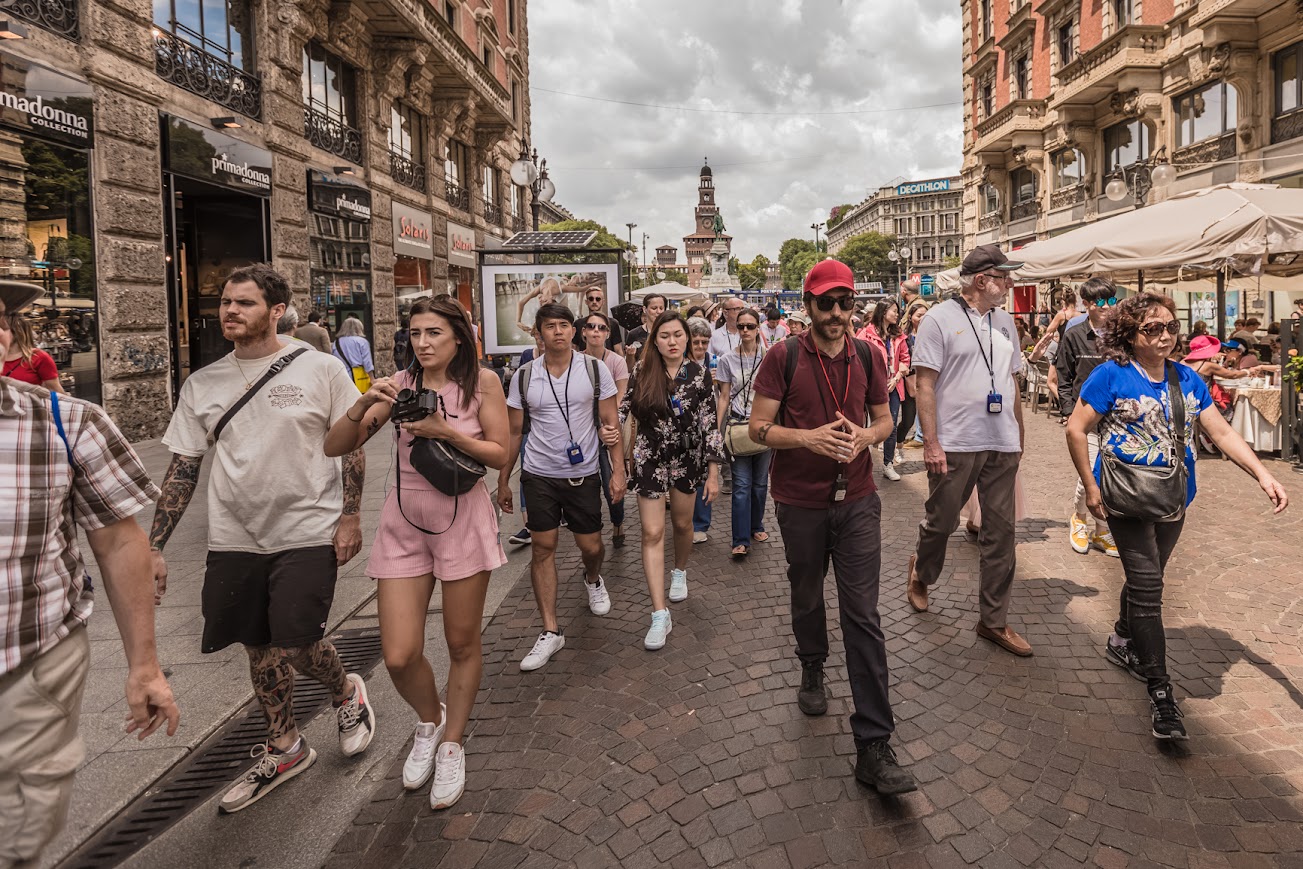
This experience is the most complete and allows you to get to know the whole city practically.
From the historic center to the Navigli, with its canals, to the modern CityLife district and then the Garibaldi district.
Four hours and four stops to really get to know the city.
Welcome to Milan!
*The itinerary may vary due to traffic, events, accidents or indications from the Municipality.
Available options
Grand Tour with hotel pick up
Duration: 4 hours<br/>Hotel pick up*: *Selected hotels only in Zone 1.<br/>Pickup included
Vintage Fiat 500 Grand Tour in Milan (4 Hs)
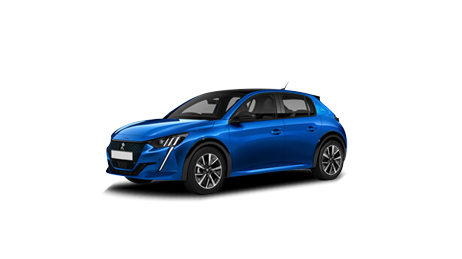
Duration: 4 hours<br/>Classic Red Fiat 500
What's included
Tour Leader Driver
4 stops (walking alone around)
Classic Red Fiat 500
*Hotel pick up: selected hotels in Zone 1 only.
Detailed itinerary
1
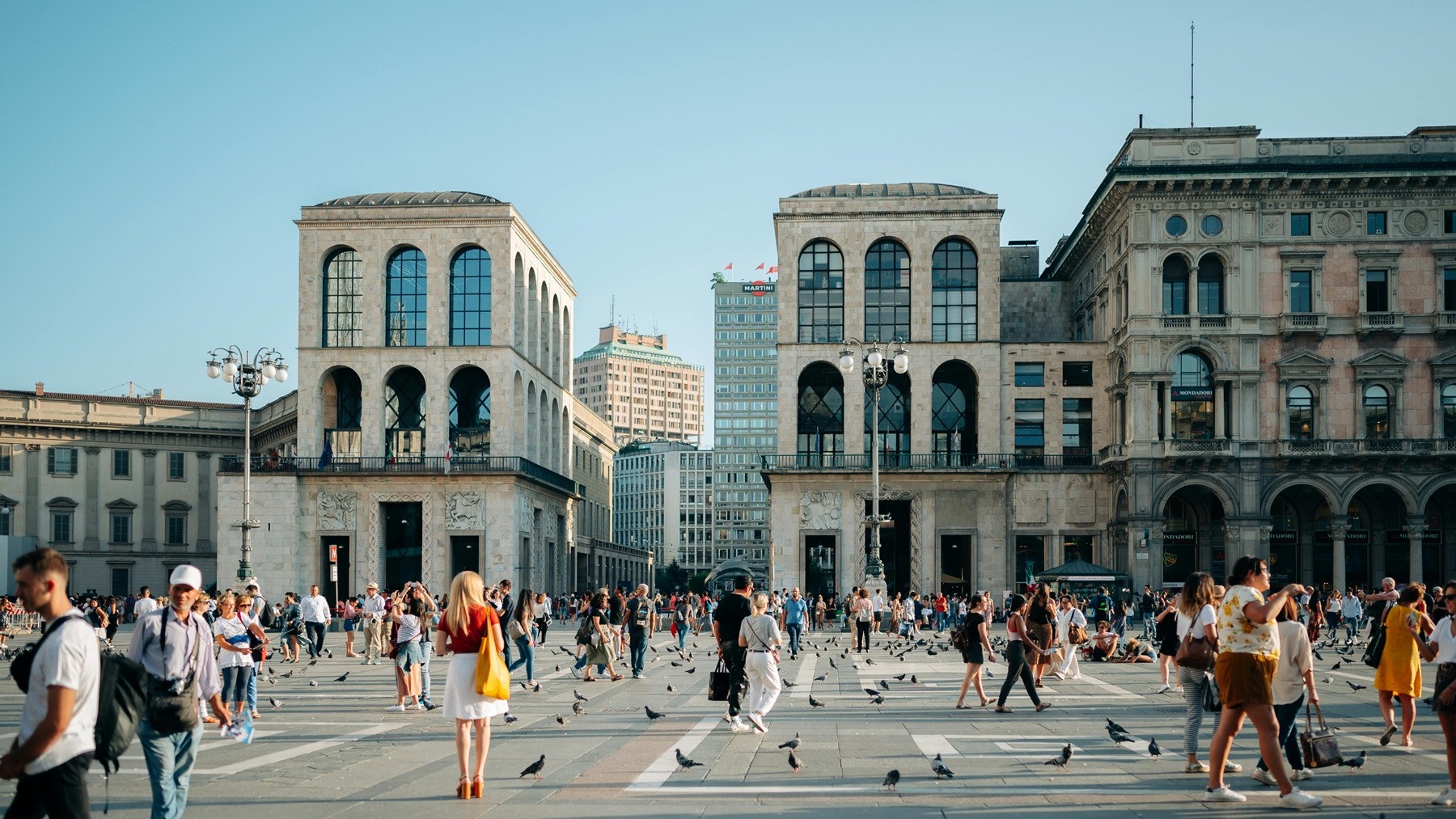
Located in front of the Giardini Montanelli, the Royal Villa of Milan, or Villa Belgiojoso Bonaparte, is a neoclassical villa with a beautiful English-style garden. Built between 1790 and 1796 by the architect Leopoldo Pollack, commissioned by Count Ludovico Barbiano of Belgiojoso. Today it is home to the Modern Art Gallery.
2
The State Archives of Milan, based in the Palazzo del Senato, via Senato n. 10, is the State institution responsible, by law, for the conservation of documents coming from the offices of state bodies, but also public ones and private producers.
3
Stop 3
Pass by
The arches of Porta Nuova (medieval) are one of the largest gates on the medieval layout of the walls of Milan.
4
Stop 4
Pass by
In the elegant Brera district there are, among the many points of interest, the Art Gallery, the Botanical Garden, the Church of Santa Maria del Carmine and then luxury boutiques and elegant bars and restaurants. At the end of Via San Marco there is still a lock created by the genius of Leonardo.
5
Stop 5
Pass by
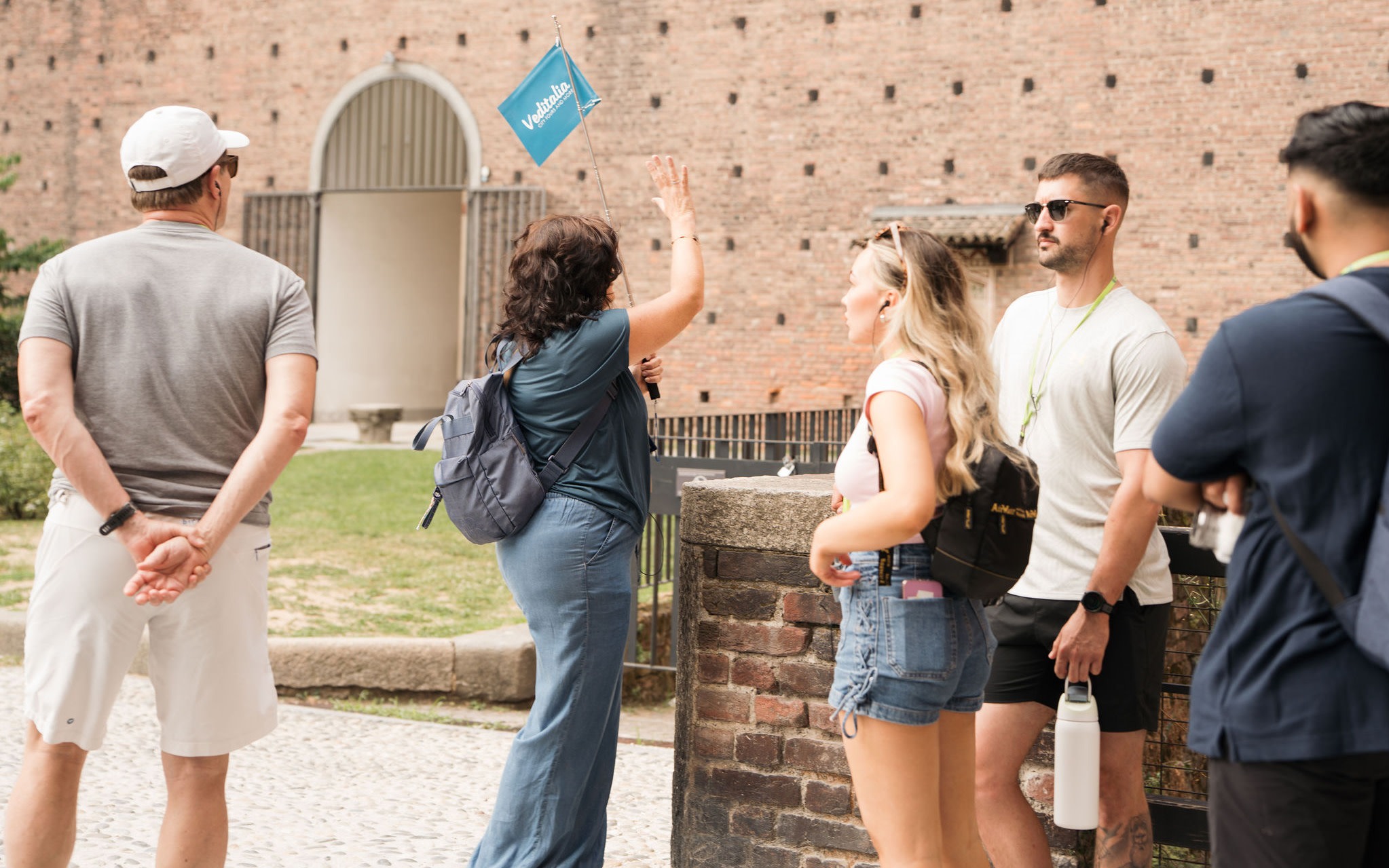
The Sforzesco Castle is a large fortified complex located in Milan just outside the historic center of the city. It was built in the 15th century by Francesco Sforza, who had recently become Duke of Milan, on the remains of a previous 14th century medieval fortification known as Porta Giovia Castle.
6
Stop 6
Pass by
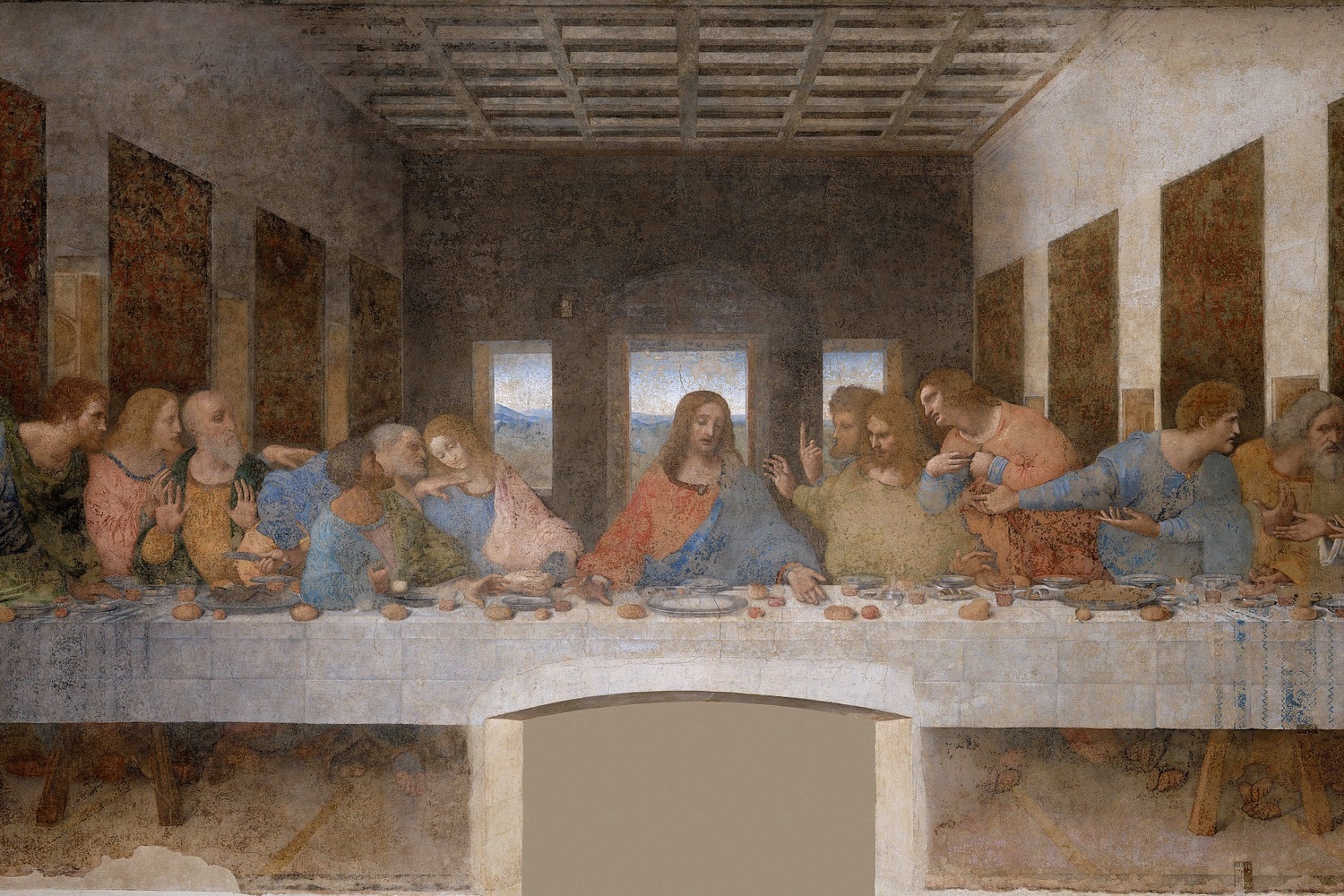
The basilica of Santa Maria delle Grazie is located in the heart of Milan and was included in the UNESCO World Heritage List in 1980 because it is one of the greatest testimonies of Renaissance art, supported by the presence of the exceptional work "Last Supper" by Da Vinci, excellent representative of human creative genius.
7
Stop 7
Pass by
The church of San Maurizio al Monastero Maggiore is considered the Sistine Chapel of Milan, due to its architectural structure and the very high quality of the decorative cycle of the Leonardesque school.
8
LOVE. (acronym for Freedom, Hate, Vengeance, Eternity), commonly known as The Finger, is a sculpture by the Italian artist Maurizio Cattelan located in front of the Palazzo della Borsa.
9
Piazza Cordusio once represented the financial center of Milan as it hosted the headquarters of various financial institutions. Starting from the 2010s, with the transfer of these to the new skyscrapers in the Porta Nuova and CityLife Project areas, the square has become the center of the social and commercial life of the city.
10
Stop 10
Pass by
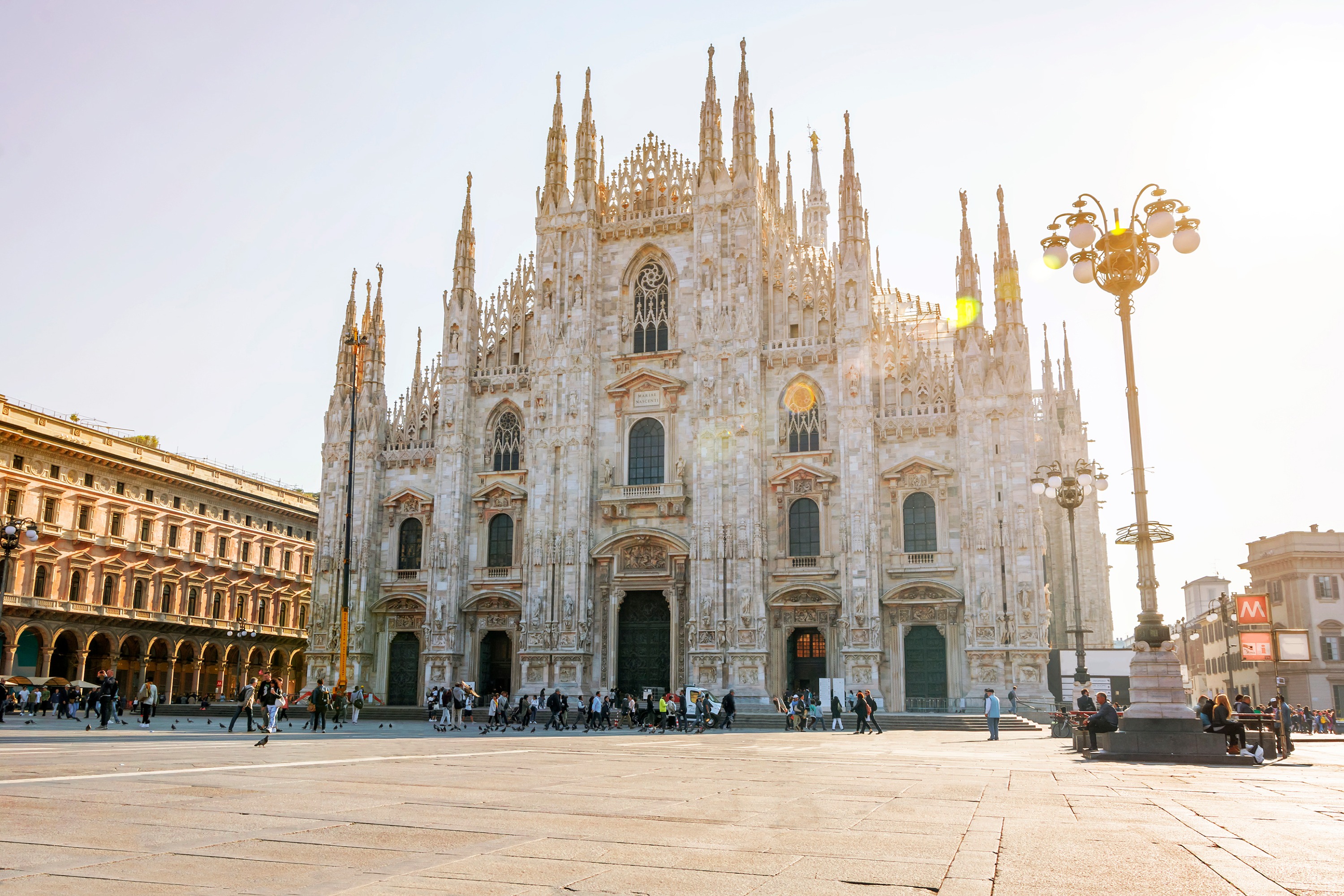
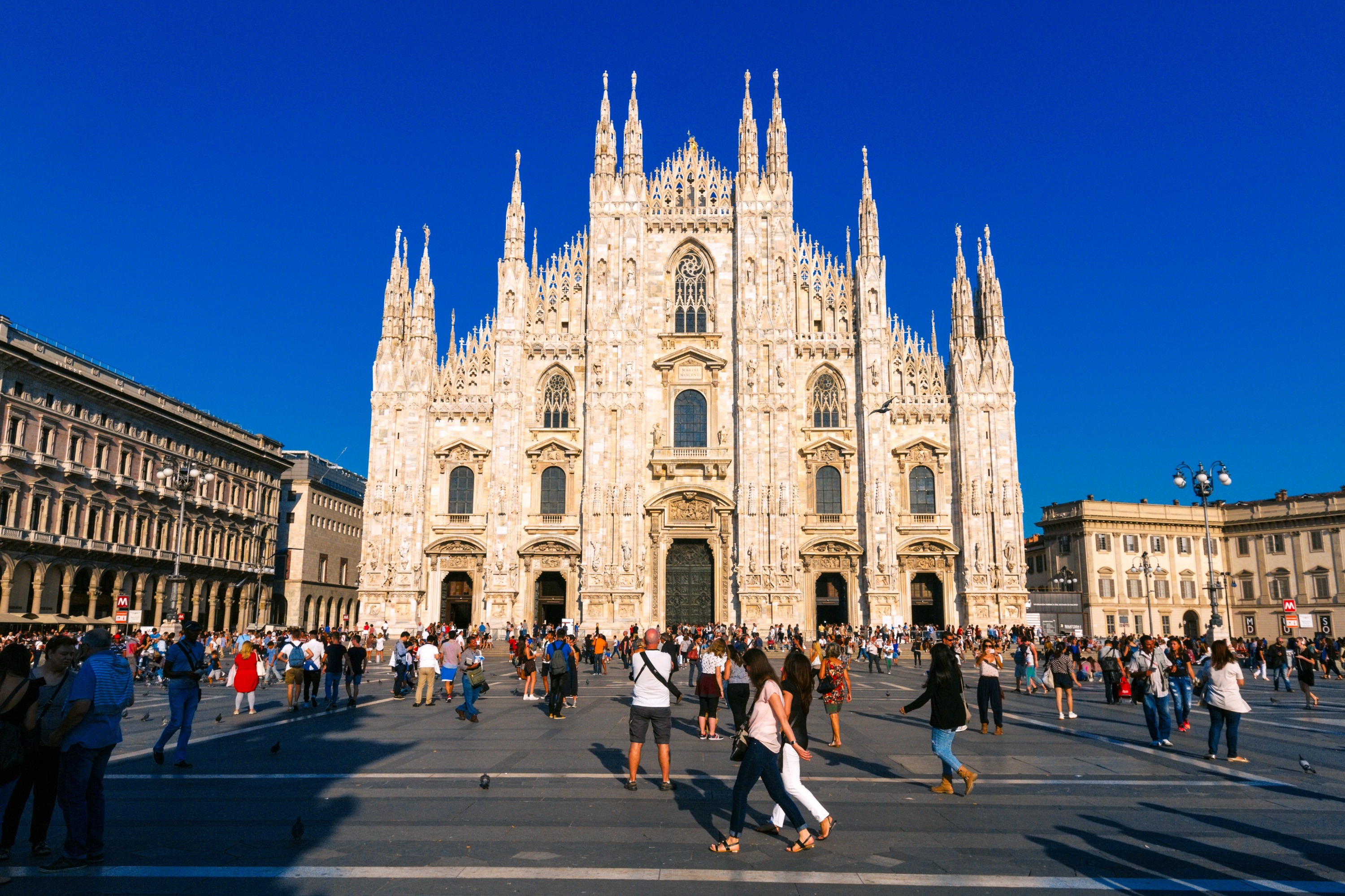
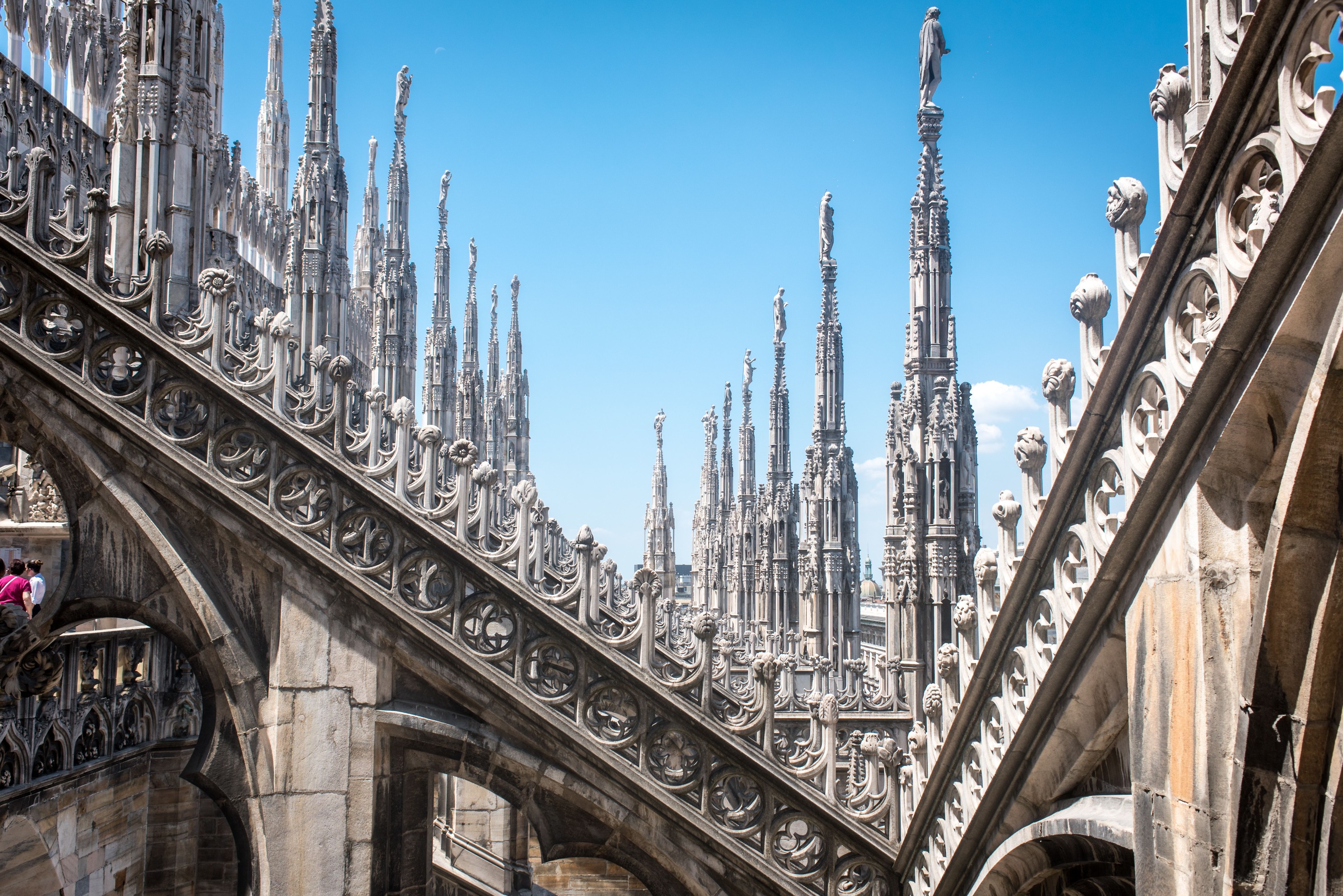
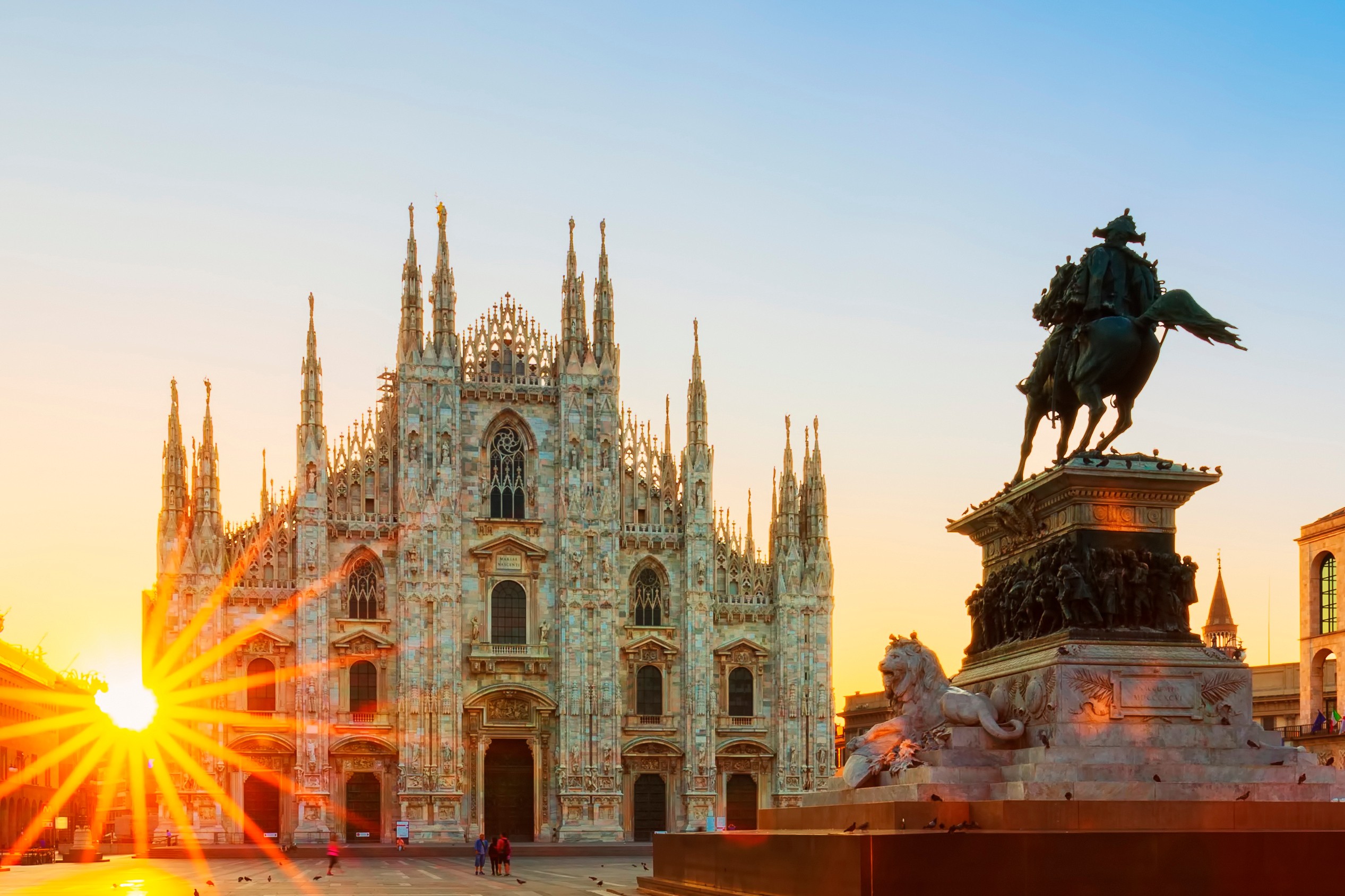
The Duomo of Milan, 1386, officially the Metropolitan Cathedral of the Nativity of the Blessed Virgin Mary, is the cathedral of the Archdiocese of Milan and an Italian national monument. Symbol of the Lombard capital, and located in the square of the same name in the center of the metropolis, it is dedicated to Santa Maria Nascente.
11
Via Torino is one of the oldest streets in Milan characterized by a long-standing commercial tradition and an important connecting road between Piazza Duomo and the Navigli area.
12
Stop 12
Pass by
In the 4th century San Lorenzo stood outside the city walls, not far from the amphitheater, the imperial palace and the circus, along the Via Ticinensis, which connected Pavia to Milan and was the most important access road to the city. For those arriving in Milan the Basilica presented itself with all its size.
13
Stop 13
Pass by
The church of San Bernardino alle Ossa is a church in Milan, located in Piazza Santo Stefano. Also referred to in the past as San Bernardino ai Morti, it is particularly known for the seventeenth-century ossuary chapel, the walls of which are largely covered in bones to form true baroque decorations.
14
Via Laghetto takes its name from the small lake of Santo Stefano, a modest basin that played a fundamental role in the construction of the Milan Cathedral. The work was carried out at the end of 1300, more precisely between 1388 and 1389, therefore a few years after the laying of the foundation stone of the Milan Cathedral (1386), to lower the cost of transporting Candoglia marble.
15
The University of Milan, also known colloquially as "La Statale", is a public university founded in 1923. The headquarters is located in the Renaissance building of "Ca' Granda" in Milan, commissioned by the Duke of Milan Francesco Sforza as the city's hospital.
16
The court was built between 1932 and 1940 under the direction of the architect Marcello Piacentini in twentieth century style.
For its construction, the church of San Filippo Neri in Bovisasca and the convent of the Slaves of Mary were demolished.
17
The Rotonda della Besana is a late Baroque cemetery complex in Milan consisting of a long closed portico in the center of which stands the former church of San Michele ai Nuovi Sepolcri, built starting in 1695 based on a design by Arrisio Arrigoni. Today it is home to the MU.BA (children's museum).
18
Porta Romana is one of the six main gates of Milan, built along the Spanish walls, now almost entirely demolished. Characterized by the presence of the monumental arch from 1596 commissioned by Philip III of Spain, it stands in the center of Piazza Medaglie d'Oro, at the mouth of Corso di Porta Romana.
19
Stop 19
Pass by
Over the centuries, the Navigli of Milan allowed navigation in an entire area that from the large lakes, crossing the entire plain, extended to the sea. The water network of the Navigli gradually expanded with the construction of the Naviglio Pavese and from the 14th century it played a leading role in the transit of materials used for the construction of the Milan Cathedral. Work that continued for the following centuries with important creations such as the Conca della Viarenna and the Naviglio della Martesana. Today the neighborhood is full of restaurants and cafes. The projects for the improvements that Leonardo da Vinci made, as a hydraulic engineer, to the system of basins, which regulated the flows of water, date back to the Renaissance.
20
The San Vittore prison is a penitentiary institution whose construction began in May 1872, while it was inaugurated on 24 June 1879 during the Kingdom of Italy by Umberto I.
It is located along Viale Papiniano, home to an important and characteristic open-air market.
21
The Teatro Nazionale, designed by Mario Borgato, was used as a movie-theater for a long time and it was then inaugurated as a theater in 1924. In the same square are the very first “skyscrapers” in the city (only 38 meters high!) designed in Art Deco style by the same architect in 1923.
22
Milan's City Life neighborhood is home to luxury apartment buildings and cutting-edge office skyscrapers.
The sprawling CityLife Shopping District offers trendy shops, international restaurants and a cinema.
In the nearby CityLife park, with over 1000 trees, it is possible to follow pedestrian and cycle paths that cross expanses of meadows.
Palazzo delle Scintille is a vast building that hosts fashion shows and exhibitions.
23
The Maspes-Vigorelli velodrome (1935) is a historic sports facility in the city of Milan originally dedicated to track cycling and today used mainly for American football.
24
Stop 24
Pass by
Il neoclassico Arco della Pace (o Porta Sempione, 1807) è stata la prima delle nuove cinque porte più recenti di Milano, ricavata lungo i bastioni spagnoli, oggi demoliti, e realizzata nell'ampio piazzale retrostante la piazza d'Armi del Castello Sforzesco come ingresso trionfale alla città dalla Francia.
25
The Gianni Brera Civic Arena, until 2001 simply called the Civic Arena, is a multifunctional sports facility in Milan. Inaugurated in 1807 as the Milan Amphitheater, in 1870 it became the Civic Arena following its acquisition by the Municipality.
26
Stop 26
Pass by
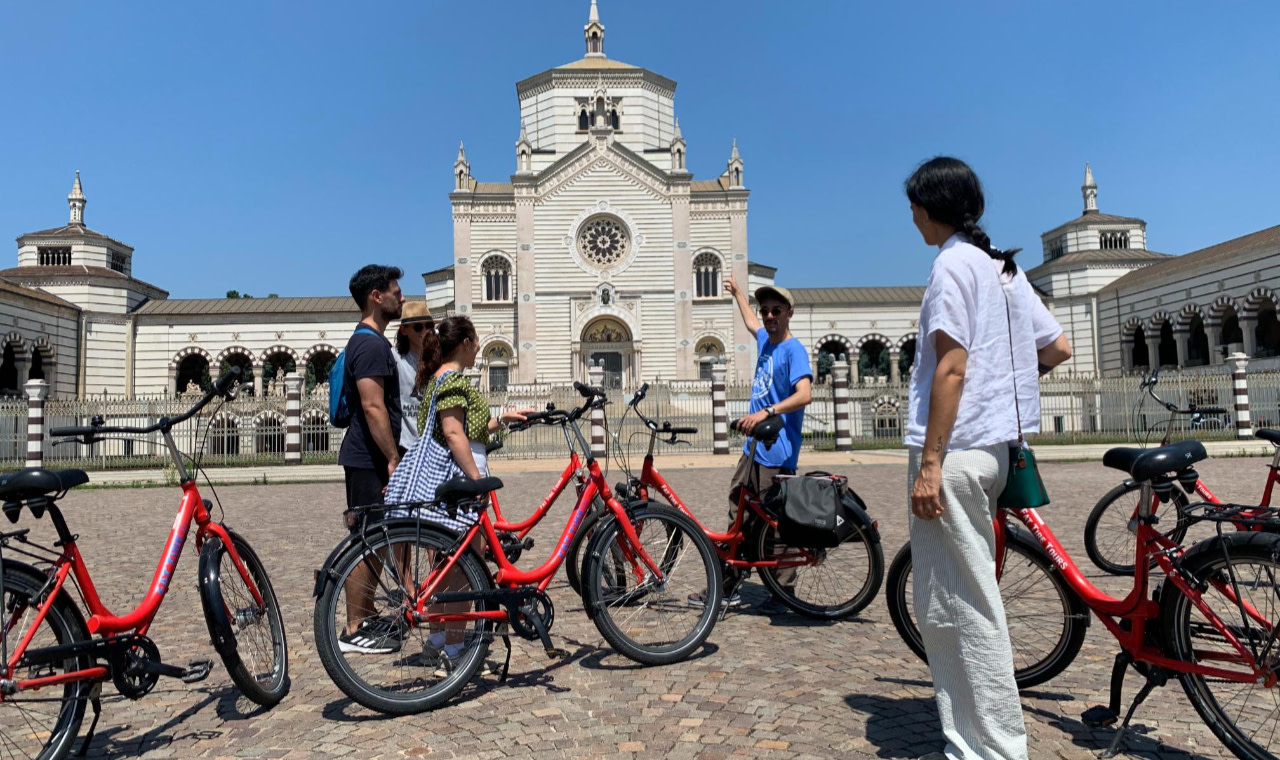
The Monumental Cemetery was designed by Carlo Maciachini and opened in 1866. The site allows visitors to time-travel into the history of Milan, as they can spot the tombs of figures whose names now adorn major metro stations, roads, and squares.
27
Built in 1990 on the initiative of a group of companies that transformed an anonymous water tank in Porta Garibaldi into a colorful homage to Milanese creativity, the Rainbow Tower was restored on the occasion of Expo2015 and returned to its original splendor.
28
Stop 28
Pass by
The UniCredit Tower complex, eco-sustainable buildings in glass and steel, was designed by the architect Cesar Pelli of the Pelli Clarke Pelli architectural studio and is made up of 3 towers, respectively 230 meters high (31 floors, 152 meters without the Spire), 100 meters (21 floors), and 50 meters (11 floors).
29
Stop 29
Pass by
The Bosco Verticale (Vertical Forest) is a complex of two residential tower buildings designed by Boeri Studio and located in the business center of Milan, on the edge of the Isola district.
30
Stop 30
Pass by
The Diamond Tower (also called Diamantone) is a skyscraper that stands in the business center of Milan, between Viale della Liberazione and Via Galilei and is currently the headquarters of the Italian companies of the BNP Paribas Group.
31
Built starting from the initial project (1911) by architect Ulisse Stacchini, the construction site of the Central Station restarted only after the end of the Great War and the consequent seizure of power in Italy by Mussolini and the fascist party. The Central Station of Milan was thus inaugurated on the first of July 1931. During the years of the Second World War, specifically between December 1943 and January 1945, as many as twenty trains departed from the now sadly well-known Track 21, destined to arrive in the concentration camps scattered across Europe.
32
The Rasini Tower (Emilio Lancia, Gio Ponti) is a historic building in Milan, used as luxury apartments, built in twentieth century style. Located on the corner between Corso Venezia and the Porta Venezia, the complex is made up of two parts, the Tower and the Palace, which constitute a single building project.
33
The Palazzo Buonarroti-Carpaccio-Giotto is well recognizable for the strong architectural characterization deriving from the large passage arch created by Piero Portaluppi.
34
Palazzo Serbelloni, a splendid example of a neoclassical palace, takes its name from the Serbelloni family. Majestic and imposing palace was built in the second half of the 18th century by Simone Cantoni.
35
Stop 35
Pass by
It is 157 meters long and 92 meters wide. It can accommodate up to 40,000 people. The Milan Cathedral is one of the largest Catholic churches in the world.
The site where the Cathedral currently stands was previously occupied by the Basilica of Sant'Ambrogio.
In 838, the Basilica of Santa Tecla was founded next to the first church, but in 1075 a fire devastated both buildings and a few centuries later, the Cathedral was built on the same site.
The construction of the Milan Cathedral began in 1386 and coincided with the rise to power of Gian Galeazzo Visconti. The purpose of this imposing construction was to modernize the area and celebrate the expansion of the Visconti territory.
The Cathedral took five centuries to complete... and "it is not yet finished".
36
Palazzo Litta, also known as Palazzo Arese Borromeo Visconti Litta, is a historic building located in Corso Magenta in Milan. Considered one of the most important examples of Milanese Baroque architecture, it is currently the seat of the Regional Secretariat of the Ministry of Cultural Heritage and Activities and Tourism for Lombardy, the Regional Museum Centre of Lombardy and the Superintendence of Archaeology, Fine Arts and Landscape for the Metropolitan City of Milan.
What's not included
Air-conditioned vehicle
Restroom on board
WiFi on board
Seat belts
Air-bags
Available languages
Guide guide
EN
IT
Important information
Public transportation options are available nearby
Infants are required to sit on an adult’s lap
Not recommended for travelers with spinal injuries
Not recommended for travelers with poor cardiovascular health
Suitable for all physical fitness levels
Classic Fiat 500 is a tiny car
No air bags, no seat belts, no air conditioning
Meeting point
Point of reference "The Belgiojoso Royal Villa" (Metro 1, Red Line, stop "Palestro") - on the road.
Important notes
Please contact the supplier to arrange the tour start time.
The itinerary (and duration) may vary depending on traffic, demonstrations, accidents or indications from the Municipality.
About Milan
Milan, the vibrant capital of Lombardy, is a city where ancient history meets modern luxury. Known for its fashion, art, and design, Milan is a dynamic metropolis that offers a rich cultural experience and a thriving culinary scene.
Top Attractions
Duomo di Milano
The Milan Cathedral is a stunning example of Gothic architecture and the third-largest church in the world. It took nearly six centuries to complete and is a symbol of the city.
Architecture/Religious
1-2 hours
€10-€15
Galleria Vittorio Emanuele II
This historic shopping gallery is one of the world's oldest and most beautiful. It features luxury boutiques, cafes, and the famous mosaic floor of the bull.
Architecture/Shopping
1 hour
Free to enter, shopping varies
Santa Maria delle Grazie
This church and convent house Leonardo da Vinci's famous mural, The Last Supper. The painting is a masterpiece of Renaissance art and a must-see for art lovers.
Historical/Religious
1-2 hours
€10-€15 (advance booking required)
Castello Sforzesco
This medieval castle was built by the Duke of Milan and later renovated by Ludovico Sforza. It houses several museums and art collections, including works by Michelangelo and Leonardo da Vinci.
Historical/Architecture
2-3 hours
€5-€10
Teatro alla Scala
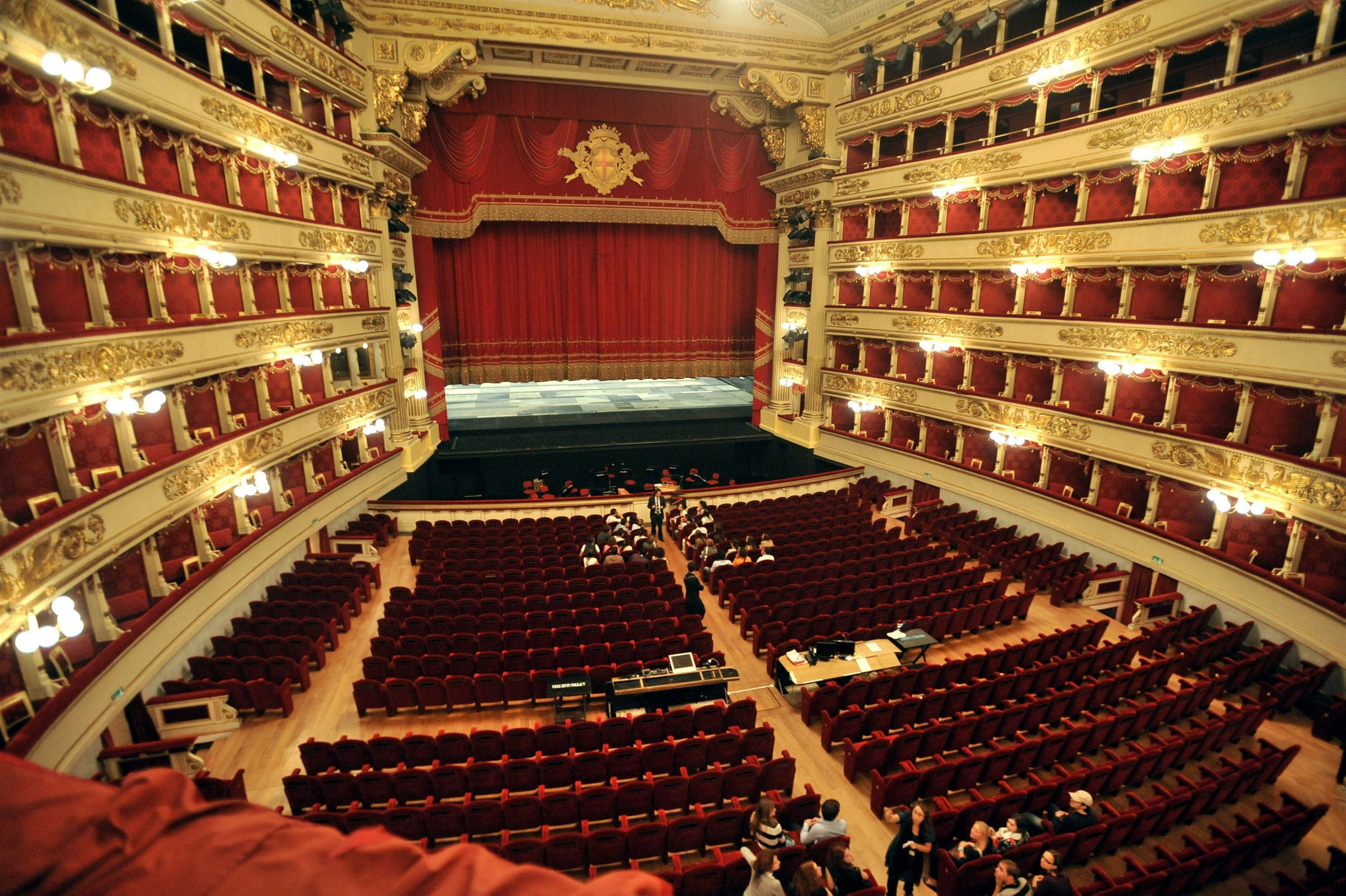
One of the world's most famous opera houses, Teatro alla Scala is a symbol of Milan's rich musical heritage. Guided tours are available to explore the historic theater and museum.
Cultural/Entertainment
1 hour
€10-€15
Must-Try Local Dishes
Risotto alla Milanese
A creamy saffron risotto, a staple of Milanese cuisine.
Main Course
Contains dairy, can be made vegetarian.
Ossobuco
Braised veal shanks, traditionally served with gremolata.
Main Course
Contains meat, can be made gluten-free.
Panzerotti
Fried dough pockets filled with tomato sauce, mozzarella, and other ingredients.
Snack
Contains dairy, can be made vegetarian or vegan.
Cotoletta alla Milanese
A breaded and fried veal cutlet, similar to schnitzel.
Main Course
Contains meat, can be made gluten-free.
Popular Activities
Hiking in the nearby Alps
Cycling along the Navigli canals
Aperitivo in Navigli
Shopping in Galleria Vittorio Emanuele II
Visiting museums and historic sites
Attending opera or ballet performances
Boat tours on Lake Como
Swimming in Lake Como
Best Time to Visit
April to June, September to October
The best time to visit Milan is during the spring and fall when the weather is pleasant, and the city is less crowded. These months offer ideal conditions for exploring the city's attractions.
15-28°C
59-82°F
Practical Information
Language
- Official: Italian
- Widely spoken: English, French, Spanish
- English: Moderately spoken
Currency
Euro (EUR)
Time Zone
GMT+1 (Central European Time, CET), GMT+2 (Central European Summer Time, CEST)
Electricity
230VV, 50HzHz
Safety Information
Overall Safety Rating: Generally safe
Milan is generally safe for tourists, but pickpocketing and petty theft can occur, especially in crowded areas and on public transportation. Be cautious with your belongings and stay alert.
Important Precautions:
- • Keep valuables secure and out of sight
- • Use official taxis or ride-sharing services
- • Be cautious of distractions and common scams
Getting there
By air
- Milano Malpensa Airport • 50 km from city center
- Milano Linate Airport • 7 km from city center
By train
Milano Centrale, Milano Rogoredo
By bus
Lampugnano Bus Station, San Donato Milanese
Getting around
Public transport
The Milano Metro system consists of four lines (M1, M2, M3, M5) and is efficient and easy to use. It is the quickest way to get around the city.
Taxis
Available • Apps: Uber, FreeNow
Rentals
Car, Bike, Scooter
Neighborhoods
Brera
Navigli
Quartiere della Moda
Isola
Day trips
Lake Como
50 km • Full day
Lake Como is a stunning alpine lake known for its beautiful villas, gardens, and scenic views. It is a popular destination for relaxation and outdoor activities.
Bergamo
50 km • Half day
Bergamo is a charming medieval city with a well-preserved old town and a rich history. It offers a mix of historic sites, museums, and local cuisine.
Verona
150 km • Full day
Verona is a romantic city known for its association with Shakespeare's Romeo and Juliet. It offers a mix of historic sites, romantic landmarks, and cultural attractions.
Festivals
Milan Fashion Week • February and September
Milan Design Week • April
Milan Film Festival • September
Pro tips
- Visit the Duomo early in the morning to avoid crowds and long queues
- Explore the Navigli district in the evening for a vibrant aperitivo experience
- Use the ATM Milano app for real-time public transportation schedules and maps
- Consider purchasing a Milan Card for discounts on attractions, transportation, and dining
- Try local specialties like risotto alla Milanese and panzerotti
From $25
per person
Price varies by option
Secure booking
Free cancellation available
Instant confirmation