Discover Bukhara One Day Group Experience
Active
5h - 7h
For a full refund, cancel at least 24 hours before the scheduled departure time.
Instant confirmation
Mobile or paper ticket accepted
About this experience
- Discover Bukhara in One Day -
Step into the living museum of the Silk Road with our Bukhara Full Day Group Tour. From the serene Lyabi-Hauz Ensemble to the soaring Kalyan Minaret, from the royal Ark Citadel to the timeless Ismail Samani Mausoleum, this journey brings centuries of history, culture, and architecture to life.
Travel comfortably with our professional guide and organized transfers, explore vibrant bazaars, admire masterpieces of Islamic art, and experience the unique atmosphere of Uzbekistan’s most historic city.
With daily departures and a fixed group price, it’s the perfect way to see Bukhara without stress — just book, join, and enjoy.
Available options
Discover Bukhara One Day Group Experience
What's included
Professional English-speaking guide (other languages available on request with enough participants)
Bottled water
Full-day program covering major landmarks of Bukhara
Meeting point assistance (guide with TravelX sign at Lyabi-Hauz Ensemble)
Detailed itinerary
1
Your adventure in Bukhara begins at the Lyabi-Hauz Ensemble, a place where history, spirituality, and daily life have blended for centuries.
Here, under the shade of ancient mulberry trees, locals once gathered around the pond (hauz) to trade stories, sip tea, and share news of the Silk Road. The square is framed by architectural gems:
The Nadir Devanbegi Madrasa, decorated with colorful mosaics and mythological creatures.
The Nadir Devanbegi Khanaka, once a spiritual refuge for wandering dervishes.
Even today, Lyabi-Hauz remains the beating heart of Bukhara — a lively square filled with chaihanas, street vendors, and the timeless charm of Uzbek hospitality. It’s the perfect first step into the city’s soul.
2
No visit to Bukhara is complete without exploring its famous Trading Domes, once bustling centers of Silk Road commerce. Each dome had its own specialty:
Toqi Sarrofon – the moneychangers’ dome, where merchants exchanged currencies from across Asia.
Toqi Telpakfurushon – the hat sellers’ dome, filled with traditional headgear like turbans and embroidered caps.
Toqi Zargaron – the jewelers’ dome, sparkling with gold, silver, and precious stones.
Tim Abdullakhan – a covered bazaar where merchants traded fine silk, fabrics, and spices.
Today, these historic domes remain full of life, with artisans and vendors offering souvenirs, carpets, and handicrafts — a perfect place to feel the spirit of the Silk Road and take home a memory of Bukhara.
3
The Magoki-Attori Mosque is one of the oldest surviving mosques in Central Asia, with origins dating back to the 9th century. Built on the site of a former Zoroastrian temple and later a marketplace for herbs and spices, it reflects the many layers of Bukhara’s history.
Its name, “Magoki-Attori”, means “the pit of the herbalists,” as the mosque once stood at the center of a bustling spice bazaar. The structure, partly sunken below ground level, has been reconstructed several times but still preserves its unique carved brickwork and decorative patterns.
Today, it also serves as a small museum of carpets, displaying traditional Uzbek weaving and offering a glimpse into Bukhara’s rich textile heritage.
4
The Ulugbek Madrasa, built in 1417 by the great astronomer-king Ulugh Beg, is the oldest madrasa in Central Asia. It marked the beginning of Bukhara’s famous Kosh Madrasa ensemble, later joined by the Abdulaziz Khan Madrasa across the street.
With its striking portal, intricate mosaics, and inscriptions dedicated to the pursuit of knowledge, this madrasa reflects Ulugh Beg’s vision of education and science as the foundations of a great civilization. Many of the finest scholars of the Timurid era studied here under his patronage.
Today, visitors can admire its elegant façade and feel the intellectual spirit of a ruler who valued wisdom as much as power.
5
Built in 1652 under the rule of Abdulaziz Khan, this madrasa stands directly across from the Ulugbek Madrasa, forming the Kosh Madrasa (“paired madrasa”) ensemble. If Ulugbek’s madrasa represents scholarly elegance, Abdulaziz Khan’s madrasa showcases the opulence of the later Bukhara Khanate.
Its façade and interior dazzle with exquisite tilework, carved marble, gilded stalactite decorations, and vibrant floral and geometric patterns. The richly ornamented prayer hall and lecture rooms reflect the artistic ambitions of the 17th century.
Together with the Ulugbek Madrasa opposite, it offers a striking contrast: the simplicity of Timurid architecture against the decorative extravagance of the later era.
6
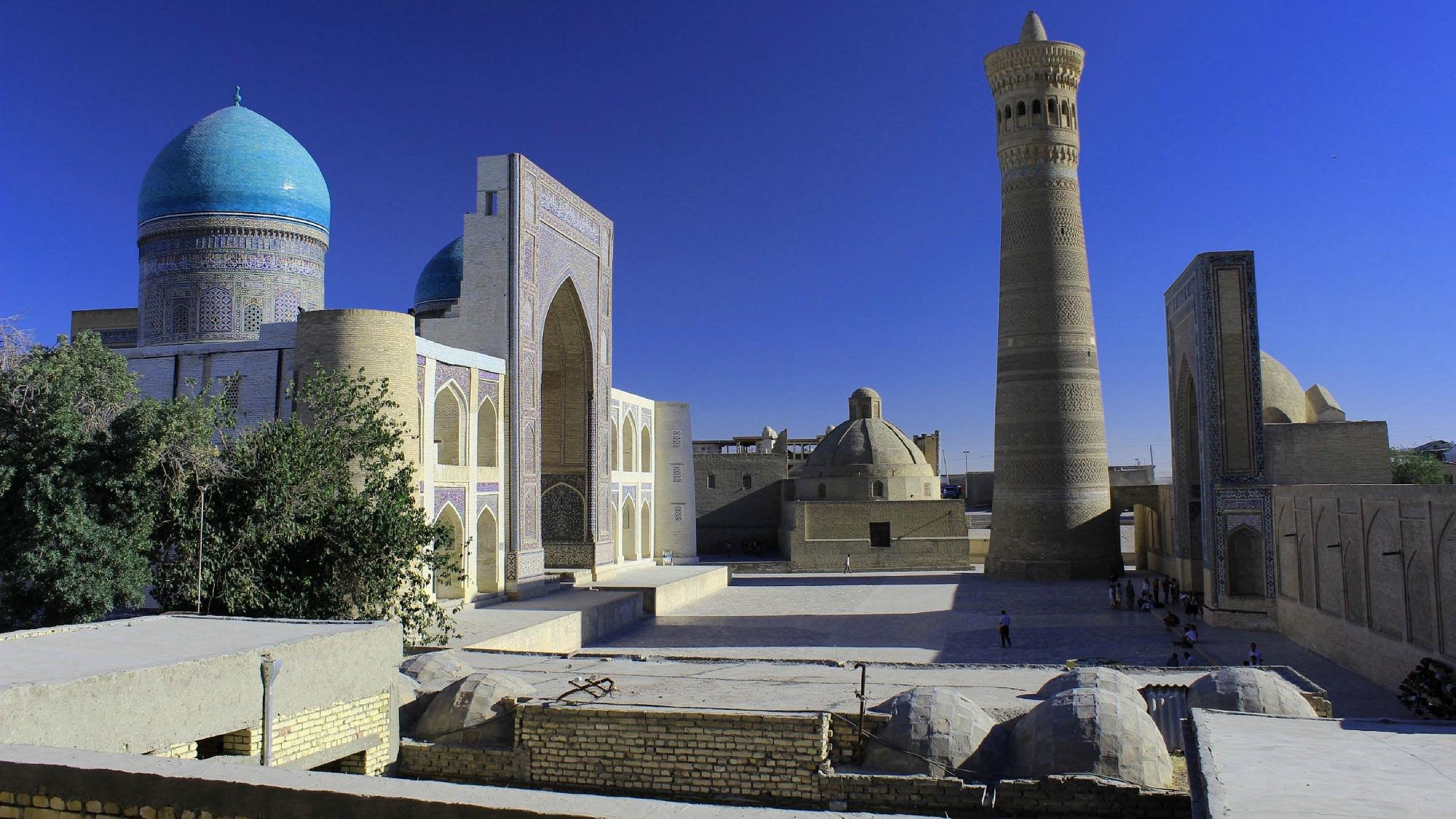
e Poi Kalon Complex, meaning “Foot of the Great,” is the spiritual heart of Bukhara. Dominated by the towering Kalyan Minaret, it has inspired awe for nearly nine centuries. Built in 1127, the minaret rises 47 meters and was once so impressive that even Genghis Khan ordered it to be spared when he destroyed the rest of the city.
Beside it stands the Kalyan Mosque, capable of hosting thousands of worshippers within its vast courtyard, and the Mir-i-Arab Madrasa, a living center of Islamic learning that still functions today. Together, these monuments form one of the most powerful images of the Silk Road.
Here, visitors can feel the blend of history, spirituality, and architecture that makes Bukhara a timeless city.
7
The Mir-i-Arab Madrasa, built in the 16th century under Ubaydullah Khan, is one of the most revered centers of Islamic learning in Central Asia. Its elegant turquoise domes, harmonious proportions, and richly decorated portal make it a masterpiece of Bukhara’s sacred architecture.
What makes this madrasa truly special is that it is still an active religious school — students study theology, philosophy, and the Qur’an within its walls. For this reason, entry inside is usually restricted, but its impressive exterior and spiritual atmosphere leave a lasting impression on visitors.
Standing opposite the vast Kalyan Mosque, the Mir-i-Arab Madrasa completes the iconic silhouette of the Poi Kalon Complex, embodying centuries of faith and knowledge.
8
The Ark Citadel is the ancient fortress and royal residence that served as the seat of Bukhara’s rulers for nearly 1,500 years. Rising above the old city, its massive mud-brick walls once protected palaces, mosques, and administrative offices of the emirate.
Inside the Ark, visitors find courtyards, gateways, and small museums that tell the story of Bukhara’s emirs, their lavish courts, and the dramatic battles that shaped the city. The citadel was both a symbol of power and a self-contained royal town.
Walking through its grand entrance, guests step back into the world of emirs and conquerors who ruled Bukhara from behind these walls. From here, one can imagine caravans arriving at the gates of this Silk Road stronghold.
9
The Bolo-Khauz Mosque, known as the “Mosque of the Emir’s Official Prayers,” was built in the early 18th century and later expanded under the last emirs of Bukhara. Its most striking feature is the elegant wooden iwan (porch), supported by 20 tall carved pillars, which create a graceful reflection in the pond (hauz) in front of the mosque.
For centuries, this was the place where the emir and his court gathered for Friday prayers. Inside, the mosque impresses with its richly painted ceiling, colorful floral motifs, and serene atmosphere.
Today, it remains one of Bukhara’s most photogenic sites, especially at sunrise or sunset, when the reflections of the wooden columns in the water make for unforgettable views.
10
The Ismail Samani Mausoleum, built in the 9th–10th centuries, is the oldest surviving monument in Bukhara and one of the finest examples of early Islamic architecture in Central Asia. Dedicated to Ismail Samani, the founder of the Samanid dynasty, this small yet perfectly proportioned structure has survived more than 1,000 years of history.
Its beauty lies in the simplicity and craftsmanship of its intricately patterned baked brickwork, which changes appearance with the light of the sun. The mausoleum is often called a “jewel of architecture,” as it bridges pre-Islamic traditions with Islamic art.
Surrounded by a peaceful park, it offers a serene and reflective ending to a journey through the treasures of Bukhara.
What's not included
Lunch (guests pay directly at the restaurant; guide assists with ordering & recommendations)
Tips for guide (optional, at guest’s discretion)
Personal expenses & souvenirs
Available languages
Written guide
DE
RU
EN
IT
FR
ES
Guide guide
RU
EN
Reviews breakdown
Viator
4.5
2 reviews
5★
1
4★
1
3★
0
2★
0
1★
0
Important information
Wheelchair accessible
Service animals allowed
Public transportation options are available nearby
Infants are required to sit on an adult’s lap
Suitable for all physical fitness levels
Meeting point
On the day of the tour, meet your guide in front of Lyabi-Hauz Ensemble.
Your guide will be waiting with a TravelX sign for easy recognition.
About Bukhara
Bukhara is one of the oldest and most well-preserved cities in Central Asia, renowned for its rich history, stunning Islamic architecture, and vibrant cultural heritage. This ancient Silk Road city offers a unique glimpse into Uzbekistan's past, with over 140 architectural monuments dating back over a millennium.
Top Attractions
Po-i-Kalyan Complex
The Po-i-Kalyan Complex is the heart of Bukhara's historic center, featuring the Kalyan Minaret, Kalyan Mosque, and Mir-i Arab Madrasah. This UNESCO-listed site is a masterpiece of Islamic architecture.
Historical/Architectural
1-2 hours
Free (small fee for some areas)
Ark of Bukhara
The Ark of Bukhara is a massive fortress that served as the residence of Bukhara's rulers for centuries. It houses museums and historic buildings within its walls.
Historical
1 hour
5,000 UZS
Lyabi-Hauz Ensemble
The Lyabi-Hauz Ensemble is a picturesque complex centered around a large pond (hauz) and surrounded by madrasahs, mosques, and tea houses. It's a popular gathering spot for locals and tourists.
Historical/Cultural
1 hour
Free
Chashma-Ayub Mausoleum
This mausoleum is said to be built around a spring that appeared miraculously when the prophet Job (Ayub) touched the ground with his staff. It's a peaceful spot with beautiful tile work.
Religious
30 minutes
Free
Trade Domes
Bukhara's trade domes, such as the Toki Zargaron (Jewelers' Dome), Toki Telpak Furushon (Hatsellers' Dome), and Toki Sarrofon (Money Changers' Dome), are a testament to the city's rich trading history. These domes once housed bustling markets and still retain their historic charm.
Historical/Cultural
1 hour
Free
Must-Try Local Dishes
Plov
A rice dish cooked with meat, carrots, and spices, often served at celebrations and gatherings
Main Dish
Contains meat, can be vegetarian if made without meat
Lagman
A hearty noodle soup with meat, vegetables, and a rich broth
Main Dish
Contains meat, can be vegetarian if made without meat
Samsa
Baked pastries filled with meat, pumpkin, or potatoes
Snack
Varies by filling, often contains meat
Shurpa
A flavorful soup made with meat, vegetables, and spices
Soup
Contains meat, can be vegetarian if made without meat
Popular Activities
Camel trekking
Sandboarding
Hiking
Tea house visits
Spas and hammams
Reading in parks
Visiting historic sites
Attending local festivals
Best Time to Visit
April to June, September to October
These months offer pleasant weather for exploring the city's historic sites. The temperatures are comfortable, and the crowds are manageable.
15°C to 30°C
59°F to 86°F
Practical Information
Language
- Official: Uzbek
- Widely spoken: Russian, English (limited)
- English: Limited
Currency
Uzbekistani Som (UZS)
Time Zone
GMT+5
Electricity
220VV, 50HzHz
Safety Information
Overall Safety Rating: Generally safe
Bukhara is generally safe for travelers, with low levels of violent crime. However, petty theft and scams can occur, especially in tourist areas.
Important Precautions:
- • Use reputable tour operators
- • Negotiate taxi fares in advance
- • Keep valuables secure
Getting there
By air
- Bukhara International Airport • 5 km from city center
By train
Bukhara Railway Station
By bus
Bukhara Central Bus Station
Getting around
Public transport
Buses are the primary mode of public transport in Bukhara. They are affordable and connect major attractions and neighborhoods.
Taxis
Available • Apps: Yandex.Taxi
Rentals
Car, Bike, Scooter
Neighborhoods
Historic Center
Modern Bukhara
Day trips
Vobkent
30 km from Bukhara • Half day to full day
Vobkent is a small town known for its historic mosque and mausoleum, offering a glimpse into the region's Islamic heritage.
Gijduvan
40 km from Bukhara • Full day
Gijduvan is famous for its ceramics and traditional pottery workshops, offering a hands-on experience in this ancient craft.
Kyzylkum Desert
100 km from Bukhara • Overnight
The Kyzylkum Desert offers a unique desert experience with opportunities for camel trekking, stargazing, and exploring the vast sand dunes.
Festivals
International Festival of Classical Music • September
Siyavushbek Festival • August
Pro tips
- Visit the Po-i-Kalyan Complex early in the morning to avoid crowds and the heat
- Try the local plov at a traditional chaikhana for an authentic experience
- Bargain politely when shopping at bazaars, as prices are often inflated for tourists
- Carry small change for bus rides, taxis, and small purchases
- Learn a few basic phrases in Uzbek or Russian to enhance your interactions with locals
From $25
per person
Price varies by option
Secure booking
Free cancellation available
Instant confirmation