Bukhara City Tour – Inside Visits Included
Active
4h - 5h
For a full refund, cancel at least 24 hours before the scheduled departure time.
Instant confirmation
Mobile or paper ticket accepted
About this experience
See the sights of Bukhara on this tour. Visit mausoleums, parks, bazaars, museums, and archaeological monuments. Relax between destinations in group tour and let us handle the itinerary. Our guides will be only too happy to share local knowledge and the rich history of the country with you.
Available options
Private Tour
Small Group Tour
What's included
All Taxes and Service Fees
Photo Stops at the Best Spots
On-Foot Pick-Up – ("Private Tour" only)
Inside visits included with guided explanations (entrance fees paid separately)
Professional Tour Guide
Detailed itinerary
1
Architectual ensemble Lyabi-Khauz is formed with three large monumental buildings: Kukeldash Madrasah in the north, khanaka and Nodir Divan-begi in the west and in the east. From the south the square was closed with Trade Street. The center of old Bukhara large ensemble became a reservoir.
The name «Lyabi-Khauz» means «at reservoir». According to the old legend, for a long time knan gardener Nadir Divan-begi could not buy a lot for planned building, where a house of alone woman was. Then all-powerful vizier ordered to built a channel under women's house, and the water began to washaway walls, unhappy women had to sell this lot. The khan hauz secretly was called «khauz of violence», what in arabian inscription gives numerical meaning of building date - 1620.
2
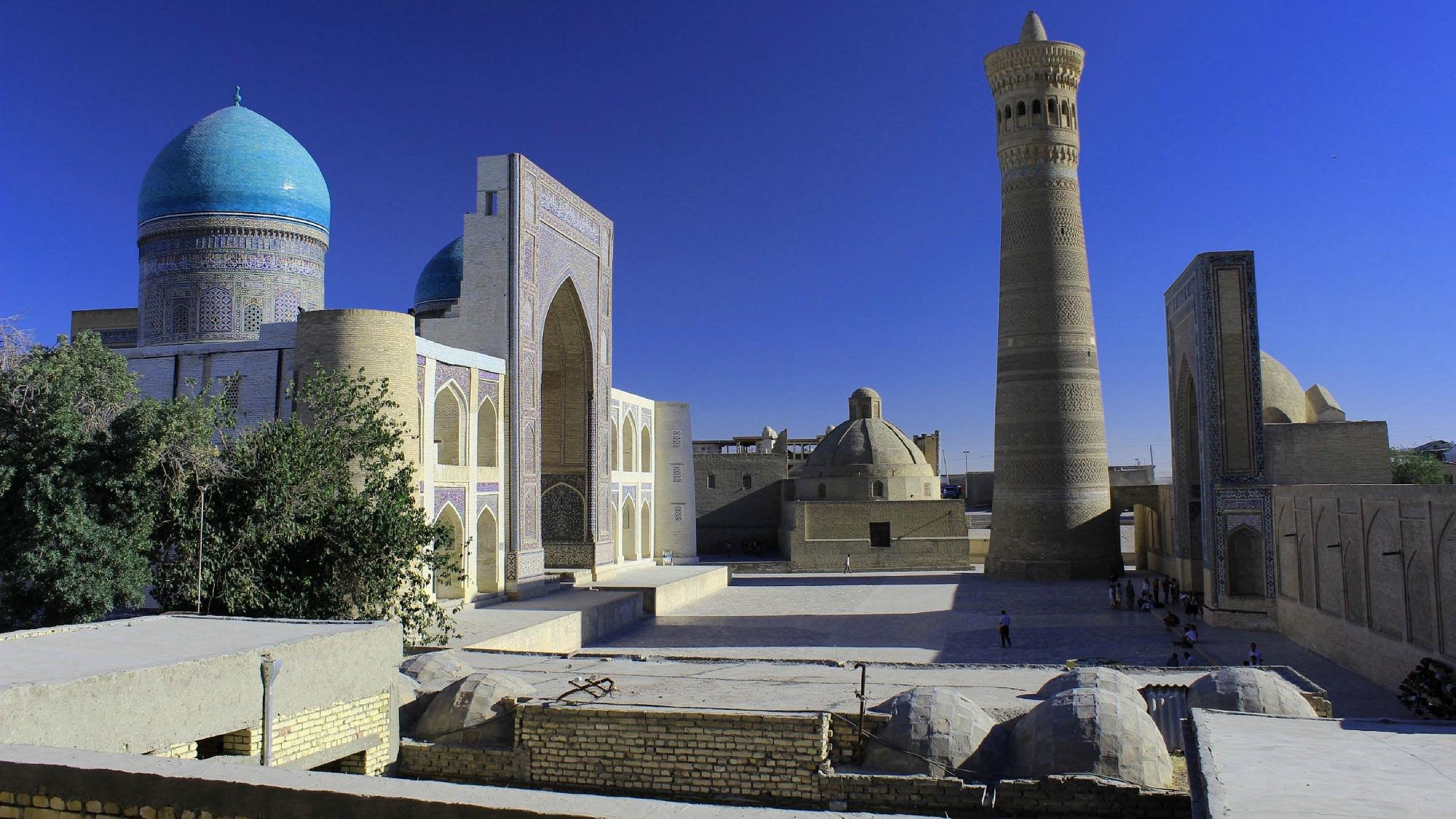
It is the main ensemble in Bukhara center, situated on the way to trade crossing of "four bazars" and Poi-Kalyan means “the pedestal of the Great” (it means “the pedestal of Kalyan minaret”). Ensemble consists of 4 monuments: Kalyan mosque and Miri-Arab Madrasah – faced to each other with main fronts; between them is Kalyan minaret; to the south of Miri-Arab there is small Amir-Allimkhan Madrasah.
3
From the beginnings of Islam, there have been three types of mosques: Djuma mosques, which are intended for the large crowds that come to Friday services, Namazga country mosques (musalla idgoh), which are used by the male population of both the city and the surrounding countryside to celebrate the two Muslim holidays Qurban and Ramazan, and Quzar mosques, which are designed to be used as daily mosques in residential neighbourhoods.
4
There are two big blue domes of the Miri-Arab madrasah towering above the surrounding buildings in the center of Bukhara. Along with the Kalyan mosque and minaret, this religious educational establishment forms the whole ensemble Poi-Kalyan that is the spiritual center of the city.
5
Bukhara is well-known to the world not only with its mosques, Ark Fortress and the majestic Kalyan minaret but also with its trading domes stretching in procession from Lyabi-Khauz to the Miri-Arab madrasah. Long ago, in the XVI century under the Shaybanides dynasty, Bukhara became the capital giving rise to unprecedented growth of the city, and since it was located on the Great Silk Road, the markets and trading stores even more congested cross-roads of public roads. Several centuries passed since that and four trading domes have only survived up to date.
6
The Ark of Bukhara is a massive fortress located in the city of Bukhara, Uzbekistan, that was initially built and occupied around the 5th century AD. In addition to being a military structure, the Ark encompassed what was essentially a town that, during much of the fortress's history, was inhabited by the various royal courts that held sway over the region surrounding Bukhara. The Ark was used as a fortress until it fell to Russia in 1920. Currently, the Ark is a tourist attraction and houses museums covering its history. The museums and other restored areas include an archaeological museum, the throne room, the reception and coronation court, a local history museum, and the court mosque.
7
Bolo-Khauz Complex is the only preserved monument on the Registan Square. It is located on the opposite site of Ark - the Emir's fortress. The complex consists of the reservoir, Friday mosque and minaret.
8
The Ismail Samani Mausoleum, located in Bukhara, is one of the oldest and most revered architectural monuments in Central Asia, dating back to the 9th–10th centuries. Built as the tomb of Ismail Samani, the founder of the Samanid dynasty, it is renowned for its stunning brickwork, symmetrical design, and historical significance. This mausoleum is a masterpiece of early Islamic architecture and offers visitors a unique glimpse into the rich cultural and architectural heritage of Bukhara.
9
Chashma-i Ayub, or Ayub’s Spring, is a historic and sacred site in Bukhara, believed to date back over a thousand years. According to legend, the spring was discovered by the prophet Job (Ayub), who struck the ground with his staff to bring forth water during his time of hardship. Today, visitors come to admire the elegant domed structure covering the spring, enjoy the refreshing water, and experience a peaceful and spiritual atmosphere. The site beautifully blends history, legend, and architecture, making it a memorable stop in Bukhara.
What's not included
Entrance tickets to all the places total
Available languages
Guide guide
EN
Reviews breakdown
Tripadvisor
5.0
2 reviews
5★
2
4★
0
3★
0
2★
0
1★
0
Important information
Wheelchair accessible
Infants and small children can ride in a pram or stroller
Service animals allowed
Public transportation options are available nearby
Transportation options are wheelchair accessible
All areas and surfaces are wheelchair accessible
Suitable for all physical fitness levels
Meeting point
Your guide will be holding a paper with the guest`s name on it next to the stature of "Mulla Nasruddin" A man riding a donkey in the lyabi house complex in the center of old town of Bukhara!
About Bukhara
Bukhara is one of the oldest and most well-preserved cities in Central Asia, renowned for its rich history, stunning Islamic architecture, and vibrant cultural heritage. This ancient Silk Road city offers a unique glimpse into Uzbekistan's past, with over 140 architectural monuments dating back over a millennium.
Top Attractions
Po-i-Kalyan Complex
The Po-i-Kalyan Complex is the heart of Bukhara's historic center, featuring the Kalyan Minaret, Kalyan Mosque, and Mir-i Arab Madrasah. This UNESCO-listed site is a masterpiece of Islamic architecture.
Historical/Architectural
1-2 hours
Free (small fee for some areas)
Ark of Bukhara
The Ark of Bukhara is a massive fortress that served as the residence of Bukhara's rulers for centuries. It houses museums and historic buildings within its walls.
Historical
1 hour
5,000 UZS
Lyabi-Hauz Ensemble
The Lyabi-Hauz Ensemble is a picturesque complex centered around a large pond (hauz) and surrounded by madrasahs, mosques, and tea houses. It's a popular gathering spot for locals and tourists.
Historical/Cultural
1 hour
Free
Chashma-Ayub Mausoleum
This mausoleum is said to be built around a spring that appeared miraculously when the prophet Job (Ayub) touched the ground with his staff. It's a peaceful spot with beautiful tile work.
Religious
30 minutes
Free
Trade Domes
Bukhara's trade domes, such as the Toki Zargaron (Jewelers' Dome), Toki Telpak Furushon (Hatsellers' Dome), and Toki Sarrofon (Money Changers' Dome), are a testament to the city's rich trading history. These domes once housed bustling markets and still retain their historic charm.
Historical/Cultural
1 hour
Free
Must-Try Local Dishes
Plov
A rice dish cooked with meat, carrots, and spices, often served at celebrations and gatherings
Main Dish
Contains meat, can be vegetarian if made without meat
Lagman
A hearty noodle soup with meat, vegetables, and a rich broth
Main Dish
Contains meat, can be vegetarian if made without meat
Samsa
Baked pastries filled with meat, pumpkin, or potatoes
Snack
Varies by filling, often contains meat
Shurpa
A flavorful soup made with meat, vegetables, and spices
Soup
Contains meat, can be vegetarian if made without meat
Popular Activities
Camel trekking
Sandboarding
Hiking
Tea house visits
Spas and hammams
Reading in parks
Visiting historic sites
Attending local festivals
Best Time to Visit
April to June, September to October
These months offer pleasant weather for exploring the city's historic sites. The temperatures are comfortable, and the crowds are manageable.
15°C to 30°C
59°F to 86°F
Practical Information
Language
- Official: Uzbek
- Widely spoken: Russian, English (limited)
- English: Limited
Currency
Uzbekistani Som (UZS)
Time Zone
GMT+5
Electricity
220VV, 50HzHz
Safety Information
Overall Safety Rating: Generally safe
Bukhara is generally safe for travelers, with low levels of violent crime. However, petty theft and scams can occur, especially in tourist areas.
Important Precautions:
- • Use reputable tour operators
- • Negotiate taxi fares in advance
- • Keep valuables secure
Getting there
By air
- Bukhara International Airport • 5 km from city center
By train
Bukhara Railway Station
By bus
Bukhara Central Bus Station
Getting around
Public transport
Buses are the primary mode of public transport in Bukhara. They are affordable and connect major attractions and neighborhoods.
Taxis
Available • Apps: Yandex.Taxi
Rentals
Car, Bike, Scooter
Neighborhoods
Historic Center
Modern Bukhara
Day trips
Vobkent
30 km from Bukhara • Half day to full day
Vobkent is a small town known for its historic mosque and mausoleum, offering a glimpse into the region's Islamic heritage.
Gijduvan
40 km from Bukhara • Full day
Gijduvan is famous for its ceramics and traditional pottery workshops, offering a hands-on experience in this ancient craft.
Kyzylkum Desert
100 km from Bukhara • Overnight
The Kyzylkum Desert offers a unique desert experience with opportunities for camel trekking, stargazing, and exploring the vast sand dunes.
Festivals
International Festival of Classical Music • September
Siyavushbek Festival • August
Pro tips
- Visit the Po-i-Kalyan Complex early in the morning to avoid crowds and the heat
- Try the local plov at a traditional chaikhana for an authentic experience
- Bargain politely when shopping at bazaars, as prices are often inflated for tourists
- Carry small change for bus rides, taxis, and small purchases
- Learn a few basic phrases in Uzbek or Russian to enhance your interactions with locals
From $25
per person
Price varies by option
Secure booking
Free cancellation available
Instant confirmation