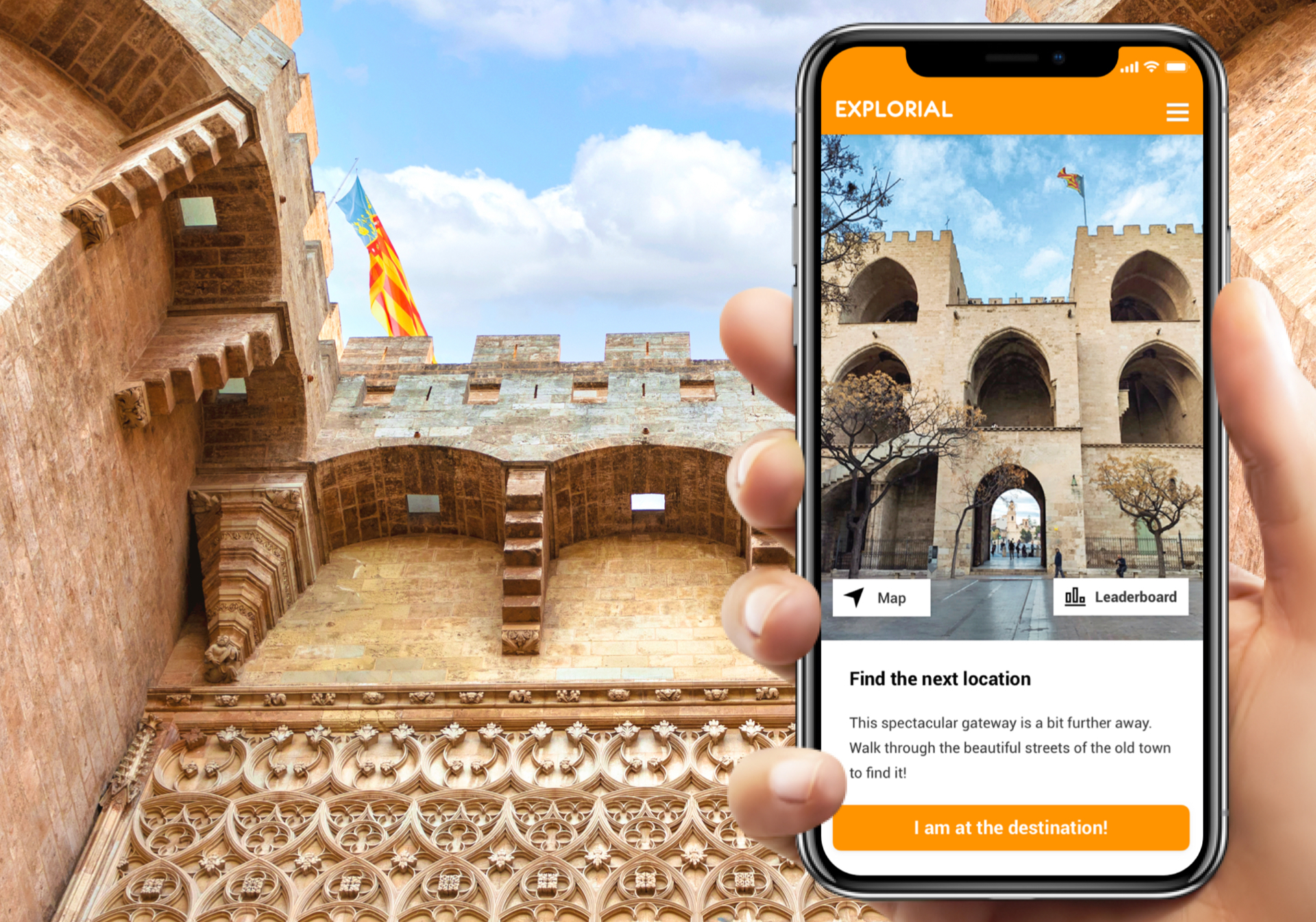
Valencia Audio Guided Walking Tour 3h and 26 Audio Commentaries
Active
3h
For a full refund, cancel at least 24 hours before the scheduled departure time.
Instant confirmation
Mobile or paper ticket accepted
About this experience
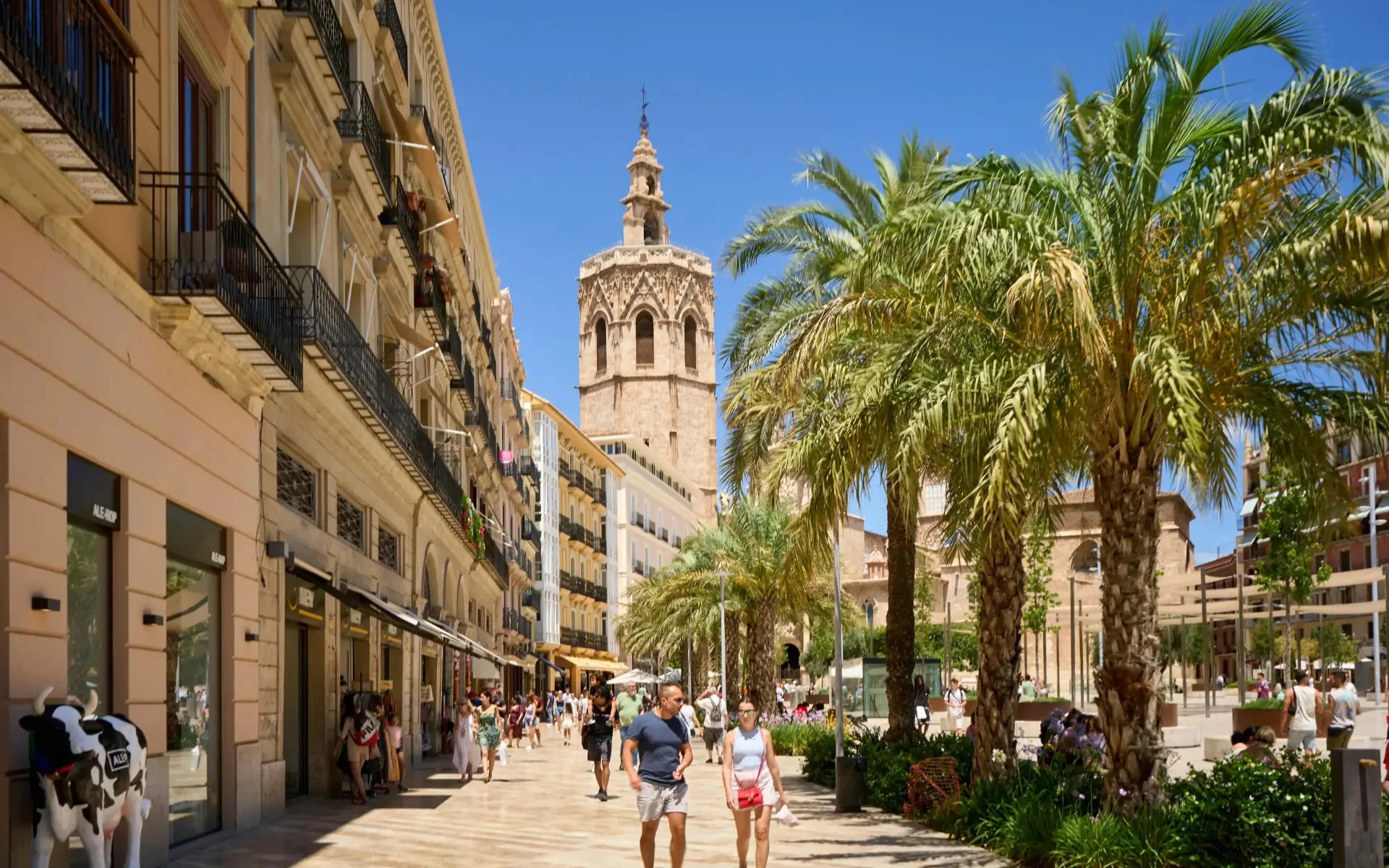
Explore Valencia in one day and discover 26 iconic sites across the city. Start with Queen’s Square, the historic heart of Valencia, before heading to Plaza del Ayuntamiento and the impressive North Station. Admire the architectural beauty of the Lonja de la Seda and stroll through the vibrant El Carmen district. This walking tour immerses you in the history, culture and local gastronomy. Enjoy fascinating stories with interactive audio guides that enrich your visit.
- Circuit of 7.1 km, ideal for fast and complete immersion
- 26 historical and cultural attractions to explore
- Audio guides available for a rewarding experience
- Discovery of local gastronomy, including paella
Available options
Audio guided circuit
What's included
Recommendations for the best photo opportunities
Immediate access to the audioguided circuit, no tickets or materials to collect
Offline mode (no data consumption during the visit)
3 languages available: French, English, Spanish
Text transcripts of all audio content
No deadlines or expirations
Admire the hidden gems that lie off the beaten track
26 immersive audio comments along the way (History...)
Interactive navigation with 3D map to discover the most beautiful streets,...
Detailed itinerary
1
The Queen’s Square is a central point of the Old Town and an essential element of Valencia’s public space. As soon as we arrive on the scene, we are won over by this perfect combination of landscaped spaces, very well maintained, and this historic city architecture that embellishes the background.
2
Plaza del Colegio del Patriarca is a generally peaceful square surrounded by beautiful buildings. As the name suggests, here you will find the colegio del Patriarca, the building behind you. A true jewel of Renaissance architecture, it was founded by the Archbishop of Valencia, Juan de Ribera, at the end of the 16th century.
3
Here you come face to face with the Church of the Society of Jesus. It was built by the Jesuits in 1595. The Society of Jesus is a male Catholic congregation founded in 1540 by St. Ignatius of Loyola, St. Francis Xavier and St. Peter Favre.
4
Mismatched from the rest of the surrounding buildings, the Dragons’ house is so unique that its facade has become one of the most photographed in Valencia. Built in 1901, the house exhibits a modernist style characterized here by elements of naturalist decoration.
5
As popular with both photo enthusiasts and gourmets, the Colón Point of Sale has more than its place in Valencia’s attractions. Designed in 1914 by the local architect Francisco Mora, the building is one of the most representative of Valencian modernism, even reminiscent of Gaudi’s constructions in Barcelona from some angles.
6
In Valencia if there is one street that does not sleep, it is surely the Colón street. Built on the ancient route of the medieval compound that protected the city from enemy invasion, this artery marked the expansion of the city at the end of the 19th century.
7
For all those who arrive in Valencia by train, the arenas, located in the immediate vicinity, offer an entrance to everything Spanish. Built between 1850 and 1860, on the site of an unfinished square, they appear on 4 levels of neoclassical style, where no less than 384 arcades are distributed.
8
In a style quite different from that displayed by its neighbors, the arenas, the north station of Valencia shows a more modern face of the destination. Inaugurated in 1917, the building has always had a much more cheerful yellow colour than is usually seen on civilian buildings.
9
Built in 1928, Casa del Chavo housed the headquarters of the National Institute of Welfare of Valencia, around the health system and old age and disability coverage.
10
Distinguished from all other squares by its original triangular shape, Plaza del Ayuntamiento is one of the central points of Valencia. Built on the site of a former convent, destroyed in 1881, this esplanade displays an impressive architectural decor, whether by the modern façade of the City Inn, on your left, or the more Gothic one of the main post office, located on your right.
11
Located on the largest square in Valencia, the City Inn surprises us with its imposing horizontal dimension of more than 6,000m2, itself topped by two small domes covered in earthenware.
12
Considering the very rich and detailed apparent style of the building on your left, it is hard to believe that you would not be a bit curious to know what Valenciana Attraction we are dealing with.
13
Unique in its kind, the round square is distinguished by the circular shape given it by its architect in 1840. Originally located in the geographic and commercial center of the city, this small esplanade has long been home to shops and stalls similar to those found at the Point of Sale.
14
No matter which Spanish destination you visit, your appetite for sparrow or ogre will always be well served! In Valencia, the quality of the cuisine can be enjoyed both sitting in a restaurant and strolling through one of its public markets.
15
Stop 15
Pass by
You're here in Plaza del Mercat, the Point of Sale Square. The red building behind you is one of them. Next door, the church of Saint Johns of Valencia unveils one of its beautiful facades.
16
It doesn’t look like this, but the Church of San Nicolás de Bari and San Pedro is one of the most fascinating jewels of the Valencian Community. And if there’s one thing Valencia is known for, it’s its breathtaking buildings, offering beautiful views, and decorated to the last detail, floor to ceiling.
17
To capture the soul of the Old Town, we are no more efficient than to take you through the El Carmen district. Both emblematic and millennia-old, this area is the real historical center of Valencia.
18
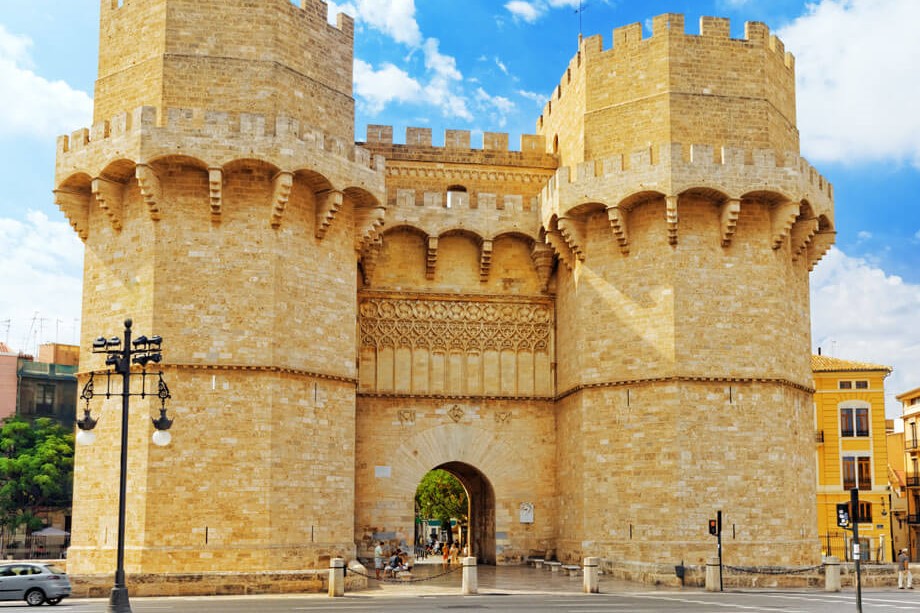
If in China the Great Wall turns a lot of heads, then in Valencia it is probably the Towers of Serranos that will catch your attention. A remarkable example of 14th century Gothic and defensive architecture, the Serranos Towers are among the 12 gates that once stood among the city walls.
19
Stop for a moment, and take a look on your right: you have a few meters from here a door that was part of the ancient Muslim wall. It dates from 1440. We must therefore imagine that at that time, the fortifications passed through here to delimit the ancient Arab district of Christian Valencia.
20
Here we arrive at the plaza del Carmen. Don’t hesitate to make a small detour to your left to discover it and see the impressive facade of the religious complex that is there. It is a former convent, bearing the same name as the square. Dedicated to the Carmelite Order, it was built in the 13th century and is a real historic place.
21
You have seen it since you entered the street: here you are in front of the tower of Saint Bartholomew. To understand its origin, we must go back to the 13th century, when Valencia, dominated by Muslims for many centuries already, was taken over by the King of Aragon James I.
22
In front of you stands a rectangular building in Gothic and Renaissance style, which is none other than the Palace of the Valencian Generality. This building was built as early as 1421, first to collect crown taxes, then to house the seat of regional self-government.
23
You now arrive at a new square, from which you can still appreciate a little the beautiful architecture of the cathedral, on your right. In front of you, we also see here a beautiful pink building.
24
Bypassing the cathedral of Valencia, we now come across the palace of the Archdiocese. Coloured with beautiful red bricks, it was built from the 13th century, and will undergo modifications over the years. First built in a Romanesque and Gothic style, it became mainly Baroque in the 18th century,
25
In front of you, you have a beautiful house that stands out from the other buildings. Called Casa del Punt de Gantxo, it reveals a magnificent architectural style that fits perfectly into Valencian modernism. This movement, Modernism, began in the late 19th century throughout Europe:
26
Built as early as the 13th century, following the Reconquista or the Christian reconquest of Valencia, St. Mary’s Cathedral stands on the exact site where an ancient mosque once stood. The numerous alterations, made up to the 17th century,
What's not included
Entrance fees to paid establishments along the route...
Headphones or headphones (optional)
Available languages
Audio guide
EN
FR
ES
Important information
Service animals allowed
Public transportation options are available nearby
Suitable for all physical fitness levels
Meeting point
We build your tours in the form of a loop so that you can easily start the tour at the point closest to you, the guidance will adapt automatically. If you are nearby, we recommend an ideal Check-out Point.
Important notes
Activating your audio-guided circuit:
Download the INWAY mobile app from your App Store or directly via this link: in-way.fr/app
Open the application and enter your code to unlock the circuit: VLE64741
We build our tours in the form of a loop so that you can easily start the tour at the point closest to you; the guidance will adapt automatically. If you are nearby, we recommend an ideal Check-out Point: 23 Pl. Ciutat de Bruges.
About Valencia
Valencia is a vibrant city on Spain's eastern coast, known for its City of Arts and Sciences, beautiful beaches, and rich culinary traditions. The city blends modern architecture with historic charm, offering a unique Mediterranean experience.
Top Attractions
City of Arts and Sciences
A futuristic complex featuring an opera house, science museum, and oceanographic park.
Architecture
Half day to full day
€30-€50 (depending on the attractions visited)
Valencia Cathedral
A stunning Gothic cathedral with a mix of architectural styles, home to the Holy Grail.
Historical
1-2 hours
€3-€5 (additional cost for tower access)
La Lonja de la Seda
A late Valencian Gothic-style civil building and a UNESCO World Heritage Site.
Historical
1 hour
€2-€4
Malvarrosa Beach
A popular urban beach with a long promenade, perfect for relaxation and water sports.
Beach
Half day to full day
Free
Central Market
One of the largest fresh produce markets in Europe, offering a variety of local and international products.
Market
1-2 hours
Free to enter, prices vary for purchases
Must-Try Local Dishes
Paella Valenciana
A traditional rice dish cooked with rabbit, chicken, and vegetables.
Main Course
Contains meat and vegetables
Fideuà
A noodle-based dish similar to paella, made with seafood.
Main Course
Contains seafood
Horchata
A sweet, milky drink made from tiger nuts, typically served with fartons (sweet pastries).
Drink
Vegan and gluten-free
All i Pebre
A traditional dish made with eel, garlic, and peppers.
Main Course
Contains fish and seafood
Popular Activities
Hiking in Albufera Natural Park
Water sports at Malvarrosa Beach
Beach lounging
Spa treatments
Visiting museums and historic sites
Attending local festivals
Boat tours in Albufera
Swimming and water sports
Best Time to Visit
March to May, September to November
These months offer pleasant weather and fewer tourists compared to the summer peak.
15-28°C
59-82°F
Practical Information
Language
- Official: Spanish
- Widely spoken: Valencian, English
- English: Moderately spoken
Currency
Euro (EUR)
Time Zone
GMT+1 (CET), GMT+2 (CEST during daylight saving time)
Electricity
230VV, 50HzHz
Safety Information
Overall Safety Rating: Generally safe
Valencia is generally safe for tourists, but it's important to be aware of pickpockets and scams in crowded areas.
Important Precautions:
- • Keep valuables secure and out of sight
- • Use licensed taxis or ride-sharing apps
- • Be cautious of strangers approaching you with offers or requests
Getting there
By air
- Valencia Airport • 8 km from city center
By train
Valencia Joaquín Sorolla Station
By bus
Valencia Bus Station
Getting around
Public transport
Efficient and affordable, with multiple lines connecting major attractions.
Taxis
Available • Apps: Cabify, Uber
Rentals
Car, Bike, Scooter
Neighborhoods
Ciutat Vella (Old Town)
El Carmen
Ruzafa
Malvarrosa
Day trips
Albufera Natural Park
10 km from Valencia • Half day to full day
A beautiful wetland area with a variety of birdlife and traditional fishing villages.
Sagunto
30 km from Valencia • Half day
A historic town with a Roman theater, castle, and medieval center.
Requena
100 km from Valencia • Full day
A picturesque town known for its wine production and historic center.
Festivals
Fallas Festival • March 15-19
Tomatina Festival • Last Wednesday of August
Las Fallas de Valencia • March 15-19
Pro tips
- Visit the City of Arts and Sciences early in the morning or late in the afternoon to avoid the midday sun and crowds
- Try local specialties like paella, fideuà, and horchata at traditional restaurants and markets
- Explore the city's neighborhoods, each with its unique character and attractions
- Use the Valencia Tourist Card for unlimited public transportation and discounts at major attractions
- Be cautious of pickpockets and scams in crowded areas, especially during festivals and peak tourist seasons
From $25
per person
Price varies by option
Secure booking
Free cancellation available
Instant confirmation