Discover the Charm of Palermo: A 3-Hour UNESCO Sites Walking Tour
Active
3h
For a full refund, cancel at least 24 hours before the scheduled departure time.
Instant confirmation
Mobile or paper ticket accepted
About this experience
Palermo, a city of allure, showcases rich cultural and historical treasures, with 8 UNESCO sites. Our intimate small group tour offers delightful exploration of top attractions and local cuisine.
Experience a captivating three-hour journey through Baroque and Normann-Arabic architecture. Piazza Pretoria, known as Square of Shame, boasts a grand marble fountain with striking nude statues. The 14th-century Praetorian Palace houses the Town Hall, open to the public.
Visit the Royal Palace, now the Regional Parliament, with the stunning Palatine Chapel's golden mosaics. Iconic sites like Martorana Church, praised as "most beautiful monument in the world," and the Cathedral of Palermo, reflecting diverse styles, await.
Indulge in a Sicilian cannolo at a local shop during this enriching cultural expedition. Join us for an unforgettable Palermo experience!
Available options
Recorrido a pie de 3 horas
Duration: 3 hours<br/>TOUR EN ESPAÑOL.: Descubre Palermo en una visita guiada a pie con 8 sitios UNESCO, rica historia, vibrante cultura ¡y una deliciosa degustación
3-Hour Walking Tour - ENG
Tour in English: Discover Palermo on a guided walking tour with 8 UNESCO sites, rich history, vibrant culture, and a tasty local treat!
3-Hour PRIVATE Walking Tour
Duration: 3 hours<br/>Private, top sights, sweetness: Join a private walking tour with a licensed guide! Discover the city’s top sights, visit the Cathedral, and enjoy a Sicilian
5-hour Palermo Walk & Palace
Two tours, one epic journey: City guided walking tour and Norman Palace & Palatine Chapel visit. Two meeting points, one unforgettable 5.5-hour adventure!
What's included
Enjoy entrance to the Cathedral
Typical Sicilian Cannolo or Granita
Delight in an enchanting walking tour
Explore with a Licensed English Speaking Guide
Marvel (from outside) at the city's main monuments
Detailed itinerary
1
Stop 1
The Teatro Massimo Vittorio Emanuele is an opera house and opera company located on the Piazza Verdi in Palermo, Sicily. It was dedicated to King Victor Emanuel II. It is the biggest in Italy, and one of the largest of Europe (at the time of its opening, it was - with its area of 7730 m² - the third largest opera house in Europe after the Palais Garnier in Paris, and the K. K. Hof-Opernhaus in Vienna). It is famous for its perfect acoustics.
2
The Galleria delle Vittorie (Gallery of the Victory) was built as a commercial mall with an entrance on 301 Via Maqueda in central Palermo, region of Sicily, Italy. The five story structure has deteriorated over the decades, though restoration was attempted.
3
crossing via Bandiera where there is a typical open-air market
4
The church of San Domenico, located in the homonymous square that dominates like a majestic queen, in size, historical, cultural and religious importance comes immediately after the Cathedral.
Surely it is one of the most beloved churches of Palermo, also because it is considered a “Pantheon of the illustrious men of Sicily”. It is also considered the church symbol of the fight against the mafia.
5
Stop 5
Pass by
The market of Piazza Caracciolo winds through alleys and adjacent streets, reflecting the true essence of the city, the energy and dynamism of the cosmopolitan culture of Palermo. Formerly called "la Bucceria" from the French "boucherie", or butcher's shop, since it was initially intended for the sale of meat.
6
The Garraffo Fountain (Italian: Fontana del Garraffo) is a Baroque fountain of Palermo. It is located in Piazza Marina, down the ancient Cassaro street, now called Via Vittorio Emanuele, within the historic centre of Palermo.
7
The Palermo Stock Exchange was one of ten active Italian stock exchanges until 1997, when the city's institutions were unified into the single Italian Stock Exchange.
Although stockbrokers were already active in the Sicilian capital in 1840, the Palermo Stock Exchange opened trading in 1845. It was the second most important stock exchange in the Kingdom of the Two Sicilies, after that of Naples.
It was based in the city's Palazzo delle Finanze, where it remained for about a century .
The Palermo stock exchange was the most important in Sicily; however, she wasn't the only one. In fact, until the First World War, three other stock exchanges were also active on the island: the most important was that of Messina, followed by those of Catania and Agrigento.
8
The descent of the Judges goes from Piazza Sant'Anna to Piazza Bellini.
Once called "calata dei giudici", the street takes its name from the Judges of the Praetorian Court, who once lived there, in the monastery of S. Caterina. The Court was presided over by the praetor (in ancient times called baiulo, corresponding to today's mayor) in civil cases, while in criminal cases there was an avenger. The judges were elected by the king himself, on the proposal of the viceroy, they had to be from Palermo and their office lasted one year.
9
Situated over the piazza Bellini, in the middle of Palermo, the church of Santa Maria dell’Ammiraglio is also known as La Martorana, in memory of Goffredo and Eloisa de Marturano, the founders of the nearby Benedictine convent. The church was built in 1143-1185 by the Greek admiral George of Antioch, who wanted to thank the Virgin Mary for her help and protection. George himself decided to assign the church to the Greek-Byzantine clergy who still officiates the ceremonies in ancient Greek or Albanian language (in fact the church belongs to the Eparchy of Piana degli Albanesi of the Italo-Albanian Catholic Church).
10
Stop 10
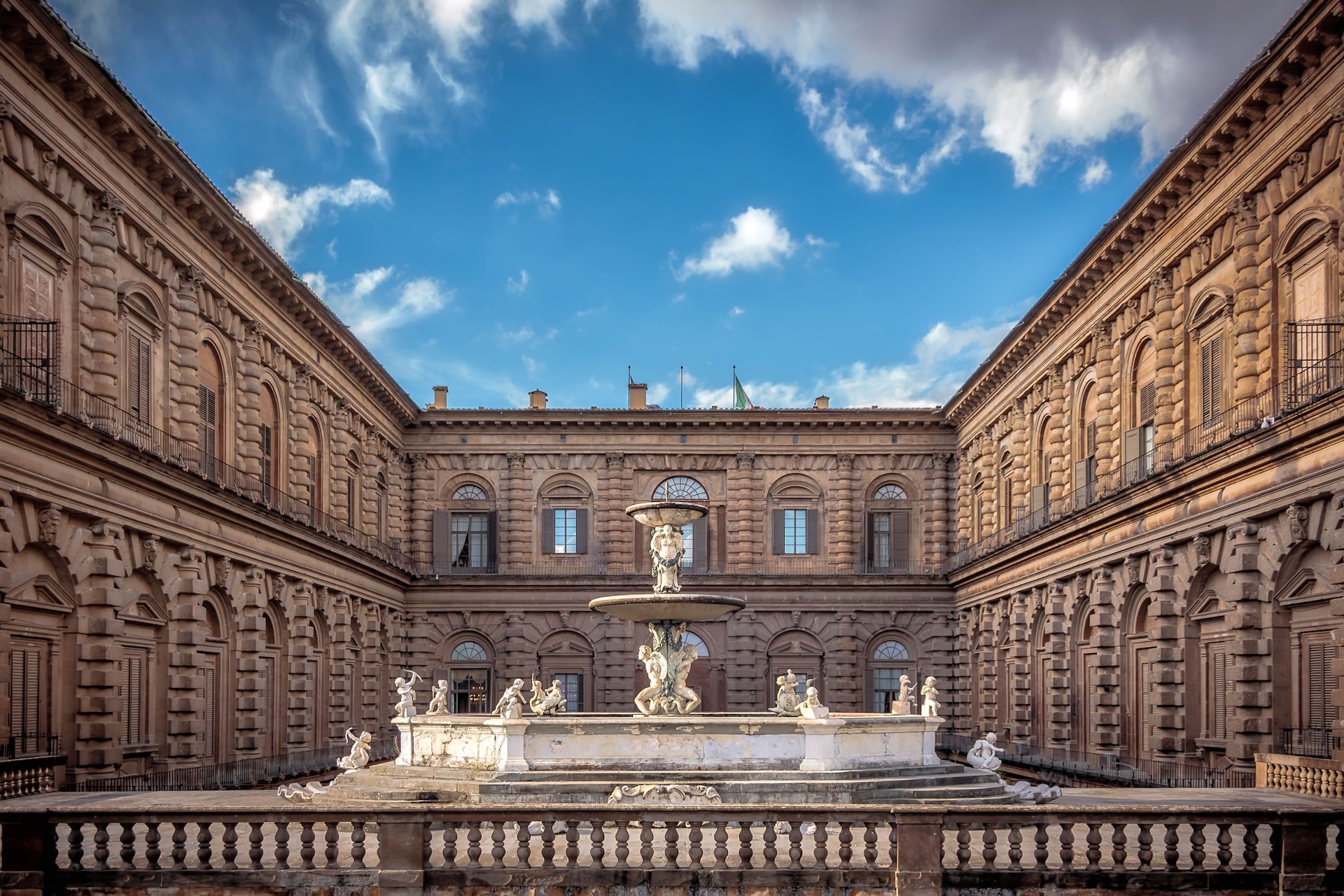
Piazza Pretoria is at the limits of the district of Kalsa, near the corner of Cassaro with Via Maqueda, just a few meters from the Quattro Canti, the intersection where all the four ancient quarters intersect, in the city of Palermo, region of Sicily, Italy. The fountain was created for the garden of don Luigi de Toledo in Florence. Previously the plot of this piazza in Palermo was a garden that belonged to the nuns of San Domenico al Maglio and, after a lot of pressure, was obtained in 1551. Subsequently, in 1584, the Palazzo di San Clemente was built near this site. The creation of this unusual garden (devoid of palaces) and of the fountain was commissioned to the Florentine sculptor Francesco Camilliani, student of Baccio Bandinelli.
11
Stop 11
“I Quattro Canti” (The Four Corners) is one of Palermo’s most spectacular and popular spots. The four buildings that outline the square were built between 1608 and 1620, while the sculptures and decorative elements were completed in 1663. Piazza Vigliena, one of the many names by which the Quattro Canti are also called, is the ideal starting point for a tour of Palermo city.
12
Stop 12
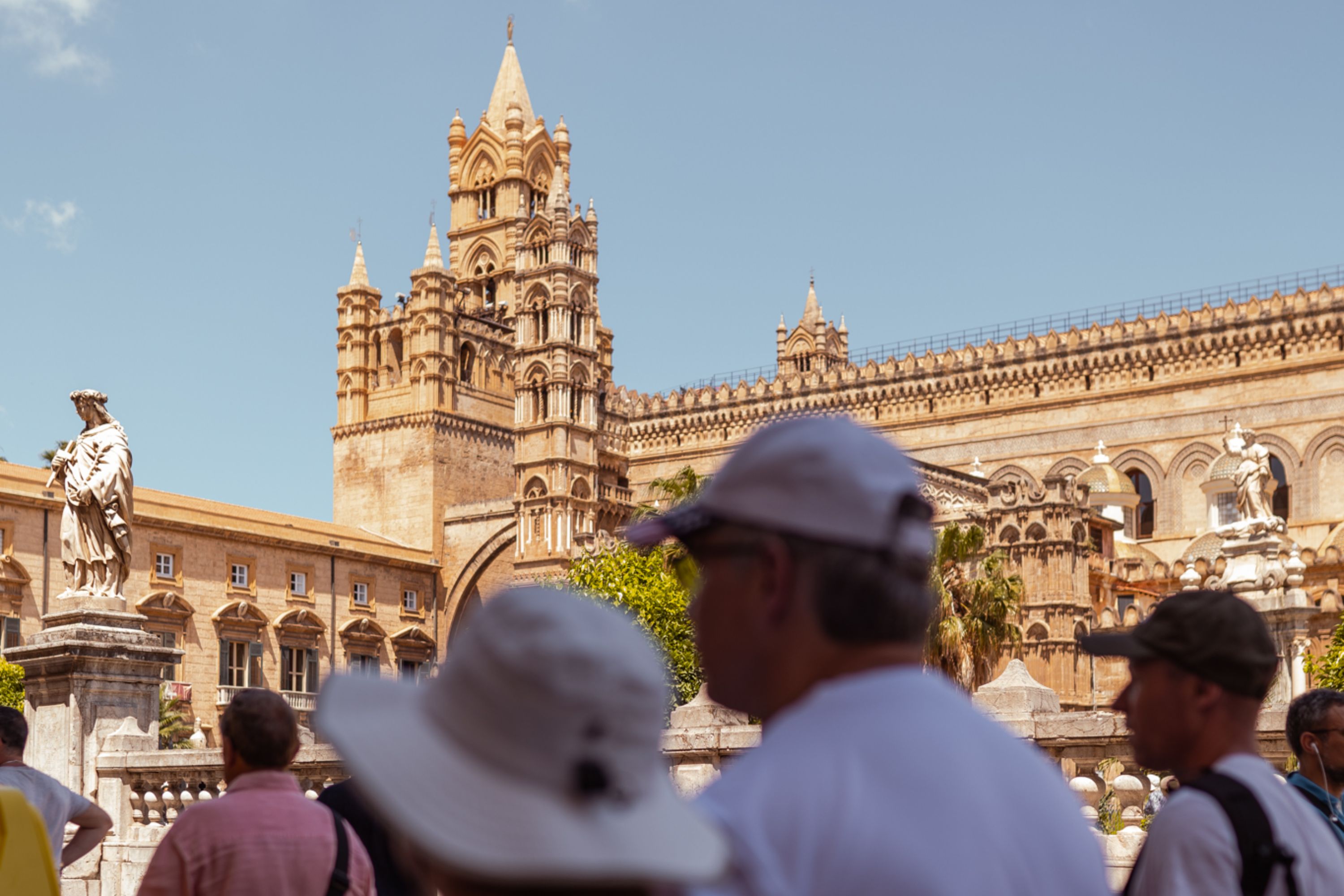
The Cathedral of Palermo is a treasure of the Norman architecture in Sicily.
The Cathedral of Palermo is one of the most important architectural monuments in Sicily. It was built in 1184 by the Normans as a re-converted Christian church on the site of a Muslim Mosque that was previously built over a Christian basilica. This Cathedral is a must see when visiting Palermo!
The reason for building this cathedral was to surpass in beauty the Cathedral of Monreale so you can imagine how architectural exaggeration was involved due to the competitiveness. What we see today is the result of a stratification of styles over the centuries from Gothic to Medieval, Arabic (an actual passage from the Koran is still engraved on one of the columns) to Neoclassical.
13
Built in 1905 by the mayor Bonanno, who named it Villa Bonanno, is a magnificent garden always open, located in Victory Square, behind the Palace of the Normans. In the garden - planted with palm trees - are visible statues and busts of famous people of Palermo. Also in the garden, were found the remains of Roman patrician houses with mosaics: notable are the mosaics of the seasons and Orpheus, now kept in the National Archaeological Museum. Adjacent to the villa is the fountain with its monument to Philip V, a work of nineteenth-century made by Nuncio Morello. It seems that the fountain was designed in 1661 by Carlo d'Aprile, with the participation of the Serpotta.
14
The Palazzo Reale (Royal Palace) in Palermo, also known as the Palazzo dei Normanni (Palace of the Normans), is one of the most extraordinary buildings in Sicily. It chronicles the history of Palermo from the first Punic settlements to the present day. One of the many halls and rooms that can be visited is the Cappella Palatina (Palatine Chapel). Its sumptuous decoration is a veritable manifesto of Arab-Norman art and it has been a World Heritage Site since 2015. The ancient Torre Pisana houses the Palermo Astronomical Observatory and the Specola Museum, while temporary exhibitions are often held in the Sale del Duca di Montalto (Duke of Montalto Halls).
What's not included
Gratuities
Hotel Pick up and Drop Off
Available languages
Guide guide
EN
ES
Reviews breakdown
Viator
4.7
129 reviews
5★
109
4★
12
3★
3
2★
2
1★
3
Tripadvisor
4.8
126 reviews
5★
114
4★
7
3★
3
2★
1
1★
1
Important information
Infants and small children can ride in a pram or stroller
Service animals allowed
Public transportation options are available nearby
Suitable for all physical fitness levels
The tour takes place regardless of the weather
We are sorry to inform you that pets are not permitted on our tours
Please let us know in advance any special need or impaired mobility of the clients and we will do our best to accomodate them.
Meeting point
TOWNS OF ITALY TOURIST HUB & COOKING SCHOOL
If booking the 5-hour Walking Tour + Palace Guided Visit, note this combo has TWO MEETING POINTS.
Walk: 9 AM at Towns of Italy Hub, Via Volturno 40-44.
Palace: 1 PM at main entrance, Piazza del Parlamento.
Reach each independently. Arrive 15 min early.
About Palermo
Palermo, the vibrant capital of Sicily, is a city of rich history, stunning architecture, and a unique cultural blend. Known for its Norman-Arab-Byzantine influences, Palermo offers a mix of grand palaces, bustling markets, and delicious street food that will captivate any traveler.
Top Attractions
Palermo Cathedral
A stunning example of Norman-Arab-Byzantine architecture, Palermo Cathedral is a must-visit for its historical significance and beautiful interior.
Historical/Religious
1-2 hours
€7 for the cathedral and cloister
Palermo Cathedral
This grand palace was the seat of the Norman kings of Sicily. It houses the Palatine Chapel, known for its stunning mosaics and Arabic-Norman architecture.
Historical/Architectural
1.5-2 hours
€12 for the palace and chapel
Ballarò Market
One of Palermo's most famous street markets, Ballarò offers a vibrant atmosphere with fresh produce, street food, and local crafts.
Cultural/Shopping
1-2 hours
Free to explore
Monreale Cathedral
Located just outside Palermo, Monreale Cathedral is famous for its stunning Byzantine mosaics and is a UNESCO World Heritage Site.
Historical/Religious
2-3 hours including travel
€6 for the cathedral and cloister
Teatro Massimo
The largest opera house in Italy and one of the most famous in the world, Teatro Massimo is a masterpiece of neoclassical architecture.
Architectural/Entertainment
1 hour for a tour
€7 for a guided tour
Must-Try Local Dishes
Arancini
Fried rice balls stuffed with ragù, mozzarella, and peas.
Snack
Vegetarian options available
Panelle
Chickpea fritters, a popular street food in Palermo.
Snack
Vegan
Pasta alla Norma
Pasta with tomato sauce, fried eggplant, ricotta salata, and basil.
Main Course
Vegetarian
Cannoli
Crispy pastry tubes filled with sweet ricotta.
Dessert
Vegetarian
Popular Activities
Hiking in the nearby mountains
Swimming and snorkeling at Mondello Beach
Beach lounging at Mondello Beach
Enjoying a leisurely meal at a seaside restaurant
Visiting museums and historical sites
Attending local festivals and events
Boat tours to the nearby islands
Swimming and water sports at the beach
Best Time to Visit
April to June, September to October
These months offer pleasant weather and fewer crowds. It's ideal for sightseeing and outdoor activities.
15°C to 30°C
59°F to 86°F
Practical Information
Language
- Official: Italian
- Widely spoken: Sicilian, English (limited)
- English: Limited
Currency
Euro (EUR)
Time Zone
GMT+1 (Central European Time), GMT+2 during daylight saving time
Electricity
230VV, 50HzHz
Safety Information
Overall Safety Rating: Generally safe
Palermo is generally safe for tourists, but petty crime and pickpocketing can occur in crowded areas. Be aware of your surroundings and take precautions to protect your belongings.
Important Precautions:
- • Keep valuables secure
- • Use licensed taxis
- • Be cautious of strangers approaching you
Getting there
By air
- Palermo Falcone-Borsellino Airport • 32 km from city center
By train
Palermo Centrale
By bus
Palermo Centrale Bus Station
Getting around
Public transport
The bus system is the primary mode of public transport in Palermo. It's affordable but can be crowded during peak hours.
Taxis
Available • Apps: FreeNow, ItTaxi
Rentals
Car, Bike, Scooter
Neighborhoods
Kalsa
Vigàta
Mondello
Day trips
Monreale
7 km • Half day
Monreale is famous for its stunning Byzantine mosaics and the Benedictine Abbey.
Cefalù
70 km • Full day
A charming coastal town known for its beautiful beach and medieval cathedral.
Erice
120 km • Full day
A medieval hilltop town with stunning views and well-preserved architecture.
Festivals
Festa di Santa Rosalia • July 10-15
Sagra del Mandarino • January to February
Palermo Pride • June
Pro tips
- Visit the markets early in the morning for the best selection and freshest produce
- Learn a few basic Italian phrases to enhance your experience and interact with locals
- Take a food tour to discover the best street food and local specialties
- Explore the city on foot to discover hidden gems and charming streets
- Visit the cathedral and other religious sites early in the morning to avoid crowds
From $25
per person
Price varies by option
Secure booking
Free cancellation available
Instant confirmation