Bukhara in One Day Guided Sightseeing Tour
Active
6h - 7h
For a full refund, cancel at least 24 hours before the scheduled departure time.
Instant confirmation
Mobile or paper ticket accepted
About this experience
On this walking tour you learn about Art, history, old town, architectural monuments, food. The UNESCO listed city Bukhara has it all. Bukhara, one of the most ancient cities of Central Asia, has a 2500-year-old history. Bumichkat “New Castle”, Al Madina as-sufriyya “Copper City”, Madinat at-tujjor “City of Traders”, Foxira “Honorable City” are some the names given to this unique city.
Available options
Bukhara in One Day Guided Sightseeing Tour
What's included
Entrance tickets to the monuments
English speaking tour guide with you for the day trip
Detailed itinerary
1
Ismail Samaniy mausoleum (IX-X centuries)— the oldest, best preserved and most breathtakingly original building in Bukhara.
2
The mausoleum of Chashmai Ayub (“Prophet Job”)— according to the legends the prophet Job came to the Zerafshan Valley and witnessed a great and terrible drought. As people perished of thirst around him, Job struck the dusty earth with his staff and a cool source of sweet spring water brought liquid salvation. The Chashmai Ayub (“the Spring of Job” in Uzbek) commemorates this site.
3
Abu Abdullah Mohammed ibn Ismail Imam Al Bukhari— after the Koran, the book most revered by Muslims is the collection of Hadith (sayings of the Prophet Mohammed) selected by, amongs others, Abu Abdullah Mohammed ibn Ismail Imam Al Bukhari. At the age of 16 he made pilgrimage to Mecca and then Al Bukhari was set on his chosen task of roaming the Islamic world in search of Hadith. His book “Al Jomiy Al Saheeh (Secure book)” took 16 years to compile from over 600,000 traditions, gathered from over 1000 sheikhs.
4
Bolo Hauz mosque (XVIII century)— it is a functioning Friday mosque from XVIII century and consists of reservoir, mosque and minaret (Note: this mosque you can visit from outside, since it is functioning Friday mosque).
5
The Citadel Ark (I-XX centuries)— the construction of the citadel is dated to beginning of the 1st millennium BC. During the history the fortress has been destroyed several times but has been restored again. All buildings of the citadel have been reconstructed mainly during the XVIII-XX centuries.
6
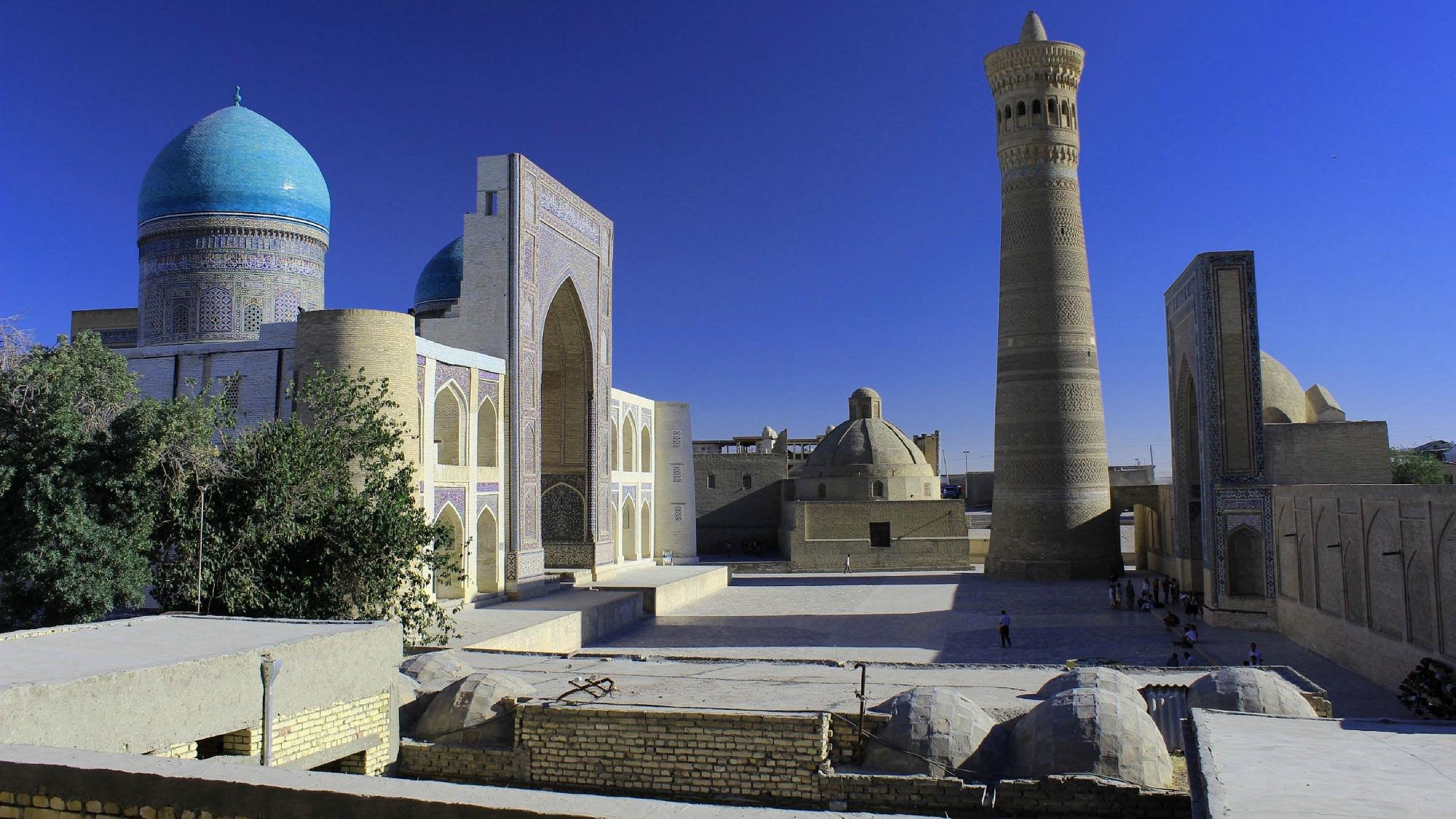
Poi Kalon complex (“The foot of tall” in Uzbek) from XII-XVI centuries. Consisting of mosque, madrassah and minaret, one of the great centre of trade and scholarship along the Silk Road. The beauty of the minaret amazed Genghis Khan (Temuchin or Temujin).
7
Magoki-Attari Mosque— Central Asia’s oldest surviving mosque. Prior to the Arab invasion there was a Buddhist monastery and then a Zoroastrian temple on the site. It now houses the dull Museum of the History of Carpet Weaving.
8
Labi Hauz Complex (“The edge of the pond” from Persian) constructed by Nadir Divan Begi, The Grand Vizier of Bukhara, around 1620.
9
XVI century Synagogue— to the south of Labi Hauz Square spreads the Jewish Quarter of the old town. Jews have been an important minority in Bukhara since their forced migration from Merv and Shiraz in the 14th century (the majority having emigrated to Israel and the US since 1970s). (Note: most of the time it is closed if it is open travelers can visit inside and see old Torah)
10
Statue of Hodja Nasruddin— the homespun philosopher and humorist on his donkey. Elsewhere in the world he is generally accepted as Turkish, but Uzbeks claim he was born in Bukhara and is one of their own.
What's not included
Lunch
Photo and video charges (for photography cameras. It is free if travelers use phone cameras)
Transport
Gratuities
Available languages
Guide guide
EN
Important information
Infants and small children can ride in a pram or stroller
Public transportation options are available nearby
Infants are required to sit on an adult’s lap
Suitable for all physical fitness levels
Total duration of the tour is from 6 to 7 hours which includes lunch break as well. On this tour you visit architectural marvels which have a rich history and important religious sites. It’s recommended to follow a specific dress code when visiting these iconic landmarks. Both men and women should wear clothing that covers their shoulders and knees. Avoid wearing tight, revealing, or transparent clothing. Women should cover their hair with a headscarf or shawl when they enter to holy places.
Meeting point
Meeting point is in front of Asia Bukhara hotel building
About Bukhara
Bukhara is one of the oldest and most well-preserved cities in Central Asia, renowned for its rich history, stunning Islamic architecture, and vibrant cultural heritage. This ancient Silk Road city offers a unique glimpse into Uzbekistan's past, with over 140 architectural monuments dating back over a millennium.
Top Attractions
Po-i-Kalyan Complex
The Po-i-Kalyan Complex is the heart of Bukhara's historic center, featuring the Kalyan Minaret, Kalyan Mosque, and Mir-i Arab Madrasah. This UNESCO-listed site is a masterpiece of Islamic architecture.
Historical/Architectural
1-2 hours
Free (small fee for some areas)
Ark of Bukhara
The Ark of Bukhara is a massive fortress that served as the residence of Bukhara's rulers for centuries. It houses museums and historic buildings within its walls.
Historical
1 hour
5,000 UZS
Lyabi-Hauz Ensemble
The Lyabi-Hauz Ensemble is a picturesque complex centered around a large pond (hauz) and surrounded by madrasahs, mosques, and tea houses. It's a popular gathering spot for locals and tourists.
Historical/Cultural
1 hour
Free
Chashma-Ayub Mausoleum
This mausoleum is said to be built around a spring that appeared miraculously when the prophet Job (Ayub) touched the ground with his staff. It's a peaceful spot with beautiful tile work.
Religious
30 minutes
Free
Trade Domes
Bukhara's trade domes, such as the Toki Zargaron (Jewelers' Dome), Toki Telpak Furushon (Hatsellers' Dome), and Toki Sarrofon (Money Changers' Dome), are a testament to the city's rich trading history. These domes once housed bustling markets and still retain their historic charm.
Historical/Cultural
1 hour
Free
Must-Try Local Dishes
Plov
A rice dish cooked with meat, carrots, and spices, often served at celebrations and gatherings
Main Dish
Contains meat, can be vegetarian if made without meat
Lagman
A hearty noodle soup with meat, vegetables, and a rich broth
Main Dish
Contains meat, can be vegetarian if made without meat
Samsa
Baked pastries filled with meat, pumpkin, or potatoes
Snack
Varies by filling, often contains meat
Shurpa
A flavorful soup made with meat, vegetables, and spices
Soup
Contains meat, can be vegetarian if made without meat
Popular Activities
Camel trekking
Sandboarding
Hiking
Tea house visits
Spas and hammams
Reading in parks
Visiting historic sites
Attending local festivals
Best Time to Visit
April to June, September to October
These months offer pleasant weather for exploring the city's historic sites. The temperatures are comfortable, and the crowds are manageable.
15°C to 30°C
59°F to 86°F
Practical Information
Language
- Official: Uzbek
- Widely spoken: Russian, English (limited)
- English: Limited
Currency
Uzbekistani Som (UZS)
Time Zone
GMT+5
Electricity
220VV, 50HzHz
Safety Information
Overall Safety Rating: Generally safe
Bukhara is generally safe for travelers, with low levels of violent crime. However, petty theft and scams can occur, especially in tourist areas.
Important Precautions:
- • Use reputable tour operators
- • Negotiate taxi fares in advance
- • Keep valuables secure
Getting there
By air
- Bukhara International Airport • 5 km from city center
By train
Bukhara Railway Station
By bus
Bukhara Central Bus Station
Getting around
Public transport
Buses are the primary mode of public transport in Bukhara. They are affordable and connect major attractions and neighborhoods.
Taxis
Available • Apps: Yandex.Taxi
Rentals
Car, Bike, Scooter
Neighborhoods
Historic Center
Modern Bukhara
Day trips
Vobkent
30 km from Bukhara • Half day to full day
Vobkent is a small town known for its historic mosque and mausoleum, offering a glimpse into the region's Islamic heritage.
Gijduvan
40 km from Bukhara • Full day
Gijduvan is famous for its ceramics and traditional pottery workshops, offering a hands-on experience in this ancient craft.
Kyzylkum Desert
100 km from Bukhara • Overnight
The Kyzylkum Desert offers a unique desert experience with opportunities for camel trekking, stargazing, and exploring the vast sand dunes.
Festivals
International Festival of Classical Music • September
Siyavushbek Festival • August
Pro tips
- Visit the Po-i-Kalyan Complex early in the morning to avoid crowds and the heat
- Try the local plov at a traditional chaikhana for an authentic experience
- Bargain politely when shopping at bazaars, as prices are often inflated for tourists
- Carry small change for bus rides, taxis, and small purchases
- Learn a few basic phrases in Uzbek or Russian to enhance your interactions with locals
From $25
per person
Price varies by option
Secure booking
Free cancellation available
Instant confirmation