Sacred City of Anuradhapura Day Tour
Active
7h
For a full refund, cancel at least 24 hours before the scheduled departure time.
Instant confirmation
Mobile or paper ticket accepted
About this experience
Unless you hire a car, visiting Sri Lanka’s UNESCO-listed ruined capital of Anuradhapura in a day is impossible. This private tour delivers: with return air-conditioned transport and a driver-guide to show you around. Roam the temples, ponds, and shrines, including the Jetavanarama stupa; and hear tales of this ancient and sacred city you’d otherwise miss.
Available options
Sacred City of Anuradhapura Day Tour
Pickup included
What's included
2 x 500 ml of water bottle per person.
Transport in an air-conditioned vehicle.
Hotel pickup and drop-off.
Service of an English Driver.
Detailed itinerary
1
Stop 1
Standing at a circumference of 370 feet and a height of 180 feet, Ruwanweliseya, the third largest stupa of Sri Lanka, is the focal point of the Maha Vihara, the first monastery of Sri Lanka. It is believed that a considerable amount of relics of Buddha is enshrined in this glorious stupa, built in replicating the shape of a bubble of water. At the eastern entrance to the stupa is a statue of King Dutugamunu. According to the records made by Fa Hsien, the Chinese Buddhist monk, who toured Sri Lanka in the 5th century CE, Maha Vihara monastery housed no less than 3000 Buddhist monks. Since the death of King Dutugamunu, “The Hero of the Nation”, the great stupa had been renovated by a succession of Sinhalese kings till King Nissanka Malla (1187-1196 AC). By the 19th century, Anuradhapura, once the greatest monastic city of the world, also named Anurogrammon, by the Greek cartographer Claudius Ptolemy (90-168 AD) was deserted; Ruwanweliseya was in ruins.
2
It is hard to believe – but there is no shadow of doubt at all –that this small tree with limbs so slender that they must be supported on iron crutches,is the oldest historically authenticated tree in the world (2,250 years). It has never since been without its hereditary attendants and care, to the very end, of the country’s kings. As lately as the reign of King Keerti Sri Rajasingha, a wall was built around the tree.In 1966 it was enclosed with a golden railing. The great ancient Sinhalese Buddhist monuments of Anuradhapura are clustered around this Peepal tree (ficus religiosa) called Sri Maha Bodhi, a sapling of the Peepal Tree at Buddha Gaya, Northern India in whose shelter Gautama Buddha attained supreme enlightenment. The sapling was brought to Sri Lanka by Buddhist nun Sanghamitta,the daughter of King Asoka of India during the 3rd Century B.C. To the north of the well protected and well adorned tree are three great monasteries:the Mahavihara, the Abhayagiri and the Jetavana.
3
Abhayagiri Monastery spreading over an area of 200 hectares,was founded by King Valagamba also known by Vattagamini Abhaya (109 BC-89-77 BC) following his ascent to the throne for the second time,having the Dravidian invaders put to sword and fire. The monastery was built following the destruction of the Jain hermitage,whose ascetic Giri had taunted King Valagamaba while he was fleeing from invaders from Southern India 14 years back.The monastery was donated to Buddhist monk Thera Mahatissa as a token of gratitude for the moral and material support extended to the king,at a time of adversity,in exile building an army to regain his kingdom. The main stupa at Abhayagiri Monastery ,Abhayagiri Stupa was built over a footprint of Buddha.The Bo tree at the monastery is an off-shoot of the Sri Maha Bodhi tree also at Anuradhapura. Standing at 370 ft in height,when it was first built, Abhayagiri Dagoba was the second tallest dagoba in Sri Lanka.
4
Isurumuniya Temple,built by King Devanampiyatissa,is located close to the Royal Pleasure Gardens by the side of Tisaweva (Tissa rainwater reservoir).The Isurumuniya temple,built partly into a cave with a lovely pool in the front and with a boulder forming the rear wall,is a treasure-trove of exquisitely carved stone sculptures. The rock face bordering the rear of the pond is well adorned with a couple of exquisite rock carvings.One is of a herd of Elephants giving the impression of their playful antics in the pond.The sculpture has also captured the majesty of the leader elephant of the herd.The other one is of a noble horseman and his horse. Also at the temple is a celebrated sculpture on a slab of granite called ‘Isurumuniya lovers’.This has now been shifted to the Isurumuni Archaeological Museum.The lovers are identified as King Dutugamunu’s son Saliya and his non-royal consort Asokamala,the ultimate lissom women with matchless beauty.
5
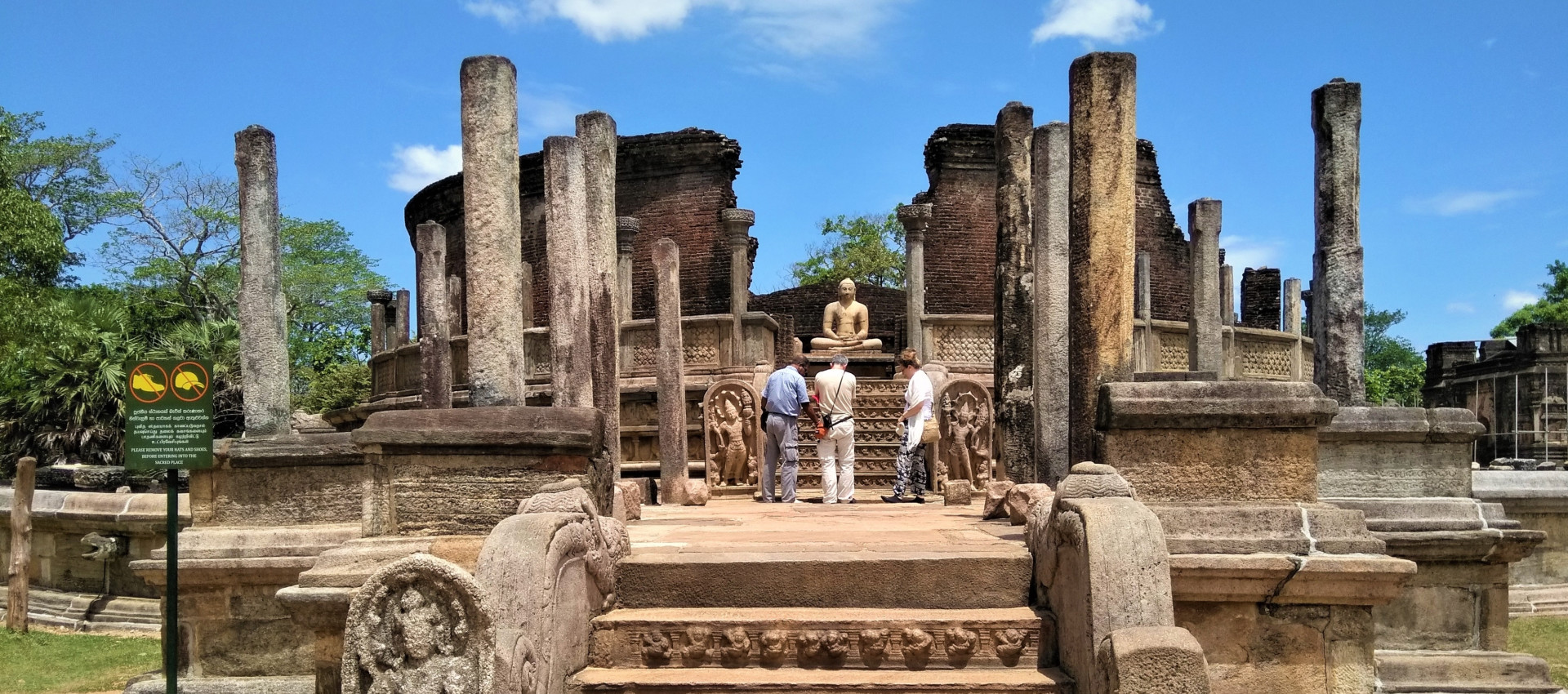
Thuparama dagoba, 20m in height and 60ft in diameter, one of the smallest of ancient stupas was built by King Devanampiya Tissa in the third century BC. Thuparama dagoba is believed to enshrine the collar bone relic of Buddha. By the seventh century, the stupa was renovated by King Aggabodhi the second in the 7th century. The graceful monolithic pillars surrounding it once upheld a circular roof making the shrine a Vata Dage (Circular – Relic – house) a characteristically Sinhalese architectural feature. The roof doesn’t exist today. Originally constructed in the ancient architectural tradition of a “paddy – heap” shape, its present “bell” shape dates to renovation in the 1862. To the south-east of Thuparama dagoba are the ruins of a hospital as it is evident by the presence of an intact medicinal trough, an oil bath cut into a slab of stone.
6
The Jetavanarama Dagoba’s massive dome rises above the entire eastern part of Anuradhapura. Built in the 3rd century by Mahasena, it may have originally topped 120m, but today is about 70m – similar to the Abhayagiri. When it was built it was almost certainly the third-tallest monument in the world, the first two being Egyptian pyramids. Its vast, bulbous form is unplastered and said to consist of more than 90 million bricks.
What's not included
Entrance Tickets for visiting sites.
Food and beverages.
Gratuities.
Available languages
Guide guide
EN
Important information
Public transportation options are available nearby
Suitable for all physical fitness levels
About Anuradhapura
Anuradhapura is a major city in Sri Lanka, famous for its well-preserved ruins of an ancient Sri Lankan civilization. It is one of the oldest continuously inhabited cities in the world and a UNESCO World Heritage Site. The city is a pilgrimage site for Buddhists and offers a rich cultural and historical experience.
Top Attractions
Sacred City of Anuradhapura
A UNESCO World Heritage Site, the Sacred City of Anuradhapura is home to ancient stupas, temples, and ruins that date back over 2,000 years.
Historical
Full day
Free
Ruwanwelisaya Dagoba
One of the tallest stupas in the world, this iconic structure is a significant pilgrimage site for Buddhists.
Religious
1-2 hours
Free
Sri Maha Bodhi
A sacred fig tree that is said to have been propagated from the original Bodhi tree under which Buddha attained enlightenment.
Religious
30 minutes to 1 hour
Free
Jethawanaramaya Dagoba
The tallest stupa in Anuradhapura, known for its impressive size and historical significance.
Historical
1 hour
Free
Isurumuniya Temple
A beautiful temple known for its rock carvings and serene atmosphere.
Religious
1-2 hours
Free
Must-Try Local Dishes
Kottu Roti
A popular Sri Lankan dish made with chopped roti, vegetables, and meat or seafood, cooked on a hot plate.
Dinner
Can be made vegetarian or vegan.
Hoppers
Bowl-shaped pancakes made from fermented rice flour and coconut milk, often served with eggs or sambal.
Breakfast
Vegetarian.
Rice and Curry
A staple Sri Lankan meal consisting of steamed rice served with a variety of curries.
Lunch/Dinner
Can be made vegetarian or vegan.
Lamprais
A Dutch-influenced dish consisting of rice, meat, and vegetables cooked in banana leaves.
Lunch/Dinner
Contains meat.
Popular Activities
Hiking in Mihintale
Exploring Ritigala Forest Monastery
Tea tasting
Visiting temples
Exploring ancient ruins
Attending religious ceremonies
Witnessing the Esala Perahera festival
Best Time to Visit
January to March
This is the best time to visit Anuradhapura as the weather is pleasant and dry, making it ideal for exploring the ancient ruins and enjoying outdoor activities.
28-32°C
82-90°F
Practical Information
Language
- Official: Sinhala, Tamil
- Widely spoken: English
- English: Moderately spoken
Currency
Sri Lankan Rupee (LKR)
Time Zone
UTC+5:30
Electricity
230VV, 50HzHz
Safety Information
Overall Safety Rating: Generally safe
Anuradhapura is generally safe for travelers, but standard precautions should be taken to avoid petty theft and scams.
Important Precautions:
- • Keep valuables secure.
- • Use reputable tour operators.
- • Be cautious of strangers offering unsolicited help.
Getting there
By air
- Colombo Bandaranaike International Airport • 200 km
By train
Anuradhapura Railway Station
By bus
Anuradhapura Bus Stand
Getting around
Public transport
Buses are the most common form of public transport and cover most areas of the city.
Taxis
Available • Apps: PickMe, Uber
Rentals
Car, Bike, Scooter
Neighborhoods
Sacred City
New Town
Tuktukaraya
Day trips
Mihintale
12 km • Half day
A sacred mountain site where Buddhism was first introduced to Sri Lanka, featuring ancient ruins and temples.
Ritigala Forest Monastery
30 km • Full day
A UNESCO-listed forest monastery with ancient ruins and a rich biodiversity.
Avukana Buddha Statue
50 km • Full day
A colossal Buddha statue carved out of a single rock, standing 40 feet tall.
Festivals
Esala Perahera • July/August (full moon day)
Poson Festival • June (full moon day)
Vesak Festival • April/May (full moon day)
Pro tips
- Visit the Sacred City early in the morning to avoid the heat and crowds.
- Hire a local guide for a more in-depth understanding of the historical sites.
- Try local street food for an authentic culinary experience.
- Respect the religious customs and traditions when visiting temples.
- Carry a water bottle and sunscreen to stay hydrated and protected from the sun.
From $25
per person
Price varies by option
Secure booking
Free cancellation available
Instant confirmation


![Minneriya National Park Safari [Morning / Evening]](https://media-cdn.tripadvisor.com/media/attractions-splice-spp-674x446/15/1f/89/35.jpg)