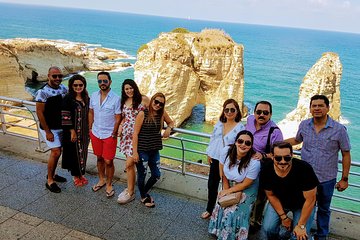


Sightseeing all-inclusive Small Group Tour of Beirut, Beiteddine & Deir El Qamar
Active
8h
All sales are final. No refund is available for cancellations.
Instant confirmation
Mobile or paper ticket accepted
About this experience
Discover Beirut's highlights, stroll through its medieval center, and snap photos along the Corniche. Then, journey to the scenic Chouf region, visiting Deir el Qamar and Beiteddine Palace. Enjoy local cuisine amid architectural marvels on this all-inclusive tour.
Available options
Sightseeing all-inclusive Small Group Tour of Beirut, Beiteddine & Deir El Qamar
Pickup included
What's included
Tickets / Admission to Historical Sites
Lunch
Hotel Pick up & Drop off
Air-conditioned vehicle
Professional Guide
Detailed itinerary
1
The pigeon rock is a stunning set of rocks and a Popular tourist destination known for its iconic rock formations in picturesque seaside surrounds, welcome you to the city of Beirut. Pigeons’ Rock (also known as the Rock of Raouché) is located at Beirut’s western-most tip, the two huge rock formations stand like gigantic sentinels to the city.
2
Stretching from the Ramlet al Bayda area to the Saint George marina, Al Manara Corniche is the most renowned seaside promenade in Beirut. Lined with palm trees, it offers a great view of the Mediterranean Sea, as well as some of the country's best assets, namely the famous Pigeon Rock, and the summits of Mount Lebanon on the eastern side.
3
“Beirut's finest leisure destination” as described in its official website, Zaitunay Bay is a new waterfront promenade with shops and restaurants.
4
This abandoned Holiday Inn Hotel is one of Beirut’s war landmarks. It was basically built Between 1971 and 1974 when Beirut’s economy was booming and when Beirut was one of the most visited touristic city of the Middle East.
The Holiday Inn was functioning until the Lebanese civil war begun in 1975. The hotel soon became considered a “war zone” in a lengthy time of conflict known as “the Battle of the Hotels” where more than 25,000 combatants were fighting for control over different luxury hotels, including the Holiday Inn as well as the famous Phoenicia hotel.
This hotel remains untouched, abandoned, empty, decades after the war, and remains a reminder to the Lebanese population about the horrors of war.
5
The Mohammad Al-Amin Mosque, also referred to as the Blue Mosque, is is the biggest mosque in Lebanon located in downtown Beirut.
This huge amber colored mosque near Martyrs square was opened in 2008 and has four minarets standing 65m high.
The Mohammad Al-Amin Mosque contains multiple domes. All of the domes of the mosque are made from light blue tiles. The mosque also has multiple arches, which are couple stories high.
6
The Al-Omari Grand Mosque was built in the age of Omar Bin El Khattab in 635 AD and then converted to Church of Saint John by the crusaders in the 12th century, it was retransformed into the city's Grand Mosque by the Mamluks in 1291. Damaged during the Civil War, the mosque's refurbishment was completed in 2004.
7
The Greek Orthodox Cathedral of Saint George is the seat of the Greek Orthodox Metropolitan bishop of the Greek Orthodox Archdiocese of Beirut and its dependencies. It is the oldest church in the city of Beirut and one of the oldest in the region and It is located in the heart of Beirut’s city center.
The first Christian temple ever built in the very location goes back to the mid sixth century AD and it’s closely associated with Beirut’s famous Law School.
8
Stop 8
Martyrs' Square is a square in the heart of downtown Beirut historically known as "Al Burj" or "Place des Cannons". It is named after the 6 May 1916 executions by the Ottomans of some Lebanese nationalists ordered by Jamal Pasha during World War I.
9
Nejme Square, or Place de l'Étoile, is the central square in the Downtown area. It is home to the Lebanese Parliament and its complementary buildings, two cathedrals, a museum, and several cafes and restaurants. Most notable for it’s 1930 four four-faced Rolex clock and for its architecture, the square has become a recognizable icon of Beirut City worldwide.
10
Beirut Souks is a commercial district in Beirut City Center. With over 200 shops, 25 restaurants and cafes, an entertainment center, and a cinema complex.
Beirut Souks is the largest and most diverse shopping and leisure area in Beirut.
11
The Roman Berytus baths are The largest outdoor sight located in downtown Beirut. They were discovered in 1968-1969 and underwent a major renovation in the mid 1990.
Roman Berytus had four major bath complexes and the first was created in the early first century under Augustus.
The terrible Berytus earthquake that happed in 551 AD destroyed all the baths.
Today, the Roman Berytus Baths reflects the ancient traditions of the site. One of the Baths is used as an artistic performance and concert space.
12
Beiteddine Palace or ‘House of Faith’ is a 19th-century palace in Beiteddine, Lebanon. It hosts the annual Beiteddine Festival and the Beiteddine Palace Museum.
Emir Bashir Chehab II, who later became the ruler of the Mount Lebanon Emirate, built the palace between 1788 and 1818. After 1840, the palace was used by the Ottomans as a government building. During the French Mandate it served as a local administrative office.
In 1943, the palace was declared the president's official summer residence. During the Lebanese Civil War it was heavily damaged. Parts of the palace are today open to the public while the rest is still the president's summer residence.
13
Deir al-Qamar, meaning "Monastery of the Moon" is a village located south-east of Beirut and five kilometres outside of Beiteddine palace in the Chouf District of the Mount Lebanon.
Deir El Qamar was the first village in Lebanon to have a municipality in 1864, and it is the birthplace of many well known personalities, such as artists, writers, and politicians. People from all religious backgrounds lived there and the town had a mosque, synagogue and Christian churches.
In the year 1860, Deir al-Qamar was destroyed during the civil war between Druze and Christians during which the town was set ablaze. Napoleon III sent a French contingent to rebuild it, recalling France ancient role as protector of the Christians in the Ottoman Empire as established by a treaty in 1523.
In 1864, Deir el-Qamar elected the first municipality in the Arab provinces of the Ottoman Empire.
The village retains a remarkable picturesque appearance with typical stone houses with red tile roofs.
14
Fakhreddine Mosque with its octagonal minaret is a mosque in Deir el Qamar, Lebanon. Built in 1493 and restored in the sixteenth century by Fakhreddine 1st, it is the oldest mosque in Mount Lebanon.
15
The Church of Saidet et Tallé and translated as Our Lady of the Hill is one of the most important historical and religious sites in Deir el Qamar and dates to the 15th century.
Monk Nicolas Smisaati built a church on the site over the ruins of an old Phoenician temple dedicated to the goddess Astarte that was later destroyed by an earthquake in 859.
According to the Maronite Heritage web site, "the legend says that there was a Druze Emir in Baakline looking at the hill of Dar El Kamar. He saw a light coming out of the hill so he gathered his soldiers and ordered them to go in the morning and dig in the land. He said to them: 'If you find an Islamic symbol, build a mosque. If you find a Christian symbol, build a church."
In the morning, the soldiers went and found a rock with a cross on it and under the cross there was the moon and venus. That was the sign that in the distant past there was a temple dedicated to the moon and venus and later it became a church.
What's not included
Gratuities
Available languages
Guide guide
AR
EN
Important information
Specialized infant seats are available
Suitable for all physical fitness levels
About Beirut
Beirut is the capital and largest city of Lebanon, renowned for its rich history, vibrant culture, and stunning Mediterranean coastline. Known as the 'Paris of the Middle East,' it offers a unique blend of ancient ruins, modern luxury, and bustling street life.
Top Attractions
Beirut Central District
The heart of Beirut, this district is a blend of modern skyscrapers and ancient ruins, offering a glimpse into the city's rich history and vibrant present.
Historical/Architecture
Half day to full day
Free to moderate
National Museum of Beirut
One of the most important archaeological museums in the Middle East, showcasing artifacts from various periods of Lebanese history.
Museum
2-3 hours
Moderate (around $5-$10)
Raouche Rock
A stunning natural limestone rock formation rising from the Mediterranean Sea, offering breathtaking views and a popular spot for photos.
Nature/Scenic
1-2 hours
Free (unless dining at the restaurant)
Byblos
One of the oldest continuously inhabited cities in the world, Byblos offers ancient ruins, a charming old souk, and a picturesque harbor.
Historical/Cultural
Half day to full day
Moderate (entry fees for some sites)
Must-Try Local Dishes
Hummus
A creamy dip made from chickpeas, tahini, lemon juice, and garlic, often served with pita bread.
Appetizer
Vegetarian, Vegan
Tabbouleh
A refreshing salad made from parsley, bulgur wheat, tomatoes, and lemon juice.
Appetizer
Vegetarian, Vegan
Kibbeh
A dish made from ground meat (usually lamb or beef) mixed with bulgur and spices, often fried or baked.
Appetizer
Contains meat
Kafta
Ground meat (usually lamb or beef) mixed with spices and herbs, often grilled or fried.
Main Course
Contains meat
Popular Activities
Hiking in the nearby mountains
Scuba diving and snorkeling in the Mediterranean
Beach lounging at Raouche or Dbayeh
Spa and wellness treatments
Visiting museums and historical sites
Attending local festivals and events
Swimming and water sports
Boat tours along the coast
Best Time to Visit
March to May, September to November
Spring and autumn offer the best weather for sightseeing and outdoor activities. The temperatures are comfortable, and the city is in full bloom during these seasons.
15°C to 28°C
59°F to 82°F
Practical Information
Language
- Official: Arabic
- Widely spoken: French, English
- English: Moderately spoken
Currency
Lebanese Pound (LBP)
Time Zone
GMT+2 (EET)
Electricity
220VV, 50HzHz
Safety Information
Overall Safety Rating: Exercise caution
Beirut is generally safe for tourists, but it's important to be aware of your surroundings and take precautions to ensure a safe and enjoyable trip. Petty crime and scams can occur, especially in tourist areas.
Important Precautions:
- • Be aware of your surroundings and keep valuables secure
- • Use reputable taxi services or ride-hailing apps
- • Avoid walking alone at night in isolated areas
Getting there
By air
- Rafic Hariri International Airport • 9 km (5.6 miles) from city center
By bus
Charles Helou Bus Station, Dawra Bus Station
Getting around
Public transport
Buses are the most common form of public transport, but they can be crowded and may not have fixed schedules.
Taxis
Available • Apps: Bolt
Rentals
Car, Bike, Scooter
Neighborhoods
Gemmayzeh
Hamra
Achrafieh
Day trips
Byblos
40 km (25 miles) • Half day to full day
One of the oldest continuously inhabited cities in the world, Byblos offers ancient ruins, a charming old souk, and a picturesque harbor.
Jeita Grotto
20 km (12 miles) • Half day
A stunning natural limestone cave system with a breathtaking underground river and waterfalls, offering a unique and unforgettable experience.
Harissa
20 km (12 miles) • Half day
A picturesque hilltop town offering panoramic views of the Mediterranean Sea and the famous Our Lady of Lebanon shrine, a popular pilgrimage site.
Festivals
Beirut International Film Festival • October to November
Beirut Jazz Festival • July
Eid al-Fitr • Varies by lunar calendar (usually April to June)
Pro tips
- Learn a few basic phrases in Arabic to enhance your experience and interact with locals
- Visit the Beirut Central District early in the morning or late in the afternoon to avoid crowds and the heat
- Try local street food like falafel, shawarma, and manakish for an authentic and affordable dining experience
- Use ride-hailing apps like Bolt for a more convenient and reliable taxi experience
- Explore the city's vibrant nightlife in neighborhoods like Gemmayzeh and Hamra, where you'll find a mix of bars, clubs, and live music venues
From $25
per person
Price varies by option
Secure booking
Free cancellation available
Instant confirmation