Heritage tour in Quba and Khinaliq
Active
7h - 9h
For a full refund, cancel at least 24 hours before the scheduled departure time.
Instant confirmation
Mobile or paper ticket accepted
About this experience
Tour will start at 9 am. Our driver/guide will pick up your from your hotel in Baku. Ride will last about 2 hours for 150 km. While reaching to Quba we will drive inside Quba city so you will get acquainted with the streets and Quba`s people and their unique houses. Then we will travel to Qechresh and will take a lunch inside of forest. And then we will start to discover beautiful waterfall of Quba - Mestdergah. Then we will travel to Chenlibel lake which you will enjoy with the nature and will have a chance to make picnic, And your wow will continue with boats on lake.After Chenlibel you will be transferred to Shahdag Mountain Winter & Summer Complex. You can have a bicycle ride on mountains, karting, teleferic, skiing and enjoy the nature. So, after Shahdag Mountain Resort we will come back to Baku. You will have an unforgettable memories on this tour.
Available options
Heritage tour in Quba and Khinaliq
What's included
All Fees and Taxes
Lunch
Air-conditioned vehicle
Detailed itinerary
1
Quba was mentioned in works of various European geographers, in ancient Arabic and Albanian sources. The castle built by the ruler Anushiravan in the 11th century was called "Bade-Firuz Qubat", and in the Arabic sources of the XII century Quba was mentioned as "Cuba". In the 13th century, in the Dictionary of Geographical names of Arabian scientist Hamabi it was mentioned among the Azerbaijani cities as Kubba, and in the sources of 16th century Quba was referred to as "Dome".
Guba (Quba) city originated from the riverside village of Gudial. In the mid-18th century, after moving his residence from Khudat, Hussain Ali became Quba's Khan (tribal Turkic Muslim ruler) and raised fortress walls around the city.[2] He thereafter attempted to create a state separate from other Azerbaijani khanates. The position of the Quba khanate grew stronger during the reign of Fatali Khan (1758–1789), son of Hussain Ali Khan.[3]
Nevertheless, Quba Khanate, like other Transcaucasian khanates, was occupied by Czarist Russia in the early 19th century and formally annexed to the Russian Empire under the agreement of 1813. After the rehabilitation Quba was included in the Derbent province in 1840 and then in the Baku province in 1860.[3]
Alexandre Dumas, Russian orientalist Berezin, the writer Bestuzhev-Marlinsky, the Norwegian scholar and adventurer Thor Heyerdahl visited Quba at the time.
Quba is also a center of carpet weaving industry. There is located a carpet making company called "Qadim Quba". The carpet "Golu Chichi" woven here in 1712 is now exhibited in the Metropolitan Museum in New York.
Population
2
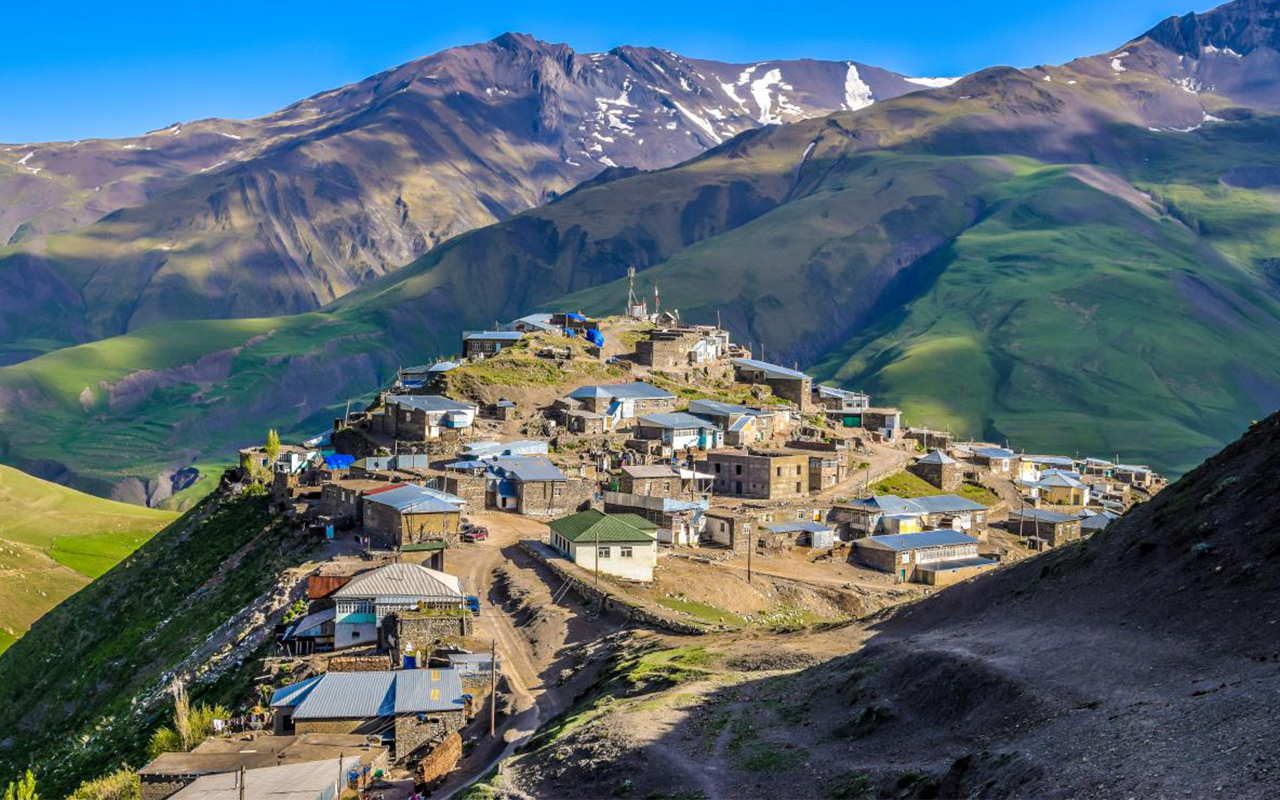
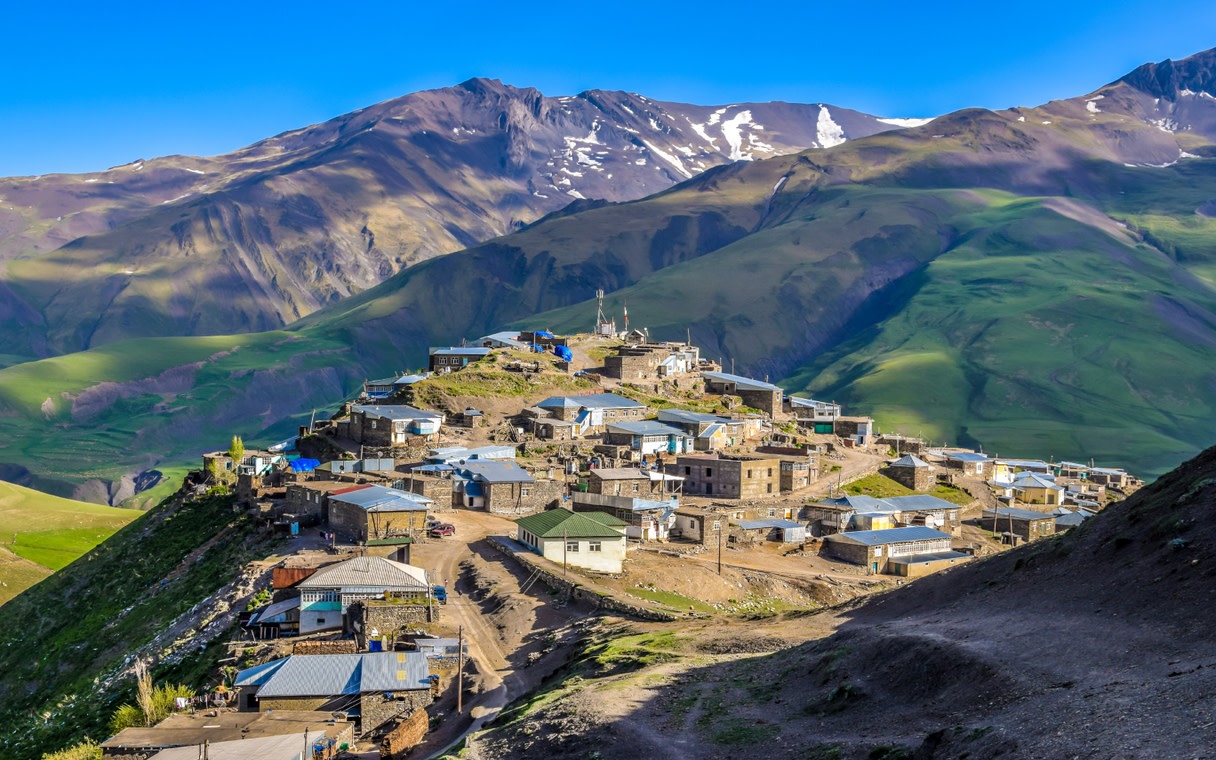
About an hour drive along a new road from Quba is Khinalug, the oldest village in Azerbaijan. At 2,100-2,200 m (6,900-7,220 ft) above sea level, Khinalug has developed its own culture and traditions, and even its own language. The villagers call the place Kyat, and consider themselves to be direct descendants of the biblical Noah.
Khinalug is over 5,000 years old. For centuries, this village was cut off from the rest of civilization by the tall mountains and dangerous rocky cliffs. Due to the isolation, the villagers were able to preserve their own unique language, which doesn’t belong to any other language family, as well as their traditions and customs, found nowhere else.There are about 2,000 people living in the village, divided into 4 families. Each family has its own graveyard and its own patterns for carpets and clothing. Today, the people are Muslim, but before they converted to Islam they were Zoroastrians. There are some temples and semi-pagan traditions that have survived.
The first records of these people date back to the 1st century CE, in the writings of the historian Pliny and the famous Strabo’s Geography. The history of the village is also recorded in the 8 large graveyards, whose area is much larger than Khinalug itself. The graves, made in 3 and even 4 layers, bear inscriptions in different alphabets on their gravestones.
The villagers of Khinalug build their houses one on top of the other. In general, they resemble a multi-story house, where the roof of one house is the courtyard for the one built above it. There are 360 stone houses in the village, each of which is about 200-300 years old. The windows are covered with a polyethylene film, and the ceilings are fitted with a smoke flap, through which the villagers can also talk to each other. The floors and walls are covered with colorful and warm carpets, sometimes woven by the women who live there. These carpets not only decorate the houses, but protect from the cold winter weather.
Khinalug, Quba districtKhinalug, Quba districtKhinalug, Quba district
The winters are cold and come early, and temperatures can drop to -30°C (-22°F). Bricks made of straw and manure are used as fuel in the winter. They not only burn well but also provide sufficient heat. Khinalug residents make these bricks all year long, and dry them wherever there is free space. Firewood is a luxury there, since the village is so high up that there are very few trees around.
The soil is generally rocky and barren, but locals manage to grow onions and potatoes in small plots, and cucumbers and tomatoes can be grown in planters, like houseplants. For animals, cows and goats are common, as well as poultry, but sheem are less common. Keeping sheep is difficult because then pens would need to be built to hold the sheep in the winter. The food is rather simple: vegetables, bread (called churek), milk, cheese, mountain honey, and dried goat meat (made each autumn).
Khinalug, Quba districtKhinalug, Quba districtKhinalug, Quba district
The residents of Khinalug are very religious. There are a lot of holy places not far from the village, such as the graves of saints, caves, and unexplored archaeological sites. Some of them were built as early as the Middle Ages. Dedicated explorers can find the Hydyr Nebi Tomb, Sheikh Shalbuza Mosque, Abu Muslim Mosque (12th century) and the Pirdzhomyard Mosque (1388). The local culture is preserved in the Historical and Ethnographic Museum of Khinalug, where visitors can find items used in traditional life and small exhibits about the history and customs of the local villagers.
With the construction of a new paved road in 2006, local life changed a lot. Tourists started visiting, and locals got a chance to leave the village. Today, many Khinalug residents speak Azerbaijani and some even know Russian. They buy goods in Quba, and trade homespun items, food products, and host and feed tourists who want to get to know this unique village. Khinalug became a little less isolated, though it still retains its unique character. In 2007, Khinalug became a state historical, architectural and ethnographic reserve.
3
Qechresh is ancient forest located in northern province of Quba municipality.
4
You will visit national garden.
5
Most ancient village in Europe (7000 BC)
6
Mestdergah is waterfall located in southern Quba ( small Caucasian mountain ranges)
7
Stop 7
Pass by
Tour finishes in entrance of ancient Old Town.
Available languages
Guide guide
DE
EN
IT
FR
ES
Important information
Infants and small children can ride in a pram or stroller
Public transportation options are available nearby
Infants are required to sit on an adult’s lap
Specialized infant seats are available
Not recommended for travelers with poor cardiovascular health
Travelers should have at least a moderate level of physical fitness
Meeting point
47 Kichik Qala
About Baku
Baku, the capital of Azerbaijan, is a vibrant city where modernity meets tradition. Situated on the Caspian Sea, it's known for its futuristic skyline, historic sites, and rich cultural heritage, including the ancient Maiden Tower and the iconic Flame Towers.
Top Attractions
Maiden Tower
A 12th-century monument that is a symbol of Baku. Its exact purpose remains a mystery.
Historical
1-2 hours
Moderate (5 AZN)
Flame Towers
Three futuristic skyscrapers that are landmarks of modern Baku. The towers are designed to resemble flames, a reference to Baku's ancient history as a center of the fire-worshipping Zoroastrian religion.
Architecture
30 minutes to 1 hour
Free to view from outside
Old City (Icheri Sheher)
The historic core of Baku, a UNESCO World Heritage site with ancient walls, narrow streets, and historic buildings.
Historical
2-3 hours
Free to explore, attractions within have varying costs
Baku Boulevard
A scenic park along the Caspian Sea with walking paths, cafes, and entertainment options.
Nature
1-2 hours
Free to enter, activities have varying costs
Heydar Aliyev Center
A stunning piece of modern architecture designed by Zaha Hadid. The center hosts exhibitions, concerts, and conferences.
Architecture
1-2 hours
Moderate (depends on the event)
Must-Try Local Dishes
Plov
A fragrant rice dish cooked with saffron, meat, and vegetables. It's often served at special occasions and is considered a national dish.
Main course
Contains meat, can be made vegetarian upon request
Dushbara
Tiny dumplings filled with minced meat and served in a broth. It's a popular street food in Baku.
Soup
Contains meat, can be made vegetarian upon request
Baku Piti
A traditional soup made with lamb, chickpeas, and noodles, served in a clay pot.
Soup
Contains meat, can be made vegetarian upon request
Baku Dolma
Grapes leaves or vegetables stuffed with a mixture of minced meat and rice, cooked in a spicy tomato sauce.
Appetizer
Contains meat, can be made vegetarian upon request
Popular Activities
Hiking in Gobustan National Park
Exploring mud volcanoes
Visiting the Shamakhi Astrophysical Observatory
Strolling along Baku Boulevard
Enjoying a cup of tea in a traditional teahouse
Relaxing at a local hammam (bathhouse)
Exploring the Old City
Visiting museums and historic sites
Best Time to Visit
April to June, September to October
This is the best time to visit Baku with pleasant weather, ideal for sightseeing and outdoor activities. Crowds are moderate, and the city hosts several festivals during these months.
18°C to 28°C
64°F to 82°F
Practical Information
Language
- Official: Azerbaijani
- Widely spoken: Russian, English (in tourist areas)
- English: Moderately spoken in tourist areas, limited elsewhere
Currency
Azerbaijani Manat (AZN)
Time Zone
GMT+4
Electricity
220VV, 50HzHz
Safety Information
Overall Safety Rating: Generally safe
Baku is generally safe for travelers, with low crime rates. However, petty crime like pickpocketing can occur in crowded areas. Exercise caution at night, especially in less touristy areas.
Important Precautions:
- • Keep valuables secure
- • Use official taxis or ride-hailing apps
- • Be cautious of strangers offering help or services
Getting there
By air
- Heydar Aliyev International Airport • 20 km from city center
By train
Baku Railway Station
By bus
Baku International Bus Terminal
Getting around
Public transport
The metro is efficient, clean, and affordable. It's the best way to get around the city quickly.
Taxis
Available • Apps: Bina Taxi, Yandex.Taxi
Rentals
Car, Bike
Neighborhoods
Old City (Icheri Sheher)
Nizami District
Khatai District
Day trips
Gobustan National Park
60 km from Baku • Full day
A UNESCO World Heritage site featuring ancient rock carvings, mud volcanoes, and a unique desert landscape. It's a great place for hiking and exploring.
Lankaran
220 km from Baku • Full day or overnight
A city in southern Azerbaijan known for its lush greenery, historic sites, and the nearby Hirkan National Park. It's a great place for nature lovers and history buffs.
Shamakhi
120 km from Baku • Full day
A historic city known for its ancient Juma Mosque, the Yeddi Gumbaz mausoleums, and the nearby Shamakhi Astrophysical Observatory. It's a great place for history lovers and those interested in astronomy.
Festivals
Baku International Jazz Festival • October
Baku International Film Festival (BAFTA) • October
Novruz Bayrami • March 20-21 (or around the spring equinox)
Pro tips
- Visit the Flame Fountain in Baku Boulevard, a unique attraction where natural gas flames continuously burn from a stone fountain
- Try traditional Azerbaijani tea in a local teahouse, such as Sazaghan Teahouse or Chaykhana #1
- Explore the Old City on foot, taking in the narrow streets, historic sites, and local markets
- Take a day trip to Gobustan National Park to see ancient rock carvings and mud volcanoes
- Visit the Heydar Aliyev Center, a stunning piece of modern architecture designed by Zaha Hadid
From $25
per person
Price varies by option
Secure booking
Free cancellation available
Instant confirmation