Tour Évora and Alentejo in a private tour
Active
9h
For a full refund, cancel at least 24 hours before the scheduled departure time.
Instant confirmation
Mobile or paper ticket accepted
About this experience
Tour Évora (UNESCO World Heritage), a place of great cultural and gastronomic wealth, where you can still find traces of various civilizations, from Roman temples, its beautiful Cathedral, the Church of São Francisco and perhaps one of the most caricatured places to visit in Portugal, the Bone Chapel always within the walls of a Medieval Village. You can choose between visiting the Cork factory or the cromlechs as option.
Carried out in our company, on our tour in a comfortable and 100% flexible way.
Available options
Tour Évora and Alentejo in a private tour
Pickup included
What's included
Private transportation
WiFi on board
Compulsory insurance
Private guide and accompaniment to all monuments
Air-conditioned vehicle
Pick up and drop off at the accommodation
Detailed itinerary
1
Visit to a traditional cork factory where we will learn the whole process, from knowing the tree (cork oak), its extraction, the choice, preparation to the final product.
Did you know that the bark of the Cork Oak grows every year and that every nine years it has to be removed from the tree, reaching 25 centimeters thick, the perfect material that is resistant to heat, cold and fire, after removing the cork The tree regenerates again, Portugal is responsible for 55% of the world production of cork, today highly valued, whether in decorative wall and floor coverings, or even in the manufacture of sporting goods, the ideal material for baseball grains or cable. fishing rods.
However, in many countries cork is best known for being the raw material for wine corks as it allows micro-portions of oxygen to come into contact with wine, so that wine can “age” while maintaining its quality. As you see, our Tour Évora has a lot to learn…
2
Stop 2
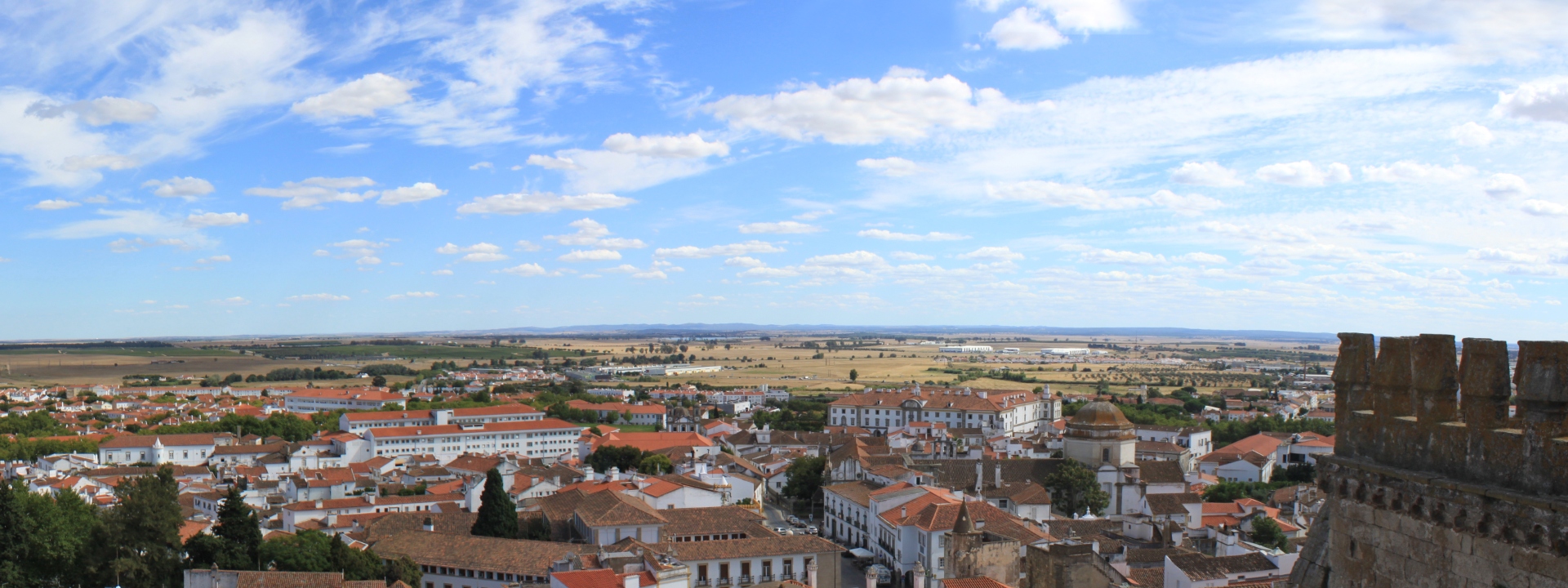
The Historic Center of Évora is an intra-wall urban space, classified as a UNESCO World Heritage Site since 1986, located in the city of Évora. [1] [2]
The city-museum of Évora has roots that go back to the time of the Roman Empire. The city still conserves, to a large extent in its central nucleus, traces of different civilizations and cultures: Celts, Romans, Arabs, Jews and Christians influenced the culture of Évora. It reached its golden age in the 15th century, when it became the residence of the kings of Portugal. The architectural and artistic quality of the white houses or decorated with tiles and wrought iron balconies, dating from the 16th to the 18th centuries, is unique. The city's monuments also had a profound influence on Portuguese architecture in Brazil.
The Historic Center of Évora, formed by narrow streets and lanes, patios and wide, has an area of 107 hectares and is clearly demarcated by the medieval walls, with an extension of more than 3 km.
3
The Água de Prata Aqueduct, also known as Aqueduto da Água da Prata or Aqueduto da Prata, is a complex work of Renaissance hydraulic engineering with the aim of supplying the city of Évora with water. Inaugurated in 1537, it was built during the reign of King João III and designed and built by the royal architect Francisco de Arruda. The aqueduct transports water from springs located in Graça do Divor, within the grounds of the São Bento de Castris Convent, which "have their first beginning at Herdade das Figueiras de Lobo", to the city of Évora, covering about 18 km.
4
Stop 4
This sinister chapel with its walls and pillars lined with human bones and skulls is estimated to be more than 5,000 monks. Do not be alarmed when at the entrance read; "In the bones we are waiting for here," because it only leads us to reflect on life.
5
Stop 5
The Church of São Francisco in Évora is a church of Gothic-Manueline architecture. Built between 1480 and 1510 by the stone masters Martim Lourenço and Pero de Trilho and decorated by the royal painters Francisco Henriques, Jorge Afonso and Garcia Fernandes, it is closely linked to the historical events that marked the period of maritime expansion in Portugal. This is evident in the symbols of the monumental nave with its ogival vault: the cross of the Order of Christ and the emblems of the founding kings, D. João II and D. Manuel I.
6
Stop 6
In Évora, all roads lead to Praça do Giraldo. It has always been this way since its construction in 1571/1573.
Praça do Giraldo is an icon of homage to Geraldo Geraldes, Sem Pavor, as he conquered Évora from the Moors in 1167. In thanks for this enormous feat, D. Afonso Henriques named him mayor of the city and frontier of the Alentejo, region that would help conquer.
7
The Church of Graça or Convent of Nossa Senhora da Graça, is an important Renaissance religious monument in the city of Évora, located in Largo da Graça, in the parish of Sé and São Pedro. This monastery, owned by the hermit monks of Saint Augustine, was founded in 1511, having been designed by the architect of the Casa Real Miguel de Arruda. The building is a beautiful example of the purest Renaissance style, with the famous Atlantean figures whom the people of Évora have called for centuries, the "Meninos da Graça" in the façade's acroterias.
8
Stop 8
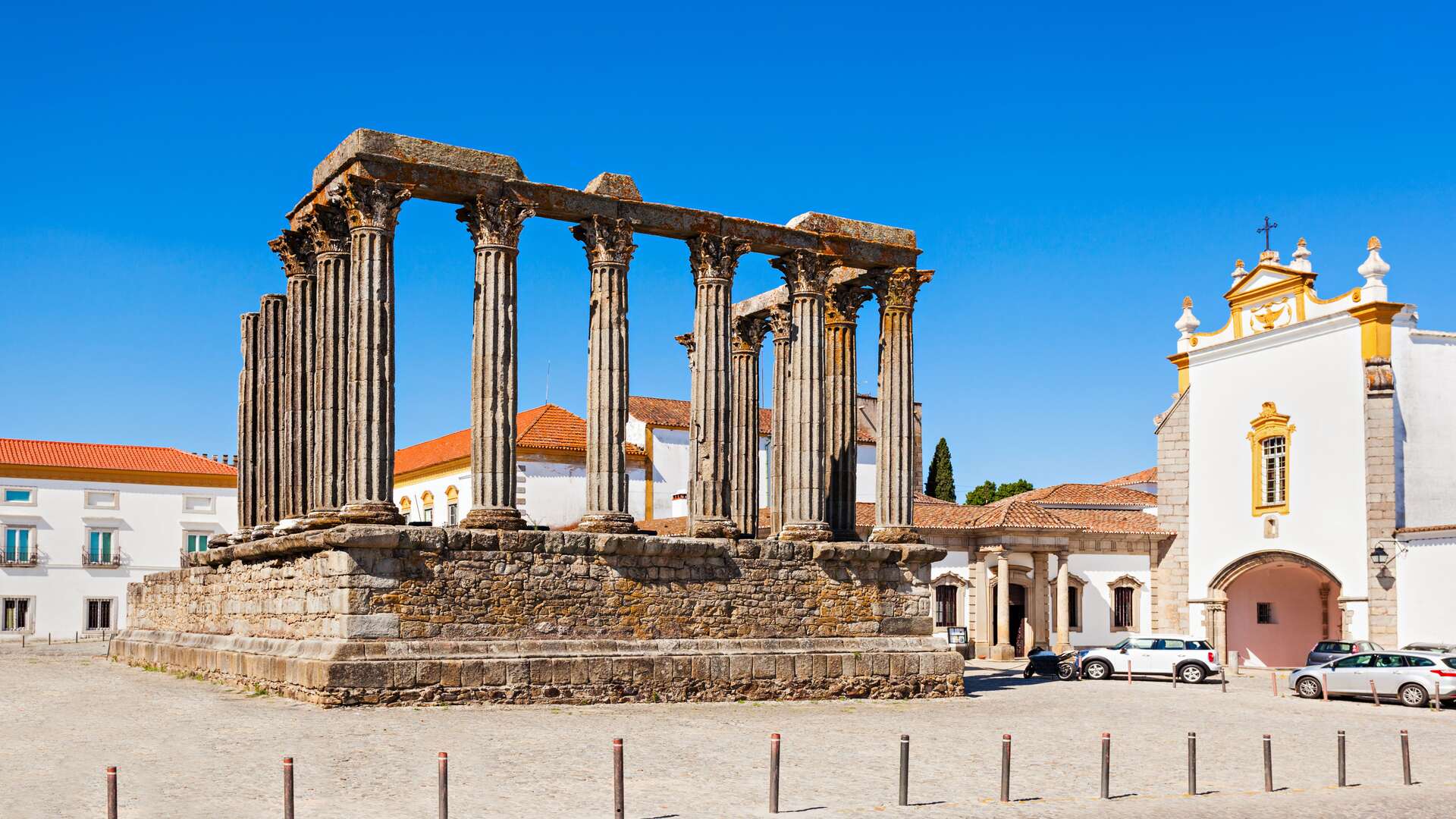
Another monument of great value is the Temple of Diana or Temple of Évora, which justifies the importance that the Romans gave to this beautiful city, next to the Cathedral, built in the Roman period, from here we can see the magnificent aqueduct of the "Water of the Silver" , outside the city walls and extending from the outskirts of the city, some of its arches are still visible inside the city, built in the 16th century to ensure water transportation.
9
Stop 9
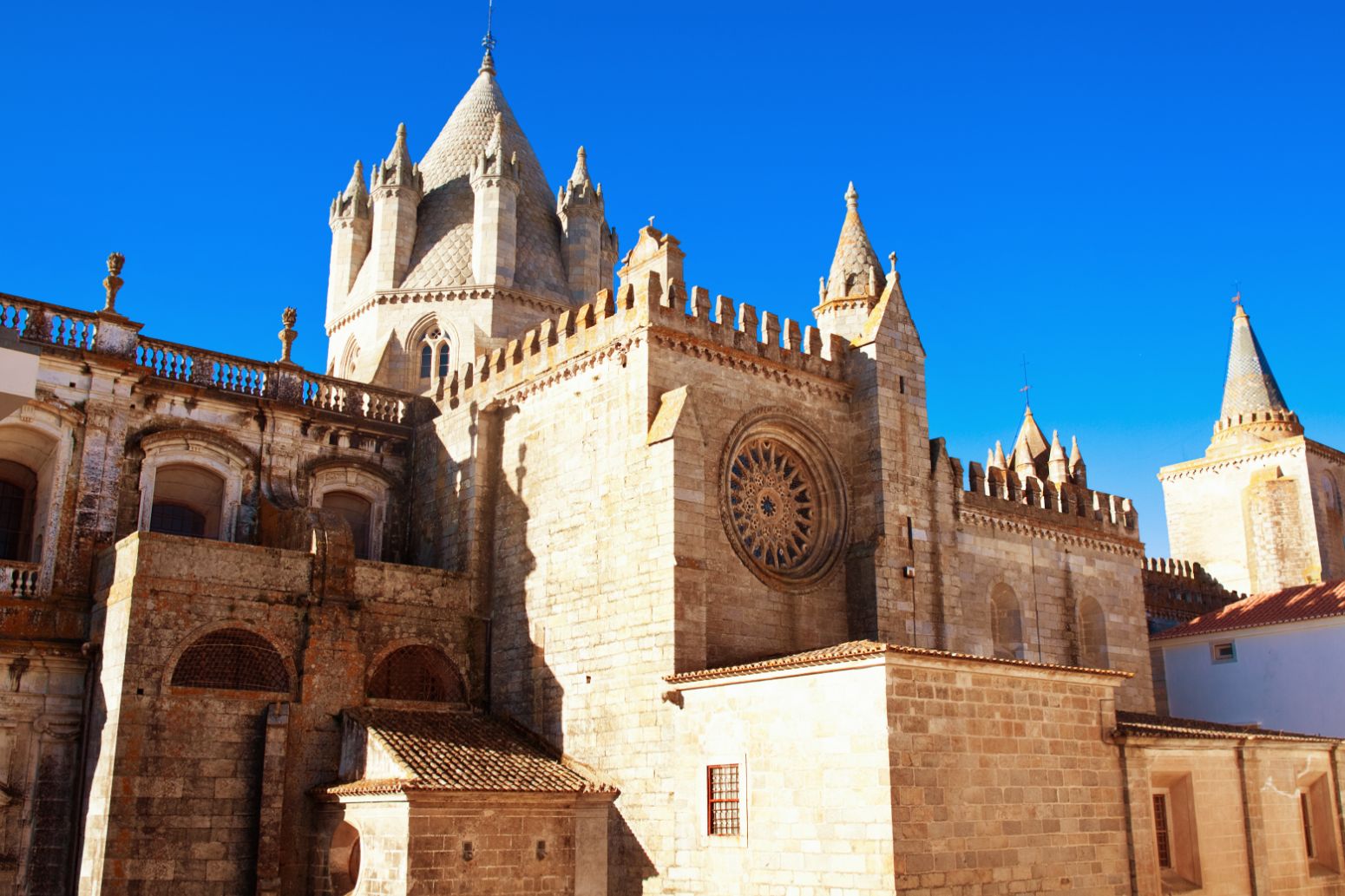
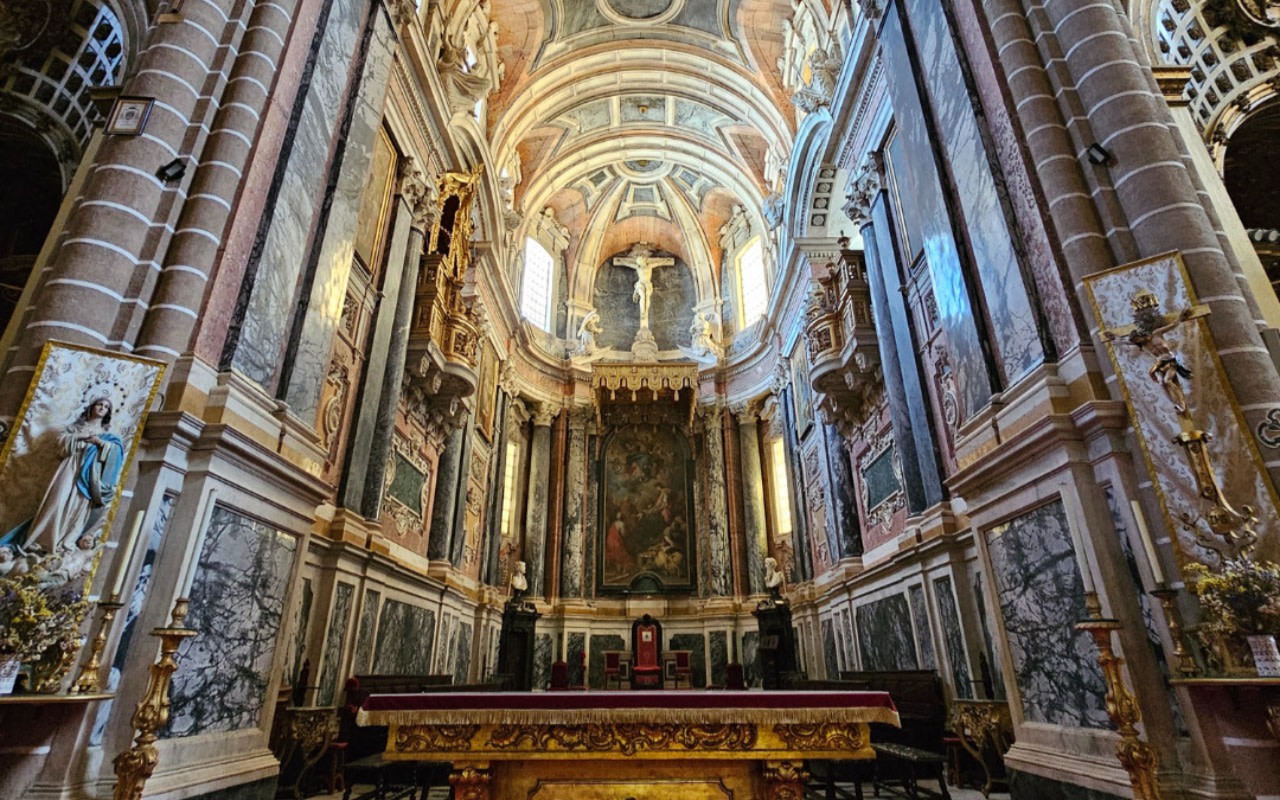
But let's go to the cathedral. To get there, you only have to go up Rua 5 de Outubro, one of the best to buy Alentejo handicrafts. The Cathedral of Évora, whose construction started in 1186 and consecrated in 1204, was completed only in 1250. It is a fascinating and imposing monument. All in granite, it is marked by the transition from the Romanesque style to the Gothic style.
Two towers from the medieval period can be seen on each side of the façade of the Cathedral of Évora. The tower on the south side is the bell tower, the one whose bells ring in city time. On each side of its portal there are spectacular sculptures of 14th century Apostles, by Mestre Pêro.
Outside the Évora Cathedral, however, the dome is the most spectacular architectural element. The lantern tower of the cruise of the ships, from the reign of D. Dinis, crowned by a stone scales needle is in fact the ex-libris of this monument.
10
Diana's Garden in Évora is located right in the heart of the city's cultural center. Extending from a square called Largo do Conde de Villa Flor, and in perfect harmony with the Roman Temple, Diana's Garden is the ideal place to end, or begin, a sightseeing tour of this beautiful city of Évora.
What's not included
Lunch
Tickets for Museums
Available languages
Audio guide
RU
PT
UK
EN
ES
Guide guide
RU
PT
UK
EN
ES
Written guide
RU
PT
UK
EN
ES
Reviews breakdown
Viator
4.7
53 reviews
5★
45
4★
5
3★
1
2★
1
1★
1
Tripadvisor
5.0
71 reviews
5★
70
4★
1
3★
0
2★
0
1★
0
Important information
Public transportation options are available nearby
Suitable for all physical fitness levels
About Lisbon
Lisbon, the capital of Portugal, is a vibrant city known for its rich history, stunning architecture, and warm climate. With its charming streets, historic trams, and breathtaking viewpoints, Lisbon offers a unique blend of old-world charm and modern energy.
Top Attractions
Belém Tower
A UNESCO World Heritage Site, this 16th-century tower is an iconic symbol of Lisbon's Age of Discoveries.
Historical
1-2 hours
€6
Alfama District
Lisbon's oldest district, known for its narrow, winding streets, Fado music, and historic charm.
Historical
Half day
Free to explore, attractions may have entry fees
Sintra
A UNESCO World Heritage Site, Sintra is a romantic town with stunning palaces and castles.
Historical
Full day
Varies by attraction, around €10-€15 per site
Must-Try Local Dishes
Bacalhau à Brás
Shredded codfish with eggs, potatoes, and onions
Main Dish
Contains fish and eggs
Pastel de Nata
Custard tart with a flaky pastry crust
Dessert
Contains dairy and eggs
Francesinha
A sandwich with meat, cheese, and a beer-based sauce
Main Dish
Contains meat, cheese, and gluten
Popular Activities
Hiking in Sintra
Surfing in Ericeira
Parasailing in Cascais
Beach lounging in Costa da Caparica
Spa day in a luxury hotel
Picnic in Jardim da Estrela
Visiting museums and galleries
Attending Fado performances
Best Time to Visit
March to May, September to October
These months offer pleasant weather and fewer crowds, making it ideal for sightseeing and outdoor activities.
15-25°C
59-77°F
Practical Information
Language
- Official: Portuguese
- Widely spoken: English, Spanish, French
- English: Moderately spoken
Currency
Euro (EUR)
Time Zone
GMT+1 (Western European Time, WET)
Electricity
230VV, 50HzHz
Safety Information
Overall Safety Rating: Generally safe
Lisbon is generally safe, but pickpocketing and petty theft can occur in crowded areas.
Important Precautions:
- • Be cautious of pickpockets in crowded areas
- • Use licensed taxis or ride-sharing apps
- • Avoid walking alone at night in less crowded areas
Getting there
By air
- Humberto Delgado Airport • 7 km from city center
By train
Santa Apolónia, Oriente
By bus
Sete Rios, Jardim do Campo Grande, Gare do Oriente
Getting around
Public transport
Efficient and clean, with four lines connecting major attractions.
Taxis
Available • Apps: Bolt, FreeNow
Rentals
Car, Bike, Scooter
Neighborhoods
Alfama
Baixa
Bairro Alto
Day trips
Sintra
25 km from Lisbon • Full day
A romantic town with stunning palaces, castles, and lush gardens.
Cascais
30 km from Lisbon • Half day to full day
A charming coastal town with beautiful beaches, historic sites, and a relaxed atmosphere.
Óbidos
80 km from Lisbon • Full day
A medieval town with a well-preserved castle, narrow streets, and charming shops.
Festivals
Santos Populares • June 13th
Festival dos Oceanos • June to September
Arraial do Alfoz • June to September
Pro tips
- Visit the Time Out Market for a variety of local and international cuisines
- Take a day trip to Sintra and Cascais for a mix of history and beach relaxation
- Explore the LX Factory for a unique shopping and dining experience
- Ride the historic Tram 28 for a scenic tour of the city
- Visit the MAAT museum for a blend of art, architecture, and technology
From $25
per person
Price varies by option
Secure booking
Free cancellation available
Instant confirmation