Anuradhapura: 14 Ancient City Sites Tuk Tuk Tour
Active
4h - 6h
For a full refund, cancel at least 24 hours before the scheduled departure time.
Instant confirmation
Mobile or paper ticket accepted
About this experience
Explore Anuradhapura Ancient City like never before with an Audio Guide App in your personal tuk-tuk. Say goodbye to passive sightseeing and embrace the thrill of navigating historic streets and iconic landmarks at your pace. Picture cruising past towering monuments from the comfort of your tuk-tuk, with the freedom to choose your picked-up time and point of meet.
Forget the inconvenience of searching for taxis or negotiating with street tuk-tuks – we prioritise your convenience and safety. Our reliable tuk-tuk service strictly adheres to Covid-19 guidelines, ensuring a worry-free tour.
Experience Anuradhapura's charm through audio-guided tuk-tuk tour that blend history with modern comfort. Join our satisfied clientele who keep returning for more. Book your unforgettable tuk-tuk adventure today!
Available options
Morning Tuk Tuk Ride
Duration: 5 hours: Spend a delightful morning exploring Ancient City sights with morning sunshine, which help to avoid heat of the daytime.<br/>Tuk Tuk: Maximum 3 passengers allowed for single Tuk Tuk (3 Wheeler). This tour does not include entry or admission fees.<br/>Audio Guide app for 14+ sites<br/>Pickup included
Afternoon Tuk Tuk Ride
Duration: 4 hours<br/>Tuk Tuk: Maximum 3 passengers allowed for single Tuk Tuk (3 Wheeler). This tour does not include entry or admission fees.<br/>Audio Guide app for 14+ sites<br/>Pickup included
What's included
Bottled water
Digital Audio guide for all sites
Parking Fees
Detailed itinerary
1
Isurumuniya is a Buddhist temple situated near to the Tissa Wewa in Anuradhapura, Sri Lanka. There are four carvings of special interest in this Vihara. They are the Isurumuniya Lovers, Elephant Pond and The Royal Family.
2
Ranmasu Uyana is a park in Sri Lanka containing the ancient Magul Uyana. It is situated close to Isurumuni Vihara and Tissawewa in the ancient sacred city of Anuradhapura, Sri Lanka. It sits on approximately 40 acres, and is a noted example of Sri Lankan garden architecture of the pre-Christian era
3
The Mirisaweti Stupa is situated in the ancient city of Anuradhapura, Sri Lanka. King Dutugamunu built the Mirisaveti Stupa after defeating King Elara. After placing the Buddha relics in the sceptre, he had gone to Tissa Wewa for a bath leaving the sceptre.
4
The oldest tree known to have been planted by a human rather than by natural seeding is a 2,300-year-old sacred fig or bo-tree (Ficus religiosa) that has been named Sri Maha Bodhiya, and stands in Anuradhapura, Sri Lanka. It was planted there in 288 BC.
5
Stop 5
The Ruwanwelisaya is a stupa, a hemispherical structure containing relics, in Sri Lanka, considered sacred to many Buddhists all over the world. It was built by King Dutugemunu c. 140 B.C., who became lord of all Sri Lanka after a war in which the Chola King Ellalan, was defeated.
6
Thuparamaya dagoba has been built in the shape of a bell. This dagoba was destroyed from time to time. During the reign of King Agbo II it was completely destroyed and the King restored it. What is seen presently is the construction of the dagoba, done in 1842 AD
7
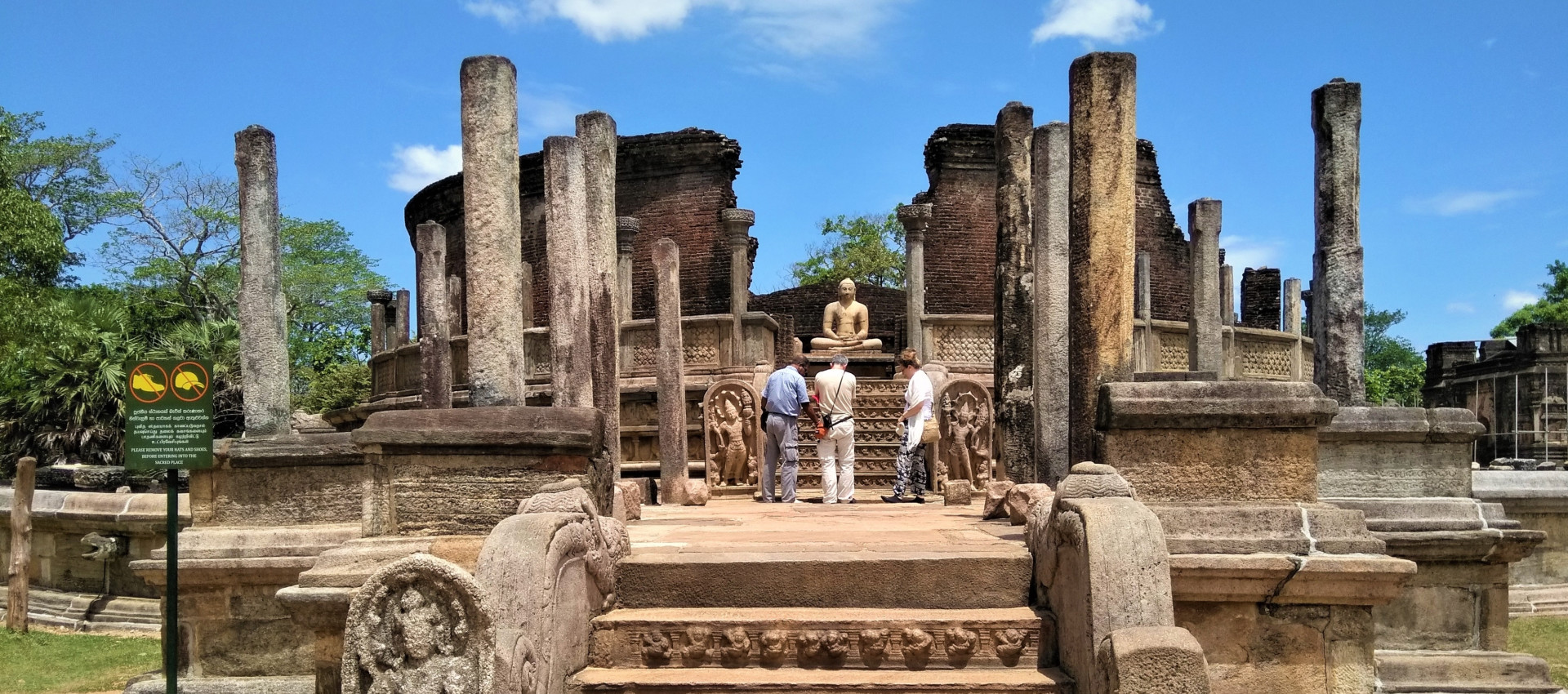
Lankarama is a stupa built by King Valagamba, in an ancient place at Galhebakada in the ancient kingdom of Anuradhapura, Sri Lanka. Nothing is known about the ancient form of the stupa, and later this was renovated. The ruins show that there are rows of stone pillars and it is no doubt that there has been a house built encircling the stupa (vatadage) to cover it.
8
The carvings of the semi circular stone slab were the same in every sandakada pahana (Moonstone). A half lotus was carved in the centre, which was enclosed by several concentric bands. The first band from the half lotus is decorated with a procession of swans, followed by a band with an intricate foliage design known as liyavel. The third band has carvings of four animals; elephants, lions, horses, and bulls. These four animals follow each other in a procession symbolizing the four stages in life: growth, energy, power and forbearance. The fourth and outermost band contains a carving of flames, usually interpreted as representing a fire altar. Sandakada pahana, also known as Moon-stone, is a unique feature of the Sinhalese architecture of ancient Sri Lanka.
9
In the beginning, the Guardstones that supported the heavy stone balustrade were unadorned. Over time, they began to be carved with symbols representing prosperity and protection.
10
Abhayagiriya Main Alms-Hall or The Main Refectory of Abhayagiriya is a ruined building located in the ancient monastery premises of Abhayagiriya in Anuradhapura, Sri Lanka. It was the place where the daily alms were provided for the monks who lived in the monastery.
Located close to the Uttara Mula this is considered the main refectory of the Abhayagiri Monastery. This is a square building with 42.7m on one side. Four stages of construction from early as 1st century BC have been found during the excavation of the site.
Danasalas were mostly built in the form of a rectangular structure. It consists of a single storied pillared building with a sunken central courtyard, three or more entrances, stone rice troughs and kitchen appurtenances, a drainage system leading the water out of the courtyard and in some examples, an attached scullery. The stone rice trough placed in a corner of the building can be identified as the most notable feature of Danasalas.
11
Historically it was a great monastic centre as well as a royal capital, with magnificent monasteries rising to many stories, roofed with gilt bronze or tiles of burnt clay glazed in brilliant colors. To the north of the city, encircled by great walls and containing elaborate bathing ponds, carved balustrades and moonstones, stood "Abhayagiri", one of seventeen such religious units in Anuradhapura and the largest of its five major viharas. One of the focal points of the complex is an ancient stupa, the Abhayagiri Dagaba. Surrounding the humped dagaba, Abhayagiri Vihara was a seat of the Northern Monastery, or Uttara Vihara and the original custodian of the Tooth relic in the island
12
The Samadhi Statue is a statue situated at Mahamevnāwa Park in Anuradhapura, Sri Lanka. The Buddha is depicted in the position of the Dhyana Mudra, the posture of meditation associated with his first Enlightenment. Whether the Buddha's Enlightenment was the experience technically called samadhi, or some other phenomenon, may depend upon the philosophical allegiance of the believer. In the Dhyana Mudra the Buddha sits cross-legged with his upturned palms placed one over the other on his lap. This position is universally known throughout the Buddhist world, and this statue is therefore one of the most typical pieces of Buddhist sculpture. It is not to be confused with the very similar "Earth-Touching Mudra," which depicts the simple action the Buddha took to fend off the illusions projected by Mara, who was desperate to prevent the Buddha from realizing that his, Mara's, projections, and with them the entire world, are an illusion. This statue is 8 feet in height and carved from granite.
13
One of the best specimen of bathing tanks or pools in ancient Sri Lanka is the pair of pools known as Kuttam Pokuna (Twin Ponds/Pools). The said pair of pools were built by the Sinhalese in the ancient kingdom of Anuradhapura. These are considered one of the significant achievements in the field of hydrological engineering and outstanding architectural and artistic creations of the ancient Sinhalese.
14
The Jetavanaramaya is a stupa, or Buddhist reliquary monument, located in the ruins of Jetavana monastery in the world heritage city of Anuradhapura, Sri Lanka. At 122 metres (400 ft) it was the world's tallest stupa and the third tallest structure in the world when it was built by King Mahasena of Anuradhapura (273–301).
What's not included
Entry Tickets for all (8) UNISCO World Heritage sites
Available languages
Audio guide
EN
Written guide
EN
Reviews breakdown
Viator
5.0
1 reviews
5★
1
4★
0
3★
0
2★
0
1★
0
Tripadvisor
5.0
7 reviews
5★
7
4★
0
3★
0
2★
0
1★
0
Important information
Infants and small children can ride in a pram or stroller
Service animals allowed
Public transportation options are available nearby
Infants are required to sit on an adult’s lap
Not recommended for travelers with spinal injuries
Not recommended for pregnant travelers
Not recommended for travelers with poor cardiovascular health
Suitable for all physical fitness levels
Explore 14+ Sites with our Audio Guide App
About Anuradhapura
Anuradhapura is a major city in Sri Lanka, famous for its well-preserved ruins of an ancient Sri Lankan civilization. It is one of the oldest continuously inhabited cities in the world and a UNESCO World Heritage Site. The city is a pilgrimage site for Buddhists and offers a rich cultural and historical experience.
Top Attractions
Sacred City of Anuradhapura
A UNESCO World Heritage Site, the Sacred City of Anuradhapura is home to ancient stupas, temples, and ruins that date back over 2,000 years.
Historical
Full day
Free
Ruwanwelisaya Dagoba
One of the tallest stupas in the world, this iconic structure is a significant pilgrimage site for Buddhists.
Religious
1-2 hours
Free
Sri Maha Bodhi
A sacred fig tree that is said to have been propagated from the original Bodhi tree under which Buddha attained enlightenment.
Religious
30 minutes to 1 hour
Free
Jethawanaramaya Dagoba
The tallest stupa in Anuradhapura, known for its impressive size and historical significance.
Historical
1 hour
Free
Isurumuniya Temple
A beautiful temple known for its rock carvings and serene atmosphere.
Religious
1-2 hours
Free
Must-Try Local Dishes
Kottu Roti
A popular Sri Lankan dish made with chopped roti, vegetables, and meat or seafood, cooked on a hot plate.
Dinner
Can be made vegetarian or vegan.
Hoppers
Bowl-shaped pancakes made from fermented rice flour and coconut milk, often served with eggs or sambal.
Breakfast
Vegetarian.
Rice and Curry
A staple Sri Lankan meal consisting of steamed rice served with a variety of curries.
Lunch/Dinner
Can be made vegetarian or vegan.
Lamprais
A Dutch-influenced dish consisting of rice, meat, and vegetables cooked in banana leaves.
Lunch/Dinner
Contains meat.
Popular Activities
Hiking in Mihintale
Exploring Ritigala Forest Monastery
Tea tasting
Visiting temples
Exploring ancient ruins
Attending religious ceremonies
Witnessing the Esala Perahera festival
Best Time to Visit
January to March
This is the best time to visit Anuradhapura as the weather is pleasant and dry, making it ideal for exploring the ancient ruins and enjoying outdoor activities.
28-32°C
82-90°F
Practical Information
Language
- Official: Sinhala, Tamil
- Widely spoken: English
- English: Moderately spoken
Currency
Sri Lankan Rupee (LKR)
Time Zone
UTC+5:30
Electricity
230VV, 50HzHz
Safety Information
Overall Safety Rating: Generally safe
Anuradhapura is generally safe for travelers, but standard precautions should be taken to avoid petty theft and scams.
Important Precautions:
- • Keep valuables secure.
- • Use reputable tour operators.
- • Be cautious of strangers offering unsolicited help.
Getting there
By air
- Colombo Bandaranaike International Airport • 200 km
By train
Anuradhapura Railway Station
By bus
Anuradhapura Bus Stand
Getting around
Public transport
Buses are the most common form of public transport and cover most areas of the city.
Taxis
Available • Apps: PickMe, Uber
Rentals
Car, Bike, Scooter
Neighborhoods
Sacred City
New Town
Tuktukaraya
Day trips
Mihintale
12 km • Half day
A sacred mountain site where Buddhism was first introduced to Sri Lanka, featuring ancient ruins and temples.
Ritigala Forest Monastery
30 km • Full day
A UNESCO-listed forest monastery with ancient ruins and a rich biodiversity.
Avukana Buddha Statue
50 km • Full day
A colossal Buddha statue carved out of a single rock, standing 40 feet tall.
Festivals
Esala Perahera • July/August (full moon day)
Poson Festival • June (full moon day)
Vesak Festival • April/May (full moon day)
Pro tips
- Visit the Sacred City early in the morning to avoid the heat and crowds.
- Hire a local guide for a more in-depth understanding of the historical sites.
- Try local street food for an authentic culinary experience.
- Respect the religious customs and traditions when visiting temples.
- Carry a water bottle and sunscreen to stay hydrated and protected from the sun.
From $25
per person
Price varies by option
Secure booking
Free cancellation available
Instant confirmation


![Minneriya National Park Safari [Morning / Evening]](https://media-cdn.tripadvisor.com/media/attractions-splice-spp-674x446/15/1f/89/35.jpg)