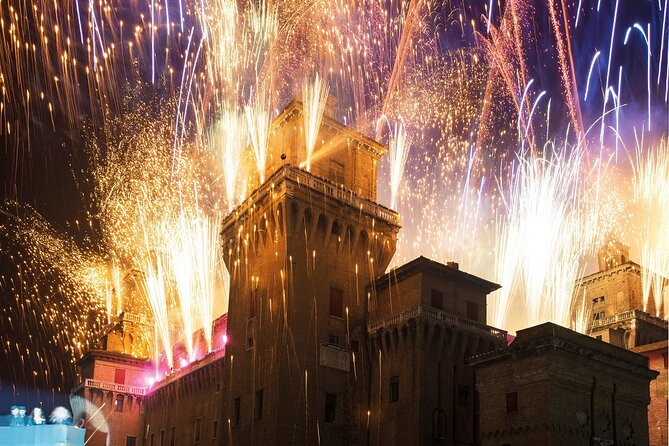


Discover Ferrara, City of the Renaissance
Active
2h
For a full refund, cancel at least 24 hours before the scheduled departure time.
Instant confirmation
Mobile or paper ticket accepted
About this experience
Explore Ferrara on this private walking tour and discover its must-see attractions
Guided walking tour led by a licensed private tour guide
Discover this hidden Italian gem and the reason why Ferrara is called the first modern city in Europe
Ferrara has retained its urban fabric virtually intact, discover how houses and town plannings were built and planned in rennaisance and medieval time.
Customize your tour to suit your own interests
Available options
Discover Ferrara, City of the Renaissance
What's included
Private tour
Professional guide
Detailed itinerary
1
Stop 1
Complete with moat Ferrara's towering castle was commissioned by the Este family in 1385. Initially it was intended to protect the Este family from the town's irate citizenry, who were up in arms over tax increases, but in the late 15th century it became the family's permanent residence. Linked to the castle by an elevated passageway, the 13th-century Palazzo Municipale was the Este family home until they moved next door to the castle.The visit of the castle interior is not included in this tour
2
Throughout the Middle Ages and almost to the end of the 15th Century, the northern boundary of the city ran along the current road System of Viale Cavour-Corso Giovecca. In 1492 Ercole I commissioned to include this vast area in the centre (thus doubling the surface area of the city) and the great architect and town-planner, Biagio Rossetti, designed a plan which, due to its original and rational nature, made Ferrara the first modern city in Europe.
In honour of the Duke who ordered the new town planning this great district is known as Addizione Erculea.
3
Between the castle and the town hall is Piazza Savonarola, dominated by the monument to Girolamo Savonarola, the famous reformer born in Ferrara in 1452 at the origin of the theocratic dictatorship of Florence (1494-1498). It was also he who had the idea of the pyre of vanities in which books and important works of art disappeared. He is represented here with his arms raised in the midst of preaching. The square is bordered to the west by Via Coperta, a five-arch building that connected the two Este family residences (the castle and the town hall)
4
The Piazza Cattedrale lies between today's town hall, former Este's residence, and the St. George cathedral. From the square you can have a beautiful view of the cathedral facade and its reliefs, a sort of poor man's bible
5
This Cathedral in the Romanesque-Gothic Lombard style has a beautiful tripartite façade endowed with a magnificent canopy (over the door), decorated with a depiction of the Last judgement.
6
Piazza del Municipio can be accessed directly from the cathedral square, passing through an imposing arch.
The wide square, one of the former inner courtyards of the Este's ducal palace, is characterized by a staircase completely covered with white marble, finished in 1481.
7
The piazza Trento Trieste is the beating heart of the city. It dates back to the Middle Ages and the building of the new cathedral around which the seats of religious, civil and lordly power, in the shape of the family who in fact ruled Ferrara, were concentrated. Indeed, all the city's seats of power were sited in the piazza: as well as the cathedral, there was the bishops' house where the present Bishops Palace stands; the Palazzo della Ragione, the Notary's Lodge, the first nucleus of the Palazzo Ducale, today's Palazzo Municipale. Along the south side of the Cathedral runs the loggia dei Merciai. Also looking on to the piazza is the ex-church of San Romano, now home to a museum.
8
This commercial thoroughfare, the medieval town's main street, which once connected the market square (piazza Trento e Trieste) with the port of Ferrara (now replaced by the Via Ripagrande) is bordered by porched medieval houses.
9
This charming medieval street marks the axis along which the so-called linear Ferrara developed between the 7th and 9th centuries A.D. and which greatly influenced the further development of the entire city. In Via delle Volte the architectural solution to development in a third dimension was to create overhead passageways: the vaults dotted along the street, to connect the warehouses on the banks of the river to the workshops-houses towards the centre. Here you can enjoy the atmosphere of its 14th and 15th-century buildings and the alleys that lead off it
10
There is hidden soul to Ferrara, its Jewish one, an important part of the city's community. Through the streets of the Ghetto. The area involved in the former Ghetto, institued in the17th Century, is constituted by today's Via Mazzini, Via Vittoria and Via Vignatagliata and Piazzetta Lampronti where, in the courtyards, the secret passageways, and on the evocative balconies, you can breathe in the intense life of the Ghetto
What's not included
Transportation to/from attractions
Available languages
Guide guide
DE
EN
IT
ES
Reviews breakdown
Viator
5.0
4 reviews
5★
4
4★
0
3★
0
2★
0
1★
0
Tripadvisor
4.9
7 reviews
5★
6
4★
1
3★
0
2★
0
1★
0
Important information
Wheelchair accessible
Infants and small children can ride in a pram or stroller
Public transportation options are available nearby
All areas and surfaces are wheelchair accessible
Suitable for all physical fitness levels
A dress code is required to enter places of worship. You may risk refused entry if you fail to comply with these dress requirements
May be operated by a multi-lingual guide
Operates in all weather conditions, please dress appropriately
Meeting point
Tour departs from Largo Castello. The guide will wait for you outside the castle, close to the side entrance over the moat.
Important notes
• Comfortable walking shoes are recommended
About Ferrara
Ferrara, a UNESCO World Heritage Site, is renowned for its well-preserved Renaissance architecture and rich cultural heritage. The city is famous for its medieval and Renaissance-era walls, castles, and palaces, making it a haven for history and architecture enthusiasts. Its unique urban layout and historic center provide a glimpse into the past, while its vibrant atmosphere and cycling culture offer a modern twist.
Top Attractions
Castello Estense
The Castello Estense is a medieval castle that served as the residence of the Este family, who ruled Ferrara for over three centuries. The castle is a prominent landmark and offers a fascinating glimpse into the city's history.
Historical/Architecture
1 to 2 hours
€7 (includes audio guide)
Ferrara Cathedral (Cattedrale di San Giorgio)
The Ferrara Cathedral is a stunning example of Romanesque and Renaissance architecture. Dedicated to Saint George, the cathedral is a significant religious and cultural landmark in the city.
Religious/Architecture
30 minutes to 1 hour
Free (donations appreciated)
Palazzo dei Diamanti
Palazzo dei Diamanti is a remarkable Renaissance palace known for its distinctive diamond-shaped facade. The palace houses the National Art Gallery of Ferrara and hosts various exhibitions and cultural events.
Architecture/Museum
1 to 2 hours
€8 (includes access to the National Art Gallery)
Parco Massari
Parco Massari is a beautiful public park located just outside the historic center of Ferrara. The park is a popular spot for locals and visitors to relax, walk, and enjoy nature.
Nature
30 minutes to 1 hour
Free
Museo Archeologico Nazionale di Ferrara
The National Archaeological Museum of Ferrara showcases a rich collection of artifacts from the ancient Etruscan, Roman, and medieval periods. The museum offers a fascinating journey through the city's ancient history.
Museum
1 to 2 hours
€6
Must-Try Local Dishes
Pasta e Piselli (Pasta with Peas)
A traditional Emilian dish made with pasta, peas, pancetta, and Parmigiano Reggiano cheese. It's a comforting and flavorful dish that showcases the region's love for simple, high-quality ingredients.
Main dish
Contains meat and dairy
Salama da Sugo
A traditional Ferrara sausage made with ground pork, fat, and spices, then cooked in a sweet and sour sauce. It's a unique and flavorful delicacy that's often served as an antipasto.
Cold cut
Contains pork
Cappellacci di Zucca
A traditional Ferrara pasta dish made with pumpkin-filled pasta shells, served with a sage and butter sauce. It's a delicious and hearty dish that's a must-try for pasta lovers.
Main dish
Contains dairy and eggs
Gnocco Fritto
A traditional Emilian fried bread, similar to a doughnut, that's often served as an accompaniment to cured meats and cheeses. It's a crispy and delicious treat that's perfect for snacking.
Bread
Contains gluten and dairy
Popular Activities
Hiking and biking in Parco del Delta del Po
Boat tours of the Po Delta region
Cycling around the city's historic center
Picnicking in Parco Massari
Enjoying a coffee or gelato at a local café
Strolling through the historic center and admiring the architecture
Visiting museums and galleries
Attending local festivals and events
Best Time to Visit
April to June, September to October
Spring and autumn offer pleasant weather, ideal for exploring the city's historic sites and enjoying outdoor activities. The city is vibrant with cultural events and festivals during these periods.
15°C to 30°C
59°F to 86°F
Practical Information
Language
- Official: Italian
- Widely spoken: English, French, German
- English: Moderately spoken
Currency
Euro (EUR)
Time Zone
CET (GMT+1), CEST (GMT+2) during daylight saving time
Electricity
230VV, 50HzHz
Safety Information
Overall Safety Rating: Generally safe
Ferrara is generally a safe city to visit, with low levels of violent crime and a welcoming atmosphere. However, as with any destination, it's important to be aware of your surroundings and take precautions to protect yourself and your belongings. Petty crime, such as pickpocketing and bag snatching, can occur in crowded areas and tourist hotspots, so it's important to keep your valuables secure and be vigilant.
Important Precautions:
- • Keep your valuables secure and be vigilant in crowded areas and tourist hotspots
- • Use licensed taxis or ride-sharing services, and insist on using the meter or agreeing on a fare before starting your journey
- • Be cautious when using ATMs or payment terminals, and cover the keypad when entering your PIN
Getting there
By air
- Bologna Guglielmo Marconi Airport • 50 km (31 miles)
By train
Ferrara Station
By bus
Ferrara Bus Station
Getting around
Public transport
The public bus system in Ferrara is operated by TPER and covers most of the city. Buses are a convenient and affordable way to get around, with frequent services and stops near major attractions.
Taxis
Available • Apps: MyTaxi, FreeNow
Rentals
Car, Bike, Scooter
Neighborhoods
Centro Storico (Historic Center)
Quadrante Nord (Northern District)
Quadrante Est (Eastern District)
Day trips
Bologna
50 km (31 miles) • Full day
Bologna is a vibrant and historic city known for its medieval architecture, rich culinary traditions, and prestigious university. It's a great destination for those interested in history, art, and food.
Comacchio
50 km (31 miles) • Half day
Comacchio is a charming coastal town located in the Po Delta Regional Park. The town is known for its picturesque canals, historic buildings, and rich fishing heritage. It's a great destination for those interested in nature, history, and local culture.
Ravenna
60 km (37 miles) • Full day
Ravenna is a historic city known for its stunning mosaics, ancient churches, and rich cultural heritage. It's a great destination for those interested in art, history, and architecture.
Festivals
Ferrara Ball • May
Ferrara Buskers Festival • September
Ferrara Palio • May and September
Pro tips
- Explore the city on two wheels, as Ferrara is known for its cycling culture and has a variety of bike rentals and bike-sharing options
- Try the local specialties, such as Salama da Sugo, Cappellacci di Zucca, and Torta di Rose, at traditional osterias and pastry shops
- Visit the historic center on a Sunday morning, when the streets are less crowded and the atmosphere is more relaxed
- Take a day trip to nearby destinations, such as Bologna, Comacchio, or Ravenna, to explore the region's rich history and culture
- Attend a local festival or event, such as the Ferrara Ball, Ferrara Buskers Festival, or Ferrara Palio, to experience the city's vibrant arts and culture scene
From $25
per person
Price varies by option
Secure booking
Free cancellation available
Instant confirmation