Best of Braga and Guimaraes Day Trip from Porto
Active
9h
For a full refund, cancel at least 24 hours before the scheduled departure time.
Instant confirmation
Mobile or paper ticket accepted
About this experience
The Minho region is an old Portuguese province and its located in the North of Portugal. Minho is known for its green landscapes, crossed by affluent rivers, and the biodiversity enriches the views for those who visit Minho. The region presents a big coastal zone with beautiful beaches.
The full-day Tour to Minho gives you the opportunity to visit the region and two cities: Guimaraes and Braga. Travel through the Minho and visit the historical centers of these two cities learning about Portuguese history in the process.
Available options
French Departure
Without lunch: Lunch is not included, but you will have free time for lunch on your own.
Portuguese Departure
Without lunch: Lunch is not included, but you will have free time for lunch on your own.
Spanish Departure
Without lunch: Lunch is not included, but you will have free time for lunch on your own.
English Departure
Without lunch: Lunch is not included, but you will have free time for lunch on your own.
What's included
Admission Ticket at Guimarães Castle
Porto City Walking Tour (available from the day after your experience)
Admission ticket at Braga's Cathedral
Confortable transportation on a Minibus with A/C
Professional Guide
Detailed itinerary
1
Stop 1
Pass by
You will meet you guide at our Meeting Point near S. Bento Train Station and he will drive you to Braga, our first stop.
On your way to the Minho Region, your guide will give you insights regarding the Portuguese history, development and cultural facts of portuguese heritage.
2
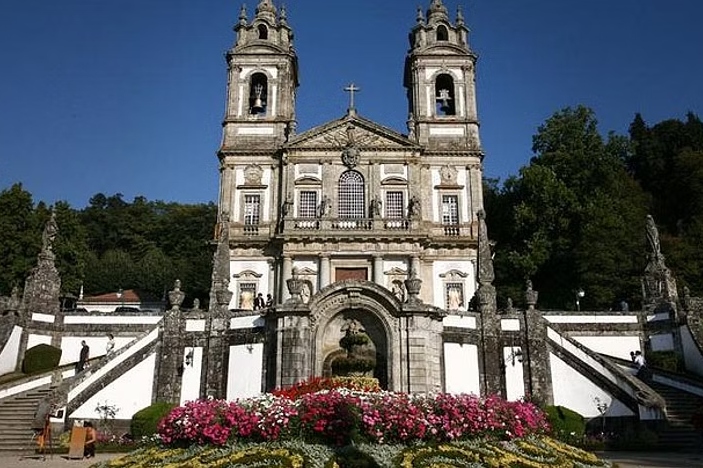
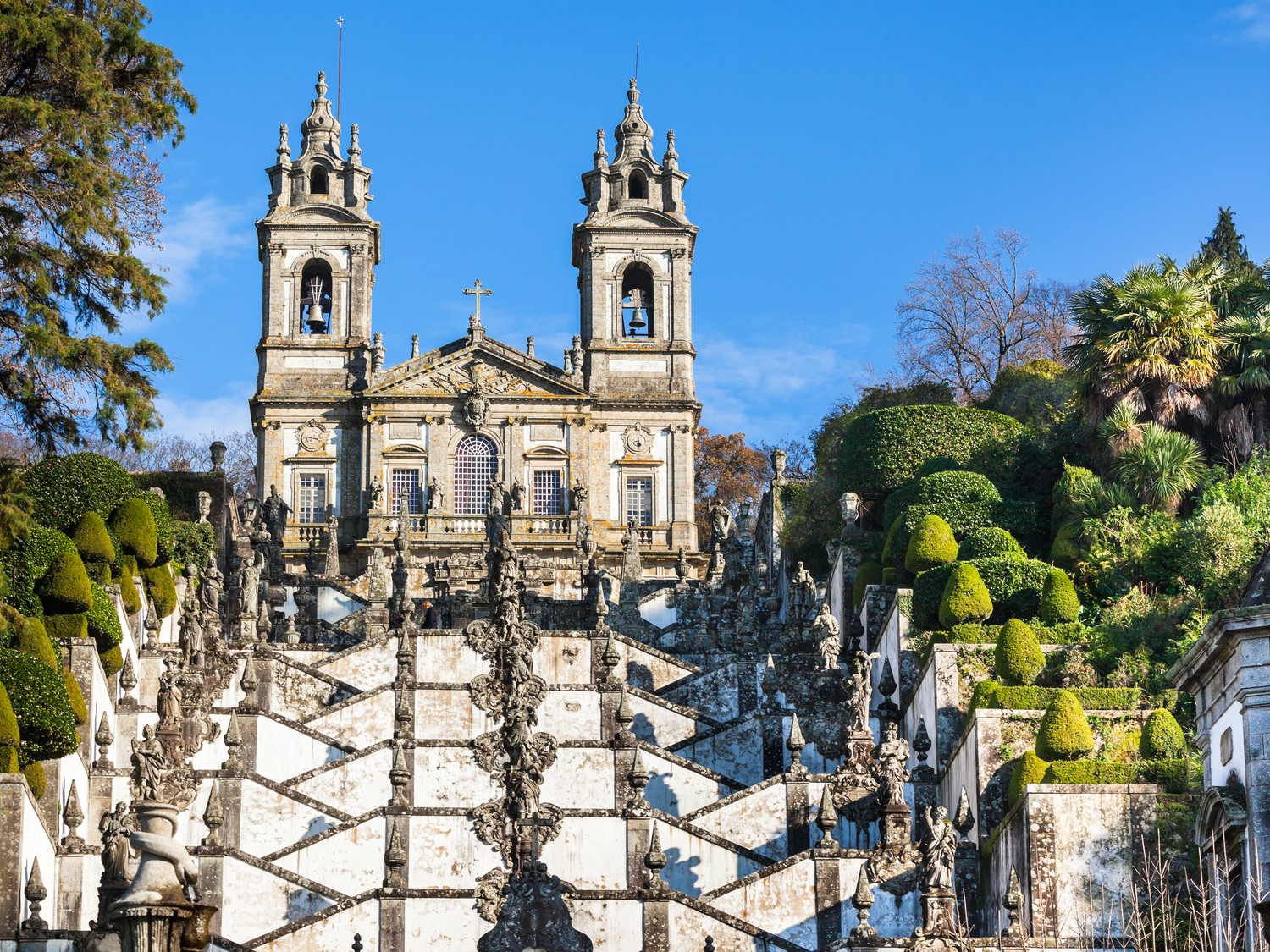
Famous for religious reasons but also for its architecture, the famous staircase and being the cause of the vertical tram, an amazing piece of 19th century engineering. This was the first of its kind to be installed in Portugal in 1882 and still uses its water powered system to power the 300 meter ramp in just 3min.
The church was built by Carlos Amarante, who gave it an Italian-inspired neo-classical design that harmoniously blends into the landscape of northern Portugal.
The staircase leading to the top contains 17 landings adorned with symbolic fountains, allegorical statues, and Baroque-style decorations along themes: Stations of the Cross, Five Senses, the Virtues, Moses receiving the Commandments and at the top, the eight biblical figures that contributed to Jesus' condemnation. Any visitor must take in the view from the bottom of the staircase. Facing up are the ornate granite fountains on the various landings and the white chalice-like outline on which the church itself "sits".
3
Stop 3
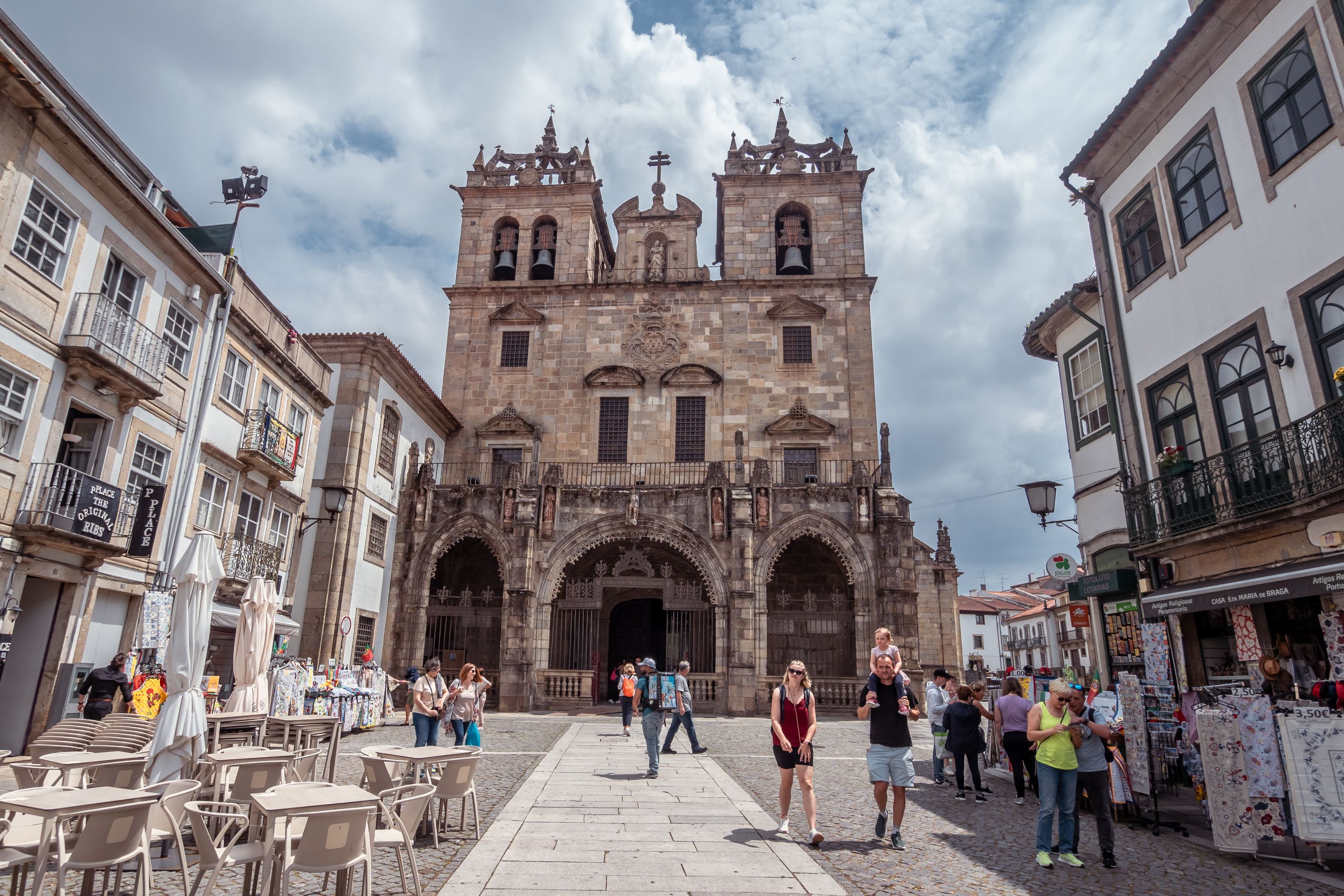
The first cathedral, older than Portugal.
The Cathedral of Braga was the first Portuguese cathedral, erected several decades before the founding of the country. It began to be built at the end of the 11th century, and was concecrated and dedicated to the Virgin Mary by Bishop Pedro in a solemn session on August 28, 1089. Competing in power with the Cathedral of Santiago de Compostela and is the jewel of the city. D. Henrique and D. Teresa, parents of the first king of Portugal, are buried in the Chapel of Kings.
4
It's now time for a break.
Enjoy some free time to explore Braga at your own pace or grab a bite to eat. Discover the city's charming streets, shops, and local attractions.
5
Afterwards, we will go on a short drive to Guimarães:
Is considered the birthplace of Portugal because Afonso Henriques, who went on to be the first king of Portugal, was born here.
6
Stop 6
The castle´s presence evokes the exciting mixture of legend, poetry and heroism that surrounds the beginning of Portuguese history. On this Monte Largo (Broad Hill), the nucleus of the future nation of Portugal was first developed.
In circa 968, Mumadona, the countess of Galicia, ordered a castle to be built on this site, where the population could seek refuge from the constant attacks unleashed upon them by the hordes of Vikings, who arrived by sea from the north of Europe, and the Muslims, who made raids from the territories that they occupied to the south.
On taking over the governorship of the province known as Portucalense from his father-in-law, Alfonso VI of León, Count Henry ordered another larger and more solid construction to be built. This represented the beginning of the important defensive structure that we can now see today, dominated by the square keep that stands between the four towers guarding each of the four corners of the walls.
Although this is not strictly documented, it is very likely that the building that stands against the inner part of the northern wall was the residence of Count Henry and the birthplace of his son Afonso Henriques, the first king of Portugal.
7
The small church of S. Miguel do Castelo was built in the 13th century. However, according to tradition, this church would have been built in the 12th century by Count Dom Henrique (Henry of Burgundy), where he would have baptised his son, the 1st King of Portugal Dom Afonso Henriques.
Of Romanic style and reduced dimensions, this church reveals great simplicity in terms of decoration. Inside, under the floor of this church lie buried the great warriors of the nation’s founding period.
8
Stop 8
The historical centre in the area that was within the Guimarães city walls, is associated with the formation and identity of Portugal, and was classified a World Heritage site based on the originality and authenticity applied in its restoration. The city still has a harmonious, well-preserved heritage that is evident in the graceful iron verandas, granite balconies and porticos, mansions, arches connecting the narrow streets, paving slabs smoothed by time, towers and cloisters. For a moment you might imagine yourself to be in a mediaeval setting, where the nobility built their houses over time, such as the Mota Prego house, the Vila Flor and Toural palaces, and the many others that give Guimarães its unique atmosphere.
What's not included
Gratuities
Personal expenses
Hotel Pick Up and Drop Off
Lunch
Available languages
Guide guide
PT
EN
FR
ES
Reviews breakdown
Viator
4.4
506 reviews
5★
341
4★
81
3★
53
2★
19
1★
12
Tripadvisor
4.8
2,036 reviews
5★
1739
4★
195
3★
57
2★
24
1★
21
Important information
Specialized infant seats are available
Suitable for all physical fitness levels
Duration: the hours of duration are approximate 9 hours, The Tour is subject to local traffic, visit schedules, etc
Please kindly note that access that the castle of Guimaraes has limited access and the access to the walls are now prohibited.
Tours are usually in one language, but a second language may be used.
Group size maximum capacity is 27 people.
Discover Porto in a unique way with a Free Walking Tour with Living Tours, available to all customers who book this activity. Our Free Walking Tour is available on a daily basis, in English and Spanish, at 9:30 a.m. and 4:30 p.m. departing from Living Tours Agency located in Rua Mouzinho da Silveira 352, 4050-418 Porto
Meeting point
Meeting Point: Calçada da Vandoma, Porto – just next to Porto Cathedral (Sé do Porto).
Look out for our friendly staff dressed in red and clearly identified with Living Tours. They’ll be ready to check you in and introduce you to your guide for the tour.
Important notes
Meeting Point: Calçada da Vandoma, Porto – just next to Porto Cathedral (Sé do Porto).
Look out for our friendly staff dressed in red and clearly identified with Living Tours. They’ll be ready to check you in and introduce you to your guide for the tour.
Please note that the drop-off point at the end of the tour is currently Rua Alexandre Herculano, next to Batalha Square.
About Porto
Porto, the second-largest city in Portugal, is a vibrant coastal city known for its rich history, stunning architecture, and delicious cuisine. With its picturesque Ribeira district, historic bridges, and world-famous port wine cellars, Porto offers a unique blend of cultural heritage and modern charm.
Top Attractions
Ribeira District
The Ribeira district is the historic heart of Porto, known for its colorful buildings, narrow streets, and lively atmosphere. It's a UNESCO World Heritage site and a must-visit for anyone coming to Porto.
Historical
2-3 hours
Free to explore
Livraria Lello
Livraria Lello is one of the most famous bookstores in the world, known for its stunning neo-Gothic interior and as an inspiration for J.K. Rowling's Harry Potter series.
Cultural
1 hour
€6 (includes a book voucher)
Clérigos Tower
The Clérigos Tower is a iconic Baroque bell tower that offers panoramic views of Porto. Climbing the 240 steps to the top is well worth the effort for the breathtaking views.
Architecture
1 hour
€5
Dom Luís I Bridge
This double-deck iron bridge spans the Douro River, connecting Porto to Vila Nova de Gaia. The upper deck offers stunning views of the river and the city.
Architecture
30 minutes
Free
Port Wine Cellars
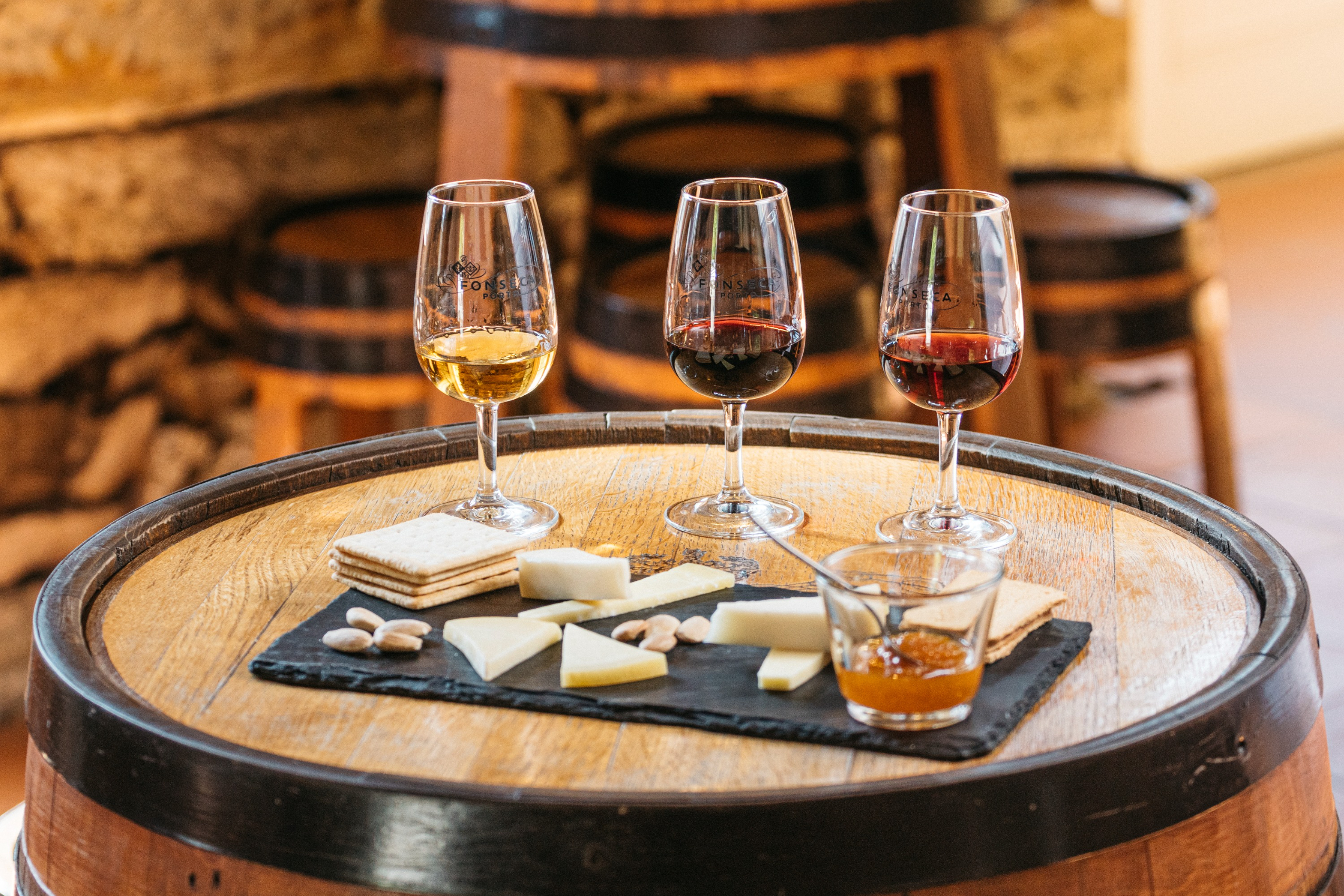
Vila Nova de Gaia is home to many of Porto's famous port wine cellars, where you can learn about the history of port wine and enjoy tastings.
Cultural
2-3 hours
€10-€30
Must-Try Local Dishes
Francesinha
A hearty sandwich made with layers of meat, covered in melted cheese and a special sauce, served with fries.
Lunch/Dinner
Contains meat and dairy
Bacalhau à Brás
A traditional Portuguese dish made with shredded cod, onions, potatoes, and eggs.
Lunch/Dinner
Contains fish and eggs
Tripas à Moda do Porto
A traditional Porto dish made with tripe, beans, and spices, slow-cooked to perfection.
Lunch/Dinner
Contains meat
Pastéis de Nata
Delicious custard tarts with a flaky pastry crust, often dusted with cinnamon or powdered sugar.
Dessert
Contains dairy and eggs
Popular Activities
Hiking in the Serra do Pilar
Kayaking on the Douro River
Sunbathing at Praia do Castelo do Queijo
Enjoying a port wine tasting
Visiting the Livraria Lello
Exploring the Ribeira district
Swimming at Praia do Castelo do Queijo
Boat tours on the Douro River
Best Time to Visit
May to September
This is the peak tourist season with warm weather and plenty of sunshine. It's ideal for exploring the city and enjoying outdoor activities.
18°C to 28°C
64°F to 82°F
Practical Information
Language
- Official: Portuguese
- Widely spoken: English, Spanish, French
- English: Widely spoken in tourist areas
Currency
Euro (EUR)
Time Zone
GMT+1 (Western European Time)
Electricity
230VV, 50HzHz
Safety Information
Overall Safety Rating: Generally safe
Porto is generally a safe city for travelers, with low violent crime rates. However, petty crime, such as pickpocketing and bag snatching, can occur in tourist areas and on public transportation.
Important Precautions:
- • Keep valuables secure and out of sight, especially in tourist areas and on public transportation
- • Be cautious when using taxis, and always ensure the meter is running or agree on a price before starting your journey
- • Avoid walking alone at night in quiet or poorly lit areas
Getting there
By air
- Francisco Sá Carneiro Airport • 11 km (7 miles) from city center
By train
Porto Campanhã, Porto São Bento
By bus
Porto Bus Terminal (Terminal de Camionagem de Porto)
Getting around
Public transport
The metro system is efficient and easy to use, with six lines connecting major points of interest.
Taxis
Available • Apps: Bolt, Uber
Rentals
Car, Bike, Scooter
Neighborhoods
Ribeira
Bolhão
Foz do Douro
Miguel Bombarda
Day trips
Braga
50 km (31 miles) • Full day
Braga is a historic city known for its beautiful churches, monasteries, and the Bom Jesus do Monte sanctuary.
Guimarães
40 km (25 miles) • Full day
Guimarães is a historic city known as the birthplace of Portugal. It's home to a well-preserved medieval center and the stunning Guimarães Castle.
Douro Valley
80 km (50 miles) • Full day
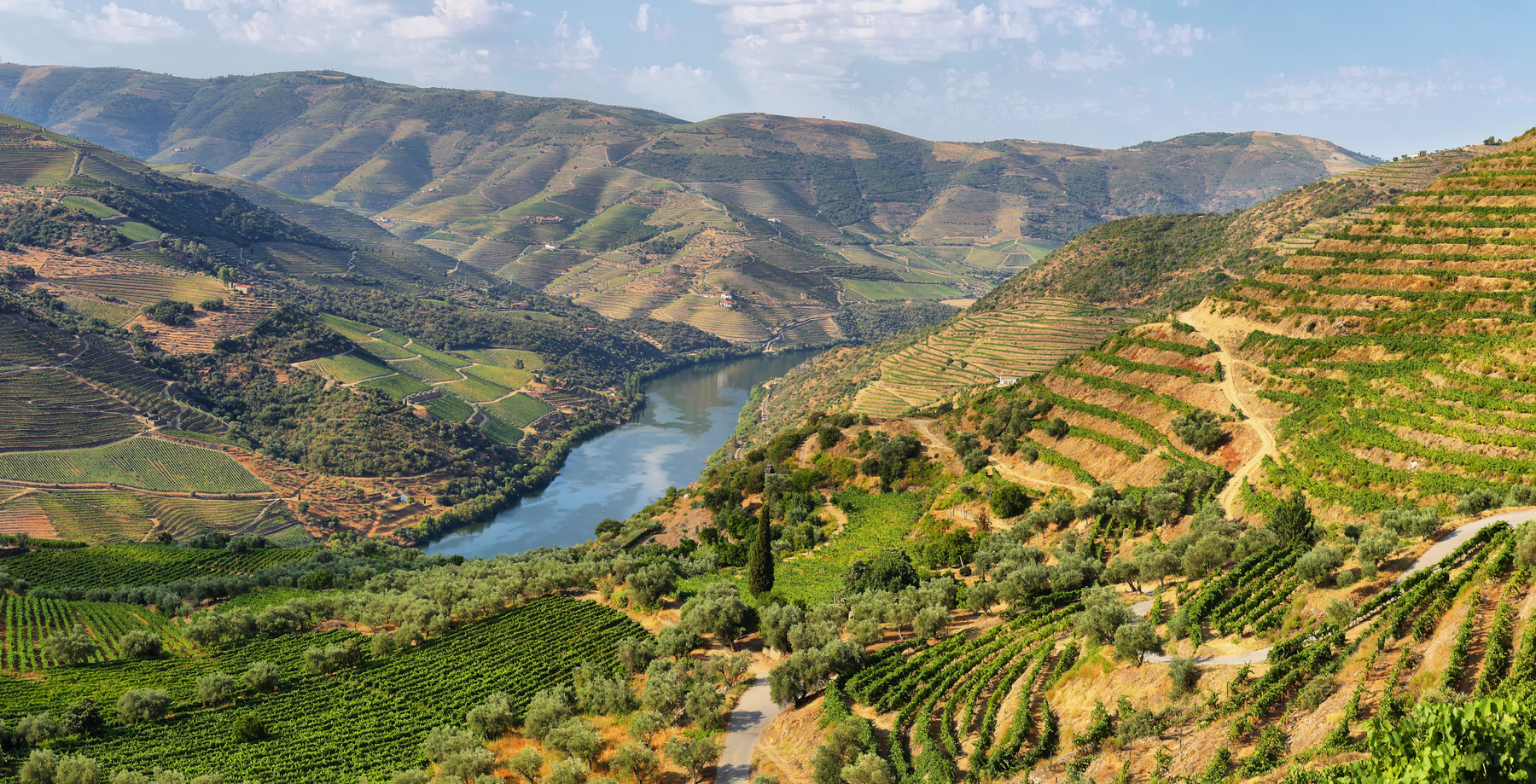
The Douro Valley is a stunning wine region known for its terraced vineyards, port wine cellars, and scenic boat tours.
Festivals
São João Festival • June 23-24
Festa de São João • June 24
Porto Wine Festival • September
Pro tips
- Visit the Livraria Lello bookstore early in the morning or late in the afternoon to avoid the crowds and long queues
- Take a port wine tasting tour to learn about the history of port wine and sample a variety of wines from different cellars
- Explore the historic center of Porto on foot, as many of its narrow streets and charming squares are best discovered by walking
- Try the local cuisine, such as Francesinha, Bacalhau à Brás, and Tripas à Moda do Porto, at traditional restaurants and cafes
- Take a day trip to the Douro Valley to see the stunning vineyards, visit port wine cellars, and enjoy a scenic boat tour on the Douro River
From $25
per person
Price varies by option
Secure booking
Free cancellation available
Instant confirmation