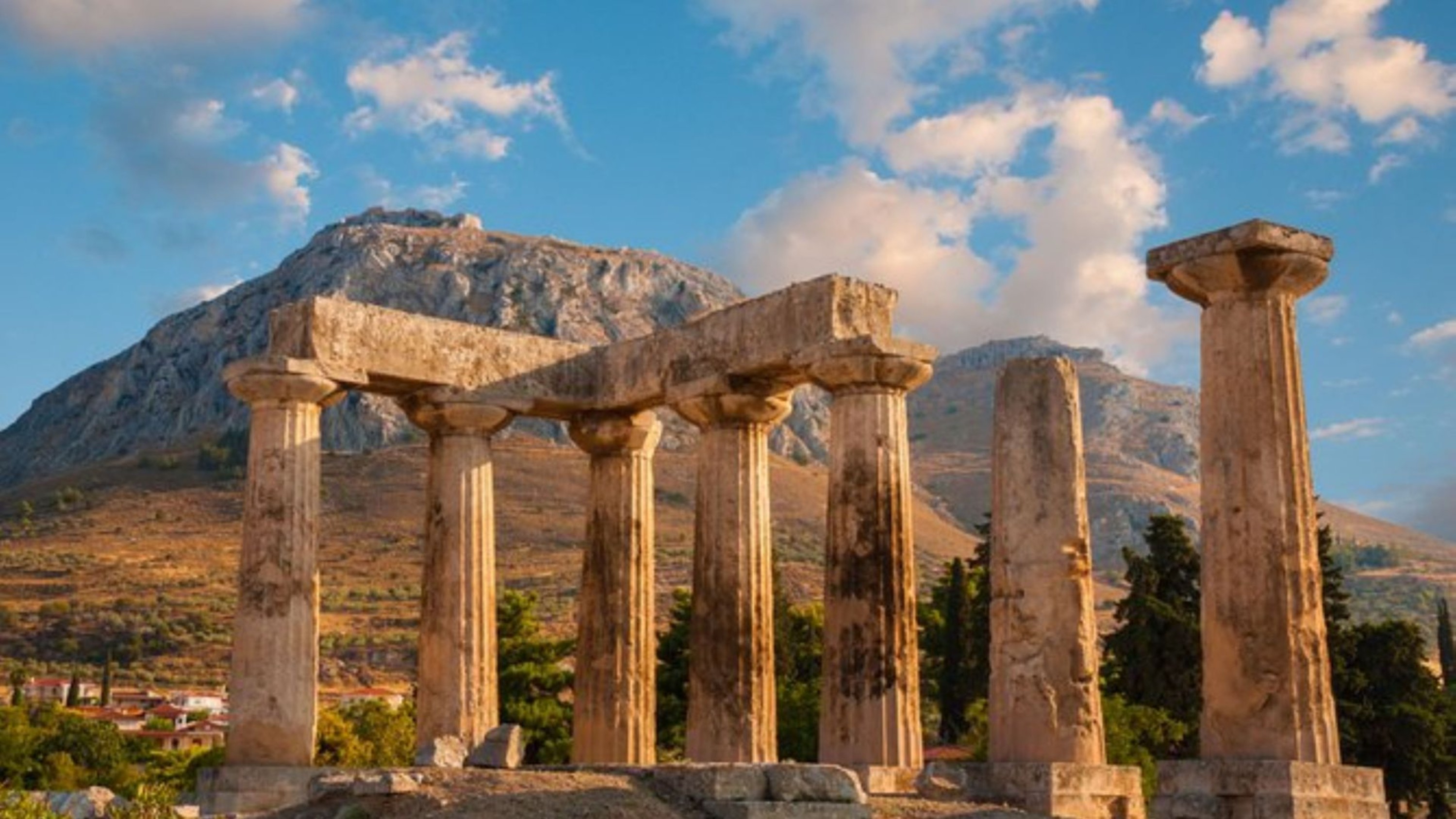
Athens best attractions sightseen and the famous Nemea wine tour
Active
9h
For a full refund, cancel at least 24 hours before the scheduled departure time.
Instant confirmation
Mobile or paper ticket accepted
About this experience
Highlights
• An 9 hours private tour in Greece, full of culture and flavor
• All important archaeological sites in Athens, such as the Acropolis and the Parthenon
• The Corinth canal and the gorgeous countryside of Peloponnese
• The famous Greek wineries of Nemea
• Travelers can customize the tour within the itinerary!
Available options
sedan up to 3 Passengers
PERSONAL AND PRIVATE: This is a private tour just for you, your family, and your friends<br/>ROUTE PLANNER: We will pick you up from your hotel or accommodation in Athens where your tour starts and we will drop you off back
<br/>TRAVEL WITH STYLE: Groups of 1-3 Mercedes sedan or similar, 4-7 Luxury Mercedes Benz Minivan, 8-15 Mercedes-Benz Sprinter A/C, Leather Interior<br/>Pickup included
Minibus up to 11 Passengers
PERSONAL AND PRIVATE: This is a private tour just for you, your family, and your friends<br/>ROUTE PLANNER: We will pick you up from your hotel or accommodation in Athens where your tour starts and we will drop you off back<br/>TRAVEL WITH STYLE: Groups of 1-3 Mercedes sedan or similar, 4-7 Luxury Mercedes Benz Minivan, 8-15 Mercedes-Benz Sprinter A/C, Leather Interior<br/>Pickup included
Group up to 7 p. / Minivan
PERSONAL AND PRIVATE: This is a private tour just for you, your family, and your friends<br/>ROUTE PLANNER: We will pick you up from your hotel or accommodation in Athens where your tour starts and we will drop you off back<br/>TRAVEL WITH STYLE: Groups of 1-3 Mercedes sedan or similar, 4-7 Luxury Mercedes Benz Minivan, 8-15 Mercedes-Benz Sprinter A/C, Leather Interior<br/>Pickup included
Group up to 15 Passengers
PERSONAL AND PRIVATE: This is a private tour just for you, your family, and your friends<br/>ROUTE PLANNER: We will pick you up from your hotel or accommodation in Athens where your tour starts and we will drop you off back<br/>TRAVEL WITH STYLE: Groups of 1-3 Mercedes sedan or similar, 4-7 Luxury Mercedes Benz Minivan, 8-15 Mercedes-Benz Sprinter A/C, Leather Interior<br/>Pickup included
What's included
A professional English speaking tour driver
Piraeus cruise port pickup
Transportaton by private vehicle Mercedes- Benz or similar
Hotel/cruise port drop-off in Athens
Detailed itinerary
1
Pick up from your cruise ship pier at Piraeus port. We will drive along the coastal road of Saronic Gulf to enjoy the Piraeus and Athens riviera.
The Port of Piraeus is the chief seaport of Athens, Greece, located on the Saronic Gulf on the western coasts of the Aegean Sea. Piraeus port is the largest port in Greece, home to Europe's biggest passenger port, and as such is a huge draw for cruise ships from around the world bringing tourists eager to explore this centuries-old city, and one of the largest in Europe. But yet another major draw is the fact that it's easy to visit Athens because it's located nearby. The Greek capital city of Athens is just 12 kilometers or 7 miles from Piraeus port. We will drive directly to the Acropolis to admire the Temple of Democracy!
2
Stop 2
Pass by
Welcome to Athens, the historical capital of Europe. Welcome to the birthplace of democracy, arts, science and philosophy of western civilisation. Home of Plato, Socrates, Pericles, Euripides, Sophocles, Aeschylus. Athens is one of the world’s oldest cities. It’s recorded history spanning around 3.400 years and it is being inhabited since the 11th millennium B.C. E. Today, under the shadow of Parthenon, the contemporary urban scenery of the sprawling city reflects its exciting history, its multi- cultural modern personality as well as the infrastructure and facilities.
The perfect Mediterranean climate with the legendary greek sunlight, the unique combination of glorious history with modern, urban innovation, the coexistence of great culture with astonishing natural beauty, the high standard hotel accommodation.
3
Stop 3
Pass by
The Acropolis of Athens is an ancient citadel located on a rocky outcrop above the city of Athens, and its monuments are universal symbols of the classical spirit and civilization and form the greatest architectural and artistic complex bequeathed by Greek Antiquity to the world. In the second half of the 5th-century bc, Athens, following the victory against the Persians and the establishment of democracy, took a leading position amongst the other city-states of the ancient world. In the age that followed, as thought and art flourished, an exceptional group of artists put into effect the ambitious plans of Athenian statesman Pericles and, under the inspired guidance of the sculptor Pheidias, transformed the rocky hill into a unique monument of thought and the arts. The most important monuments were built during that time: the Parthenon, built by Ictinus, the Erechtheon, the Propylaea, the monumental entrance to the Acropolis, designed by Mnesicles, and the small temple Athena Nike.
4
Stop 4
The Propylaea of the Athenian Acropolis was built on the west side of the hill, where the gate of the Mycenaean fortification once stood. The first propylon, or gate, was constructed in the age of Peisistratos (mid-sixth century BC), after the Acropolis had become a sanctuary dedicated to Athena.
A new propylon, built-in 510-480 BC, was destroyed by the Persians in 480 BC and repaired after the end of the Persian Wars, during the fortification of the Acropolis by Themistokles and Kimon. The monumental Propylaia admired by modern visitors was part of the great Periclean building program. They have erected in 437-432 BC, after the completion of the Parthenon, by architect Mnesikles. The original building plan was particularly daring both in architectural and artistic terms but was never completed.
The pie-shaped building of Pentelic marble frames beautifully the entrance to the sacred precinct. The central section, the propylon proper, had an outer (west) and inner (east) facade...
5
Stop 5
The temple of Athena Nike stands at the southeast edge of the sacred rock atop a bastion, which in Mycenaean times protected the entrance to the Acropolis. The Classical temple, designed by architect Kallikrates and built-in 426-421 BC, succeeded earlier temples also dedicated to Athena Nike. The first one of these, a mid-sixth century BC wooden temple was destroyed by the Persians in 480 BC. The eschara, the altar believed to have supported the cult statue of the goddess, dates to this period. Under Kimon, c. 468 BC, a small temple of tufa was erected around the base of the statue and a new altar was built outside the temple.
The foundations of these early temples and altars are preserved inside the bastion under the floor of the Classical structure. Pausanias (1, 22, 4) refers to this temple as that of the Apteros Nike, or Wingless Victory, and mentions that the cult statue of the goddess had no wings so that she would never leave Athens. Apart from the cult of Athena Nike other...
6
Stop 6
The Parthenon, dedicated by the Athenians to Athena Parthenos, the patron of their city, is the most magnificent creation of Athenian democracy at the height of its power. It is also the finest monument on the Acropolis in terms of both conception and execution. Built between 447 and 438 BC, as part of the greater Periklean building project, this so-called Periklean Parthenon (Parthenon III) replaced an earlier marble temple (Parthenon II), begun after the victory at the battle of Marathon at approximately 490 BC and destroyed by the Persians in 480 BC. This temple replaced the very first Parthenon (Parthenon I) of c. 570 BC from Periklis . The Parthenon was designed by architects Iktinos and Kallikrates, while the sculptor Pheidias supervised the entire building program and conceived the temple's sculptural decoration and a chryselephantine statue of Athena. The Parthenon is a double peripteral Doric temple with several unique and innovative architectural features.
7
Stop 7
The elegant building known as the Erechtheion, on the north side of the sacred rock of the Acropolis, was erected in 421-406 BC as a replacement of an earlier temple dedicated to Athena Polias, the so-called "Old temple". The name Erechtheion, mentioned only by Pausanias (1, 26, 5), derives from Erechtheus, the mythical king of Athens, who was worshipped there. The sanctuary also contained the grave of Kekrops and the traces of the dispute between Athena and Poseidon for the possession of the city of Athens.
Another door on the south facade of the western temple opened onto the porch of the Karyatides, a pi-shaped structure with six female statues instead of columns to support the roof. Created by Alkamemes or Kallimachos, the statues were later named Karyatides after the young women from Karyes of Laconia who danced in honor of the goddess Artemis. Five of them are in the Acropolis Museum and another in the British Museum; those on the building are casts.
8
Stop 8
Admire the Kallimarmaro stadium, else Panathenaea stadium where here the first modern Olympic games took place in 1896. It is called Kallimarmaro because is all made of marble. A special marble called the Pentelic marble. Special because it changes color according to the daylight. Cool within the morning and in the afternoon it changes color to bone gold color. The monuments on the Acropolis and the temple of Zeus are made of the same Pendelikon marble.
9
Stop 9
Pass by
Located in southern Athens, between the Acropolis and the Ilissos river, the Olympeion was the sanctuary of Olympian Zeus. Here stands one of the greatest ancient temples of Zeus and, according to Vitruvius, one of the most famous marble buildings ever constructed. The sanctuary's foundation is attributed to the mythical Deukalion. The site also comprises the temple of Apollo Delphinios - the sanctuary of Apollo Delphinios was traditionally associated with Theseus - and a tripartite building with a south courtyard of ca. 500 BC. The latter has been identified as the Delphinion Court, which was allegedly founded by Aegeas.
10
Stop 10
Pass by
The National Garden of Athens, located behind the Parliament and Syntagma Square, is a green oasis in the heart of the city.
The National Garden of Athens is a large green space of over 160.000 square meters adorned with over 500 types of plants and trees from all over the world.
Former Royal Gardens; The gardens were designed in 1839 by order of Queen Amalia of the Greeks, but were not open to the public until 1923 when they were renamed “National Garden”.
The designer of the gardens, Friedrich Schmidt, traveled all over the world in search of the most beautiful, exotic and unique flora. This task was also granted to the Hellenic Navy.
11
Stop 11
The history of the impressive building of the Hellenic Parliament is intimately linked to the history of the Modern Greek state. Initially, the building served as the palace of Kings Otto and George I. It became the Parliament and Senate building a hundred years after it was constructed and still houses the Hellenic Parliament today. Through all those years, the building has undergone a series of changes and has been modernized. From 1836 to 1862; After the selection of Otto, Prince of Bavaria, as King of Greece, and the relocation of the Greek capital to Athens, it was decided to erect the palace on Boubounistra Hill. It proved an inspired choice. The chosen location was in the center of the new capital, easily defendable and cool. On February 6th, 1836 the founding stone was laid at the highest eastern point of the city. The ancient quarry of Pentele was the source of marble. King and queen Otto, and Amalia, took up residence on July 25th, 1843.
12
Stop 12
The Tomb of the Unknown Soldier is a war memorial located in Syntagma Square in Athens, in front of the Old Royal Palace. It is a cenotaph dedicated to the Greek soldiers killed during war. It was sculpted between 1930 and 1932 by sculptor Fokion Rok. The tomb is guarded by the Evzones of the Presidential Guard.
13
Syntagma Square has literally been the very heart of Athens ever since the city became the capital of the modern Greek state, and it's the perfect central location for sightseeing.
It is located in front of the 19th century Old Royal Palace, housing the Greek Parliament since 1934. With the Greek Parliament building and the Tomb of the Unknown Soldier looming over it, it is rich with history and is the place where most major events of the last two centuries have taken place.
Its name in Greek means “Constitution Square,” a name granted by Greece’s first modern royal, King Otto, on September 3, 1843, after an uprising of the people. This was a smart political move since the royal palace overlooked the square.
14
Stop 14
The Academy of Athens was founded with the Constitutional Decree of March 18th, 1926, as an Academy of Sciences, Humanities, and Fine Arts. The same Decree appointed its first Members, who were all eminent representatives of the scientific, intellectual, and artistic circles of that era.
15
Stop 15
The National and Kapodistrian University of Athens (NKUA) is a public, self-governed Higher Education Institution, under the auspices of the Ministry of Education, Research, and Religious Affairs. Inaugurated in 1837, it has been the oldest higher education institution in the Modern Greek state and the first university in the Balkan and Eastern Mediterranean area. Since then it has been an internationally competitive, globally-focused, research-led university.
16
Stop 16
Pass by
The National Library forms part of the so-called "Neoclassical Trilogy" of the City of Athens: Academy - University - Library.
With a history of over two centuries, containing more than one million books and magazines, and a host of handwritten codices dating from the 9th to the 19th centuries, the National Library of Greece is the custodian of the Greek literary heritage, bridging the past, the present and the future.
It was built between 1887 and 1902, based on a study of the Danish architect, Theophile Hansen -brother of Cristian Hansen. Hernest Ziller was the supervising architect who also studied the entrance stairways and the main bookstands. As early as 1858, King Otho had ordered Hansen to make a study for the construction of a Library next to the University, which had already started being built.
17
Stop 17
We will be traveling through Athens and its superbs till we will reach the famous Corinth canal, traveling along the picturesque coastal road of the Saronic golf!
18
Stop 18
The famous Corinth Canal is a waterway that crosses the narrow isthmus of Corinth to link the Ionian Sea with the Saronic Gulf in the Aegean Sea. As such, it cuts through the narrow Isthmus of Corinth the canal and separates the Greek mainland from the Peloponnese, arguably making the peninsula an island.
Dug through the isthmus at sea level, the canal is 6.4 kilometers long with a width of only 25 meters.
The canal, though executed in the late 19th century, has been a 2000-year-old dream. Before its construction, ships in the Aegean Sea that wanted to cross to the Adriatic or anchor in Corinth had to circle the Peloponnese, an extra 185 nautical miles.
It is believed that Periander, the tyrant of Corinth (602 BC), was the first to conceive of the idea of digging the Corinth Canal. As the project was too complicated given the limited technical capabilities of the times, Periander constructed the diolkós, a stone road that allowed ships to be transferred on wheeled platforms.
19
After we will admire the impressive Corinth canal, we will be traveling through the picturesque and productive soil of Peloponesse. Enjoy the ride along the olive fields, citrus fruits, vineyards, and all the goods the Peloponnesian land has to offer!
Escape to the Peloponnese, where Myth meets history. Monuments from every period of the eventful history, great archeological sites; ancient Olympia, Epidaurus, Mycenae and Nemea, the Temple of Apollo Epicurius, Byzantine churches and Monasteries.
Enjoy sightseeing and sports; explore unique villages and alluring castles amidst stunning natural beauty, mountains, forests, vineyards, rivers, and caves. Not to mention that the Peloponnese is surrounded by the Greek sea, with lovely beaches, and sandy smooth coasts on the western part – rocky and lacy on its easternmost side. It is no coincidence that the tour of the Peloponnese is very popular among travelers.
20
Neméa is arguably Greece's most important red-wine appellation, located in the northeast corner of the Peloponnese peninsula. The mountains and valleys surrounding the small village of Neméa have been producing wine for centuries, mostly from the native Agiorgitiko grape and the appellation that surrounds the village is geographically the largest in Greece. A wide range of styles is made from this red grape variety, from rich, age-worthy dry wines to lighter, sweeter examples.
Wine growing in Neméa dates back to at least the 5th Century BC, although the exact date is hard to pinpoint. Wine is a part of the Greek mythology surrounding the half-god Heracles, who was sent to Neméa to slay the Neméan lion. Around 40 wineries are located within Neméa's boundaries. Agiorgitiko is Neméa's native grape variety, and is named for the St George's Church found within the boundaries of the appellation: Agiorgitiko translates as "St George's grape". Visit 2 wineries depending on how fast you are!
21
After our visit to the last winery in Nemea, we will take the way back to Piraeus where our tour ends.
Thank you for choosing us for your tour of Athens!
What's not included
Food and drinks
Gratuities
Wine tasting fee
Entrance fees to the archaeological sites and museum
English-speaking licensed tour guide (We can arrange for a tour guide for you with an extra cost)
Available languages
Guide guide
EN
Reviews breakdown
Tripadvisor
3.0
2 reviews
5★
1
4★
0
3★
0
2★
0
1★
1
Important information
Specialized infant seats are available
Travelers should have at least a moderate level of physical fitness
At time of booking, Cruise ship passengers must provide the following information at time of booking: ship name, docking time, disembarkation time and re-boarding time
Dress code is formal
Driver/Guide: You will have a professional English-speaking driver with good knowledge of the history and culture of Greece, to guide you till you enter archaeological sites and museums according to the program. Tour drivers are not licensed to companion you inside the archaeological sites and museums. If you'd like to have one, we can arrange it for you at an additional cost. Licensed by the state tour guides are freelance and it is subject to availability on bookings day!
Athens International Airport transfers can be arranged on request
IMPORTANT NOTE: You will visit at least one winery and depending on you making time, you can visit a second one having in mind that this tour lasts for 9 hours.
We suggest that you have your admission tickets pre-purchased as there is a chance not to find availability, please note that we can buy the tickets for you in advance -under a small service fee
Important notes
HOTEL MEETING INSTRUCTIONS: We will meet you at the main entrance of your hotel. Please inform the porter that you are expecting your tour driver to call for you. If you are staying in a small hotel, please inform the receptionist instead.
CRUISE PORT MEETING INSTRUCTIONS: Please disembark and walk outside the terminal exit door, where our driver/guide will be waiting for you holding a sign with your name on it.
• Please note: transport included. This voucher will not be accepted if presented directly at the venue.
• Comfortable walking shoes are recommended
• If you have not already specified, you MUST advise supplier as soon as possible your Ship name, docking time, disembarkation time and departure time so that appropriate arrangements can be made
Times are subject to change due to local traffic conditions.
About Athens
Athens, the capital of Greece, is a city rich in history and culture, often considered the cradle of Western civilization. It is home to iconic ancient landmarks, vibrant neighborhoods, and a thriving modern scene.
Top Attractions
Acropolis of Athens
The Acropolis is the most iconic landmark in Athens, featuring ancient ruins and temples, including the Parthenon.
Historical
2-3 hours
€20 (combined ticket for multiple sites)
Ancient Agora of Athens
The heart of ancient Athens, featuring the Temple of Hephaestus and the Stoa of Attalos.
Historical
1-2 hours
€8 (included in the combined ticket)
Plaka
A charming, historic neighborhood with narrow streets, neoclassical houses, and vibrant nightlife.
Cultural
2-3 hours
Free to explore
Acropolis Museum
A modern museum showcasing artifacts from the Acropolis and its surroundings.
Museum
1-2 hours
€10
Temple of Olympian Zeus
An ancient temple dedicated to Zeus, once the largest temple in Greece.
Historical
30 minutes to 1 hour
€6 (included in the combined ticket)
Must-Try Local Dishes
Moussaka
A baked dish with layers of eggplant, minced meat, and béchamel sauce.
Dinner
Vegetarian versions available
Souvlaki
Grilled meat skewers, often served with pita bread and tzatziki.
Snack
Can be made with chicken, pork, or vegetarian options
Tzatziki
A yogurt-based dip with cucumber, garlic, and herbs.
Snack
Vegetarian and vegan options available
Baklava
A sweet pastry made with layers of filo, nuts, and honey syrup.
Dessert
Vegetarian
Popular Activities
Hiking in the mountains
Rock climbing
Scuba diving
Beach visits
Spa treatments
Café hopping
Museum visits
Theater performances
Best Time to Visit
April to June, September to October
The best time to visit Athens is during the spring and autumn months when the weather is pleasant and the tourist crowds are smaller.
18°C to 32°C
64°F to 90°F
Practical Information
Language
- Official: Greek
- Widely spoken: English, French, German
- English: Moderately spoken
Currency
Euro (EUR)
Time Zone
GMT+2 (EET)
Electricity
230VV, 50HzHz
Safety Information
Overall Safety Rating: Generally safe
Athens is generally safe for travelers, but petty crime and pickpocketing can occur in tourist areas. Be cautious with your belongings and avoid poorly lit areas at night.
Important Precautions:
- • Keep valuables secure
- • Use licensed taxis or ride-sharing apps
- • Be cautious with ATMs and credit cards
Getting there
By air
- Eleftherios Venizelos International Airport • 30 km from city center
By train
Athens Central Railway Station
By bus
KTEL Bus Station
Getting around
Public transport
Clean, efficient, and air-conditioned. Easy to navigate with clear signage in English.
Taxis
Available • Apps: Beat, Uber
Rentals
Car, Bike, Scooter
Neighborhoods
Plaka
Monastiraki
Psiri
Koukaki
Kolonaki
Day trips
Cape Sounion
65 km from Athens • Half day to full day
A scenic coastal area featuring the Temple of Poseidon with stunning views of the Aegean Sea.
Delphi
180 km from Athens • Full day
An ancient archaeological site and home to the famous Oracle of Delphi.
Meteora
350 km from Athens • Overnight
A unique landscape featuring rock formations and medieval monasteries perched atop cliffs.
Festivals
Athens Festival • May to October
Athens Epidaurus Festival • June to August
Athens International Film Festival • October
Pro tips
- Visit major attractions early in the morning or late in the afternoon to avoid crowds and heat
- Use the metro for easy and efficient travel around the city
- Explore local neighborhoods for an authentic Greek experience
- Try local street food for a quick and delicious meal
- Learn a few basic Greek phrases to enhance your experience and connect with locals
From $25
per person
Price varies by option
Secure booking
Free cancellation available
Instant confirmation