Strasbourg: 10K Premium Private Running Tour | Licensed Guide
Active
3h
For a full refund, cancel at least 24 hours before the scheduled departure time.
Instant confirmation
Mobile or paper ticket accepted
About this experience
Run Through History: A 10K Strasbourg Running Tour
Lace up your running shoes for a unique premium experience with your officially licensed local guide, Yann! This 10K running circuit offers you the chance to combine sport and culture while exploring the treasures of the European, Imperial, and Old Town districts.
Far from classic tours, this sporty and cultural immersion is punctuated by stops enriched with stories, local legends, and hidden gems. It’s an opportunity to push your limits while uncovering the secrets of the Alsatian capital. The pace is moderate, but a good level of physical fitness is required.
Your four-legged companion is welcome!
Build your private group (up to 12 participants) for an intimate and firendly adventure. Run, learn, and fall in love with Strasbourg!
Practical Information:
- Moderate fitness level required.
- Not suitable for people with reduced mobility.
- In case of physical difficulty, no refund will be given.
- Minimum age 15. Minors must be accompanied.
Available options
Private Group Tour - FR
French: This guided tour is conducted in French only.
Private Group Tour - EN
English: This guided tour is conducted in English only.
What's included
Free for dogs. They must be kept on a leash and be sociable.
Tour led by an officially licensed tour guide.
Detailed itinerary
1
Stop 1
The Strasbourg Cathedral is no mere monument; it is a Gothic masterpiece that tells four centuries of history. I will give you the keys to unlock its secrets.
We will begin our discovery in front of the 3D model at the foot of the cathedral’s south façade, then continue our exploration before the western façade, a true stone book rich with sculptures and symbols.
You will learn how the structure transformed over time, from its Romanesque foundations to its 142-meter-high spire (466-foot-high). Together, we will decipher its history and the anecdotes of its builders.
Before continuing the tour, I will explain how this marvel was built, one step at a time, and how it became the tallest monument in Christendom until the 19th century.
2
Stop 2
Pass by
The Ill River has been the beating heart of Strasbourg since its creation. As we run along Quai des Pêcheurs (Fishermen's Wharf), we will feel the soul of the city. The boatmen, one of the city's oldest guilds, made Strasbourg a major commercial hub during the Middle Ages. It was here that wine and grain arrived from the south, while furs and other goods came from the north.
From there, we will have a breathtaking view of Saint Paul's Reformed Church, a neo-Gothic jewel that stands proudly over the water.
Our run will then lead us to Palais Universitaire, a majestic monument that overlooks the banks of the Ill.
3
Palais Universitaire (University Palace) of Strasbourg commands the heart of the Neustadt. This neo-Renaissance masterpiece embodies German expertise, as it was built following the 1870 annexation to project imperial power.
But this majestic palace has had a fascinating destiny. I will take you on a journey through time to recount how it transitioned from a symbol of the German era to a symbol of European reconciliation, notably by hosting the first session of the Council of Europe in 1949.
This building is a bridge of stone between two eras, a place where history, science, and politics intertwined to forge the destiny of Europe.
4
Stop 4
Pass by
Avenue de la Forêt-Noire—a name that echoes the Vosges Mountains' twin range—is one of the majestic arteries of the Neustadt's Imperial Quarter.
Today, far from its past as a military thoroughfare, it is a lively area, bordered by the university campus and the botanical garden. It is here, on this green, vibrant axis, that history and knowledge meet.
5
Stop 5
Parc de l'Orangerie (Orangerie Park), Strasbourg's largest urban park, is a jewel of greenery in the heart of the city. It is here that history becomes poetry.
I will immerse you in the soul of this place, to tell you the story of the Joséphine Pavilion. Built in 1804 to house a hundred orange trees confiscated from a neighboring château during the French Revolution, it today bears the name of Empress Joséphine de Beauharnais, wife of Napoléon Bonaparte. The elegance of the Empress still seems to linger in the air.
It is a place steeped in history, where the echoes of the Revolution mingle with imperial history, and where the open spaces invite you to dream.
6
Palais de l'Europe (Palace of Europe)—a name that echoes an entire continent—stands as a symbol of reconciliation. I will take you on a journey through time to tell you its story and the importance of its imposing architecture.
It is here, at the headquarters of the Council of Europe, that the first stones of European democracy were laid. This is a place where the past mingles with the present, where history, politics, and architecture converge.
7
The European Court of Human Rights, with its bold architecture and two cylinders of glass and steel, stands as a symbol of justice and hope.
Its design, built on transparency, is an allegory for European justice, which aims to be accessible and open to all. This building is a place where human rights are protected and where the voices of European citizens are heard.
It is a place that, through its architecture, reminds us of the importance of justice in building the Europe of today.
8
Stop 8
The European Parliament, the beating heart and official headquarters of the European Union, stands as a tribute to the commitment of an exceptional woman.
It is named after Louise Weiss, a journalist, woman of letters, and the Dean of the Members of Parliament, whose pioneering spirit still echoes through its halls.
9
Stop 9
Pass by
The Ungemach Garden City is a hidden residential area, an enchanted interlude in the European institutions district.
It is the wild story of an urban utopia, built in the 1920s. This architectural and social project aimed to encourage the birth rate by offering families beautiful houses with gardens at a rent proportional to the number of children.
We will discover the silence of its paths. A unique architectural and social history.
10
Stop 10
Pass by
We will continue our run along Quai Rouget de Lisle (Rouget de Lisle Quays), a name that echoes the national anthem... but be patient! The story hidden behind this song will be recounted further on, at Place Broglie (Broglie Square).
Indeed, it was here, in Strasbourg, that a war song became a national symbol. I will tell you the behind-the-scenes story of this creation that changed the destiny of France.
11
Stop 11
We are now arriving at the foot of Saint Paul's Church, a neo-Gothic jewel we had spotted from a distance. Its two 76-meter twin spires command the Ill River, standing as a witness to the 1870 annexation because it was built for German soldiers.
Its architecture hides a mystery: it has 16 doors! I will tell you its unique story.
12
Stop 12
Pass by
Avenue de la Liberté, one of Strasbourg's most beautiful avenues, is the heart of the Imperial Quarter. I will tell you how, following the 1870 annexation, it was designed to be the axis of "Knowledge-Power."
Although it is not the longest avenue in the district, it was the most important, as it embodied the ambition of the German Empire. It is here that history and architecture unite to tell you a chapter of the city's story.
13
Place de la République (Republic Square), the former heart of the "Kaiser Platz," immerses you in a magnificent past. On either side, the National Theater and the National and University Library, with thousands of books from the personal collection of Emperor William I, bear witness to the cultural ambition of the German Empire.
But the square is also a place of memory. I will tell you the unique story of the War Memorial (Monument aux Morts), a typically Alsatian memorial that makes no mention of the homeland for which the soldiers fell. It's an opportunity to share a fascinating chapter of history, unique to Alsace.
14
Palais du Rhin (Palace of the Rhine), in the heart of the former "Kaiser Platz," stands as the symbol of imperial power. Designed as a residence for Emperor William I following the 1870 annexation, this majestic edifice was nevertheless inaugurated by his grandson, William II.
But for all its imposing size, this palace never managed to win the heart of the young Emperor, who ironically found it "too massive" for his taste.
Today, far from its imperial past, Palais du Rhin has seen its destiny transformed: it is the headquarters of the Central Commission for the Navigation of the Rhine, the oldest international organization in the world.
15
We are now arriving in the Old Town and starting with Place Broglie (Broglie Square), a location where Strasbourg's history unfolds in multiple acts. From the Janus fountain, the two-faced Roman god who reminds us that history has both a past and a future, to the Opera, whose tumultuous story is a testament to the city's wars and reconstructions—everything here breathes history.
But the square is also a place of memory. I will recount the story of Strasbourg's liberation by Marshal Leclerc and the secret of the French flag—an amusing and fascinating anecdote.
Finally, I will tell you two stories: that of the city's very first Christmas market, which was held right here after 1570, and that of La Marseillaise, the French national anthem, whose first note resonated in a building on the square.
16
Place Kléber (Kléber Square), the beating heart of Strasbourg, is a place where history and the present meet. I will show you the statue of General Kléber, a hero of the Napoleonic army, whose body rests beneath the pedestal of his statue.
At its side stands the majestic Aubette, a building that has seen its destiny transformed on several occasions.
17
Stop 17
In the heart of the city, Place Gutenberg comes alive, watched over by the statue of the man who gave wings to knowledge.
Your guide will take you on a journey through time, recounting how this square was a crucial location in history. It was here, in Strasbourg, that Johannes Gutenberg perfected his invention and where the very first Bible in German was printed. You will learn how, long before the era of social media, the world’s first newspaper was also born in this city.
In the background, the Chamber of Commerce and Industry, the proud Renaissance building named Neue Bau, still seems to echo the intellectual ferment of the time. Its façades, typical of the Alsatian style, are silent witnesses to Strasbourg's prosperity and ingenuity.
This is a square where the past, commerce, and innovation meet, and your guide will give you all the keys to unlock its secrets.
18
Stop 18
On the square that bears its name, Saint Thomas Church stands like a stone sentinel. Considered the city’s Protestant cathedral, it is a majestic witness to the Reformation.
I will take you on a journey through time to tell you its unique history. You will learn how, starting in the 16th century, Saint Thomas Church became the centerpiece of Alsatian Protestantism, a movement that shaped Strasbourg’s identity.
Its architecture, both sober and elegant, is a true stone book that will speak to you of the beliefs and intellectual movements of the era. You will understand why it is a symbol of the Reformation, and how its sandstone walls still seem to echo a different faith.
19
Stop 19
From Pont Saint-Martin, your gaze falls upon Petite France, a postcard-perfect scene where half-timbered houses are reflected in the water. This name, which sounds so romantic, hides a story that contradicts its charm.
I will immerse you in the soul of this place to tell you its untold story. You will discover that the name "Petite France" actually comes from an old hospital that, in the 16th century, housed soldiers suffering from the "French disease"... The hospital was located here and ended up giving its name to the district—a historical detail that transforms how you look at this magical place.
20
Stop 20
Since the Middle Ages, the stone towers of Ponts Couverts (Covered Bridges) have stood like proud guards. Witnesses to an age of iron and stone, their 13th-century walls tell a story that is both military and carceral.
I will reveal the secrets of this ancient fortification. You will discover how this defensive structure, which also served as a prison, has evolved over time.
And finally, a riddle will be posed to you: if they are called the Covered Bridges, why don't they have a roof today? The answer is simpler than it seems!
21
Stop 21
Barrage Vauban (Vauban Dam), a chapter of history written by the hand of Louis XIV, stands as a masterpiece of defensive engineering. I will tell you how, after the annexation of Strasbourg, the Sun King ordered his architect to build this dam to protect the city in case of attack.
Yet, despite its ingenuity, the dam met with an ironic fate. I will recount how it was used during the Franco-Prussian War of 1870, but how its effectiveness was nullified by Prussian bombs.
It is from its terrace, which offers a unique panorama of the city (subject to opening hours), that we will bridge the gap between past and present. We will be able to admire the architecture of Petite France and the Neustadt, and discuss Strasbourg's destiny today, in the heart of the magnificent Alsace region.
22
Square Louise Weiss—a name that echoes an exceptional woman we mentioned earlier.
Lined with magnificent half-timbered houses, this square takes on a whole new dimension as Christmas approaches, as it hosts a part of France's oldest Christmas market, dating back to 1570, and one of the oldest in the world.
23
Stop 23
Petite France is so much more than a postcard-perfect scene where half-timbered houses are reflected in the water. Once a working-class district for tanners, millers, and fishermen, it has transformed its humble past into a universal charm that now attracts visitors from all over the world.
I will immerse you in the soul of this place, which has a vibrant artisan history, notably with a presentation of the tanners' "poêle" (guildhall). This working district is also where the history of the guilds was written—these powerful groups of artisans and merchants who held the reins of the city.
The traditional houses, dating from the 15th and 16th centuries, hide other secrets: I'll explain why their unique architecture was a clever trick to avoid taxes. This location is a living page of history, a bridge between the past and the present.
24
Stop 24
Pass by
From Petite France, we will head onto Quai Saint-Thomas (Saint-Thomas Quays), a charming passage that will offer you another perspective on the city. Passing by a lock and a pedestrian footbridge over the water, beneath the arch of Pont Saint-Martin (Saint-Martin Bridge), you will be able to admire the magnificent façades reflected in the Ill River.
This walk will lead us, step by step, to Ancienne Douane (Old Customs House). You will discover how this district, once bustling with boatmen, has become a place of calm and beauty—a haven of serenity in the heart of the city.
25
Stop 25
Walking up from the quays on Rue de la Douane, another piece of the past is revealed: Ancienne Douane (Old Customs House). Formerly the city's port hub and headquarters of the boatmen's guild, it is the perfect opportunity to tell you about the new Port of Strasbourg, today the second-largest inland port in France.
26
Stop 26
Next, we will face Pont du Corbeau (Raven Bridge), a name that alone evokes a dark and fascinating past. It was here, on this bridge—once the "bridge of torments"—that public executions and humiliations took place during the Middle Ages.
Want to know how criminals were judged and executed in this spot? I will recount these stories, as terrifying as they are surprising, which are etched into Strasbourg’s memory.
This is a chapter in the history of justice that you will discover here, and one that stands in stark contrast to the magnificent architecture that has captivated you.
27
Stop 27
We will take the magnificent Rue du Maroquin, one of the city’s most beautiful streets—a jewel box of traditional houses and authentic "winstubs". It is the ideal place to end our tour on a high note and capture the final memories of this adventure.
We will then conclude our journey by returning to the Cathedral, where it all began, to leave you with an unforgettable memory of Strasbourg.
What's not included
Your smile is my greatest reward. If you enjoyed the tour, a small tip is proof that history and humor were on the menu. It's the very essence of my profession.
This tour is a feast for the mind, not the stomach! Refreshments and snacks are not included, so be sure to bring your own food and water to stay fueled and hydrated.
This tour focuses exclusively on the exterior of the monuments. While interior visits to these buildings are free, we will not be entering them, so no admission fees are required.
No interior visit of the cathedral.
Available languages
Guide guide
EN
FR
Important information
Public transportation options are available nearby
Not recommended for travelers with spinal injuries
Not recommended for pregnant travelers
Not recommended for travelers with poor cardiovascular health
Travelers should have at least a moderate level of physical fitness
Meeting point
The meeting point and the end of the tour are located at Place du Château, at the south foot of the Cathedral. You’ll find me next to the bronze 3D model, wearing a yellow and black cap or a yellow beanie (depending on the weather).
About Strasbourg
Strasbourg is a picturesque city in northeastern France, known for its charming half-timbered houses, canals, and the stunning Gothic cathedral. As the capital of the Alsace region, it offers a unique blend of French and German cultures, making it a fascinating destination for history buffs and food enthusiasts alike.
Top Attractions
Strasbourg Cathedral
This stunning Gothic cathedral is one of the most iconic landmarks in Strasbourg. Its intricate facade and towering spire offer breathtaking views of the city.
Architecture/Historical
1-2 hours
€10 for access to the tower
La Petite France
This charming neighborhood is known for its half-timbered houses, canals, and cobblestone streets. It offers a glimpse into Strasbourg's rich history and architectural heritage.
Historical/Cultural
1-2 hours
Free to explore
European Parliament
The European Parliament is one of the key institutions of the European Union. Visitors can take guided tours to learn about the workings of the EU and its impact on Europe.
Political/Cultural
1-2 hours
Free
Strasbourg Christmas Market
One of the oldest and most famous Christmas markets in Europe, the Strasbourg Christmas Market offers a magical atmosphere with festive decorations, traditional crafts, and delicious local treats.
Cultural/Festival
2-3 hours
Free to enter, variable for purchases
Must-Try Local Dishes
Tarte Flambée
A thin, crispy crust topped with crème fraîche, onions, and bacon. It is a traditional Alsatian dish that is both delicious and filling.
Dinner
Contains dairy and meat.
Choucroute
A hearty dish made with sauerkraut, sausages, and pork, often served with potatoes. It is a staple of Alsatian cuisine and a must-try for any visitor.
Dinner
Contains meat and may contain allergens.
Baeckeoffe
A traditional Alsatian casserole made with layers of marinated meat (beef, pork, and lamb), potatoes, and vegetables. It is slow-cooked and served with a side of sauerkraut.
Dinner
Contains meat and may contain allergens.
Kougelhopf
A sweet, yeast-based cake that is a specialty of the Alsace region. It is often flavored with raisins, almonds, and rum, and is a popular breakfast or dessert item.
Dessert
Contains dairy, eggs, and may contain nuts.
Popular Activities
Hiking in the Vosges Mountains
Biking along the canals
Boat tours on the Ill River
Wine tasting in local vineyards
Visiting museums and historical sites
Attending local festivals and events
Boating on the Ill River
Fishing in local lakes and rivers
Best Time to Visit
December to January
This is the time of the famous Christmas markets, which attract visitors from all over the world. The city is beautifully decorated and offers a magical atmosphere.
-2°C to 5°C
28°F to 41°F
Practical Information
Language
- Official: French
- Widely spoken: German, English
- English: Moderately spoken
Currency
Euro (EUR)
Time Zone
GMT+1 (CET), GMT+2 (CEST during daylight saving time)
Electricity
230VV, 50HzHz
Safety Information
Overall Safety Rating: Generally safe
Strasbourg is generally safe for tourists, with low crime rates. However, as with any tourist destination, it's important to be aware of your surroundings and take precautions to protect yourself and your belongings.
Important Precautions:
- • Be aware of your surroundings, especially in crowded areas.
- • Keep your valuables secure and out of sight.
- • Use licensed taxis or ride-sharing services.
Getting there
By air
- Strasbourg Airport • 10 km from city center
By train
Strasbourg-Ville
By bus
Strasbourg Bus Station
Getting around
Public transport
The tram system is efficient and covers most of the city. It is a convenient way to get around, especially for tourists.
Taxis
Available • Apps: G7, Uber
Rentals
Car, Bike, Scooter
Neighborhoods
La Petite France
Neudorf
Kronenburg
Day trips
Colmar
65 km • Full day
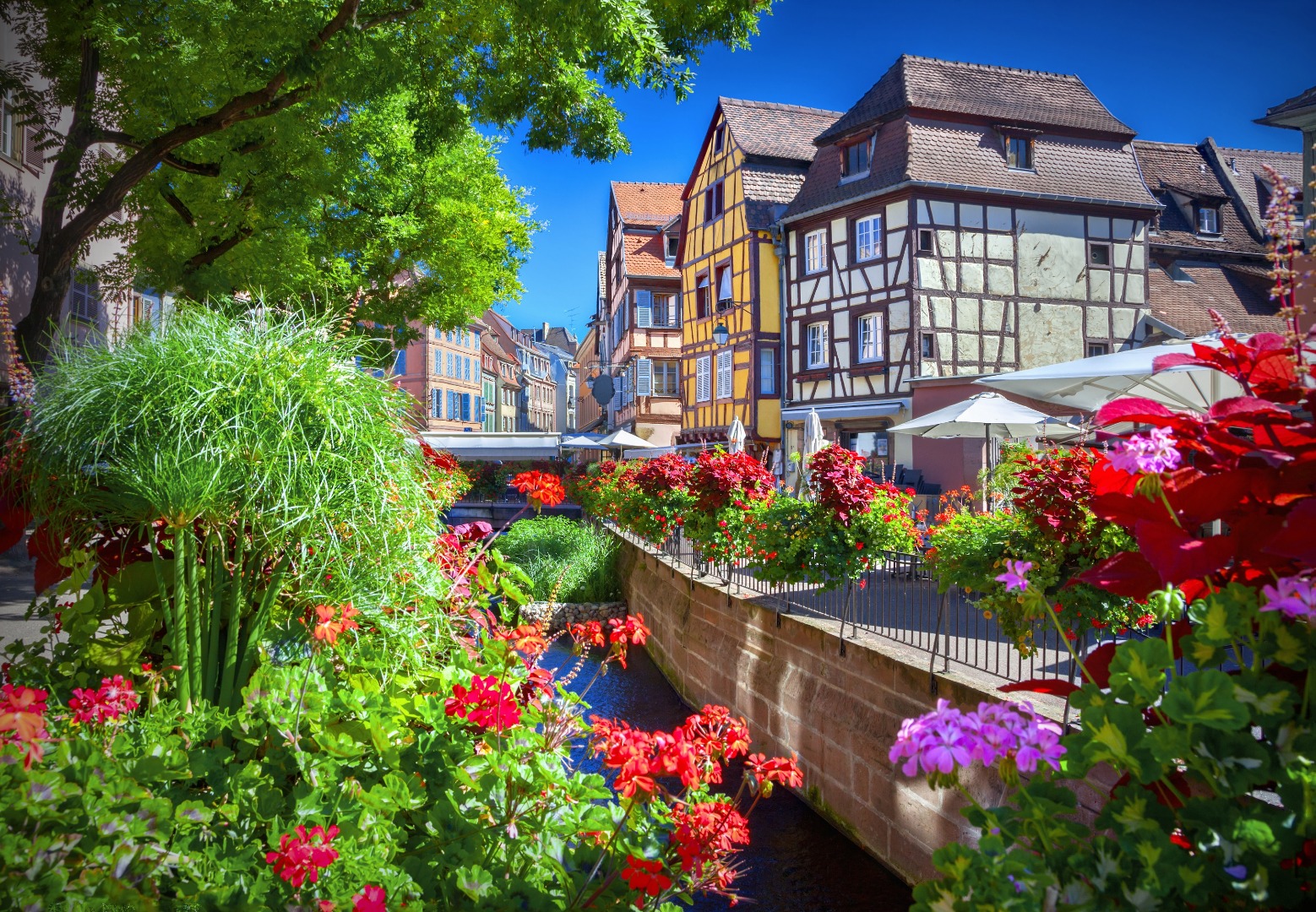
Colmar is a charming town known for its well-preserved old town, canals, and half-timbered houses. It offers a glimpse into Alsatian history and architecture.
Eguisheim
25 km • Half day
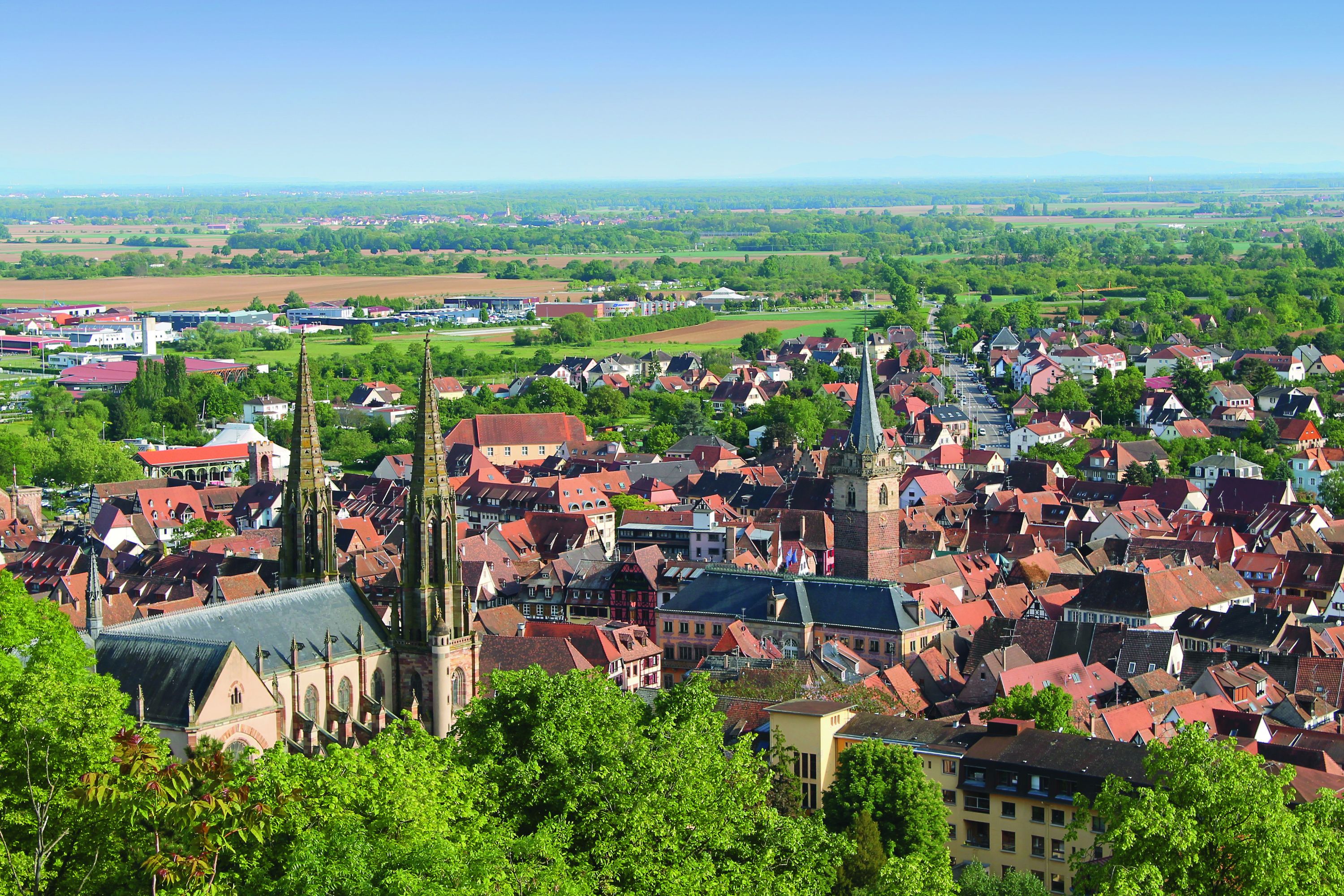
Eguisheim is a picturesque village known for its vineyards, wine cellars, and traditional Alsatian architecture. It is a great place to learn about the region's wine culture.
Mont Sainte-Odile
30 km • Half day
Mont Sainte-Odile is a mountain known for its beautiful views, hiking trails, and the Abbey of Mont Sainte-Odile. It is a great place for outdoor activities and history buffs.
Festivals
Strasbourg Christmas Market • Late November to late December
Strasbourg International Music Festival • Mid-June to mid-July
Pro tips
- Visit the Strasbourg Christmas Market if you're traveling during the holiday season.
- Take a boat tour on the canals for a unique perspective of the city.
- Explore the European Parliament to learn about the workings of the EU.
- Try traditional Alsatian dishes like tarte flambée and choucroute.
- Take a day trip to Colmar or Eguisheim to experience more of the Alsace region.
From $25
per person
Price varies by option
Secure booking
Free cancellation available
Instant confirmation