Aix-en-Provence Audioguided walking tour 2h20 and 24 reviews
Active
2h
For a full refund, cancel at least 24 hours before the scheduled departure time.
Instant confirmation
Mobile or paper ticket accepted
About this experience
Experience Aix-en-Provence differently with our exclusive audio guided tour. At your own pace, explore the City of Fountains through an itinerary designed to reveal its beauties, secrets and Provencal atmosphere. Guided by a 3D interactive map and immersive commentary, discover Aix beyond the classic circuits.
From Cours Mirabeau to Sainte-Victoire, cross old streets, mansions, markets and gardens. Discover the Mazarin district, Cézanne’s workshop, Saint-Sauveur Cathedral or the Pavillon de Vendôme, punctuated by anecdotes and legends.
The app works offline, with real-time geolocation and commentary in French, English and Spanish. Useable on five devices, it forms a flexible loop: start where you want and resume when you want.
Available options
Aix-en-Provence Audioguided walking tour 2h20 and 24 reviews
What's included
Recommendations for the best photo opportunities
Immediate access to the audioguided circuit, no tickets or materials to collect
Offline mode (no data consumption during the visit)
24 immersive audio comments along the way (History...)
Interactive navigation with 3D map to discover the most beautiful streets, squares and neighborhoods
3 languages available: French, English, Spanish
Text transcripts of all audio content
No deadlines or expirations
Admire the hidden gems that lie off the beaten track
Detailed itinerary
1
Stop 1
Pass by
This is the pretty place of Verdun. We enter here another part of the city, designed before that of Mazarin. It was built in 1583, with the aim of expanding the city, which has grown considerably in previous centuries.
2
Stop 2
Pass by
Before we talk about the Church of the Magdalene, let us dwell for a moment on the square on which it is located, the Place des Préchers. It owes its name to the old convent that was nearby.
3
Stop 3
Pass by
This small square not far from the City Inn houses the Provencal Point of Sale of Aix twice a week where fruits, vegetables, cheeses and other typical local products adorn the stalls that unfold there.
4
Stop 4
Pass by
You arrive here on the Plaza del Inn, where the Clock Tower already stands before you.
5
Stop 5
Pass by
On your left is the Carders’ Forum, one of the city’s main squares. Don’t hesitate to make a little detour to discover it.
6
On your left is a building that contains the Old Aix Museum. It is located in the former Inn Estienne de Saint-Jean, built in the 17th century, certainly by Pierre Puget.
7
Stop 7
Pass by
Let’s look to the right now: at the end of the square, we see a building listed as Historical Monuments, the former palace of the Archbishops. Come close to observe it.
8
Stop 8
Pass by
Here you are in front of the amazing Cathedral of Saint Saviour. It is built on the site of the ancient Roman forum, the main square of the ancient city, called Aquae Sextiae.
9
Take a look on your right. Here you are in front of a funerary monument made by Joseph Sec, an 18th century Aixois bourgeois, who was Jacobin, gray penitent, timber merchant and master carpenter.
10
Stop 10
Pass by
True testimony to the medieval past of the city, this tower is the only vestige of the rampart that surrounded Aix-en-Provence in the Middle Ages.
11
Stop 11
Pass by
On your right is a small street that is not exceptional at first glance, but is one of the places where the famous Emile Zola lived during his life.
12
Stop 12
Pass by
Behind you stands the imposing Vendôme pavilion. This superb building is due to the Duke of Vendôme, Louis de Mercoeur, governor of Provence, who wishes, in 1664, to build a building for the woman with whom he is madly in love, Lucrece de Forbin Solliès.
13
If there is one thing that characterizes the city of Aix-en-Provence, it is water! The city has been famous for its warm waters since ancient times.
14
Stop 14
Pass by
Here you are on the pretty little place of Tanners. In the center, there is a fountain, of course. Get a little closer to observe it.
15
Here you are on the Place du Général de Gaulle, where you can see the most famous fountain in Aix: the fountain of the Rotonde.
16
Stop 16
Pass by
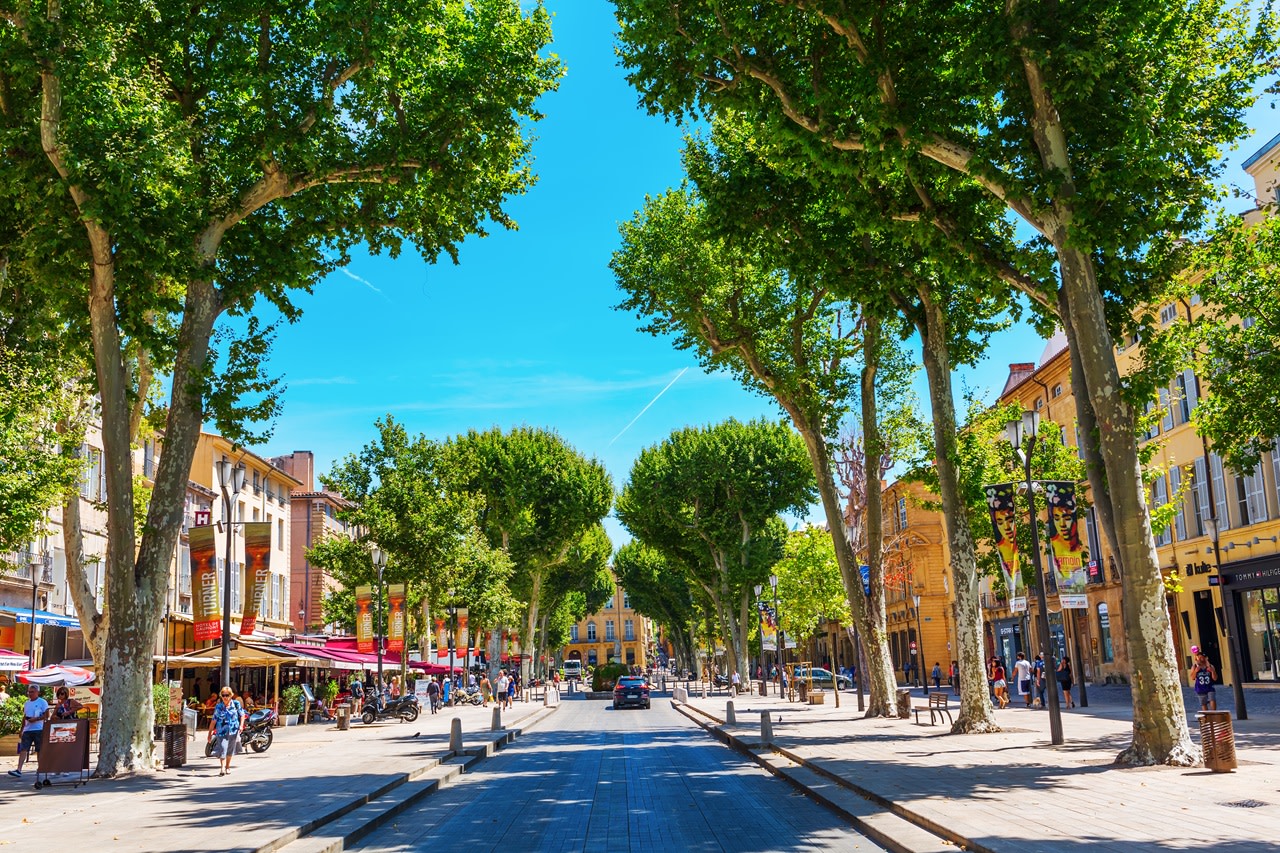
The Cours Mirabeau is one of the busiest places in Aix-en-Provence. It was built in the 17th century, in place of the ramparts. An esplanade was then built to be a place of walk for the Aix nobility.
17
You are in front of the Inn of Caumont, one of the most beautiful mansions in the city. It was built between 1715 and 1742 by George Vallon, at the request of François de Rolland, President of the Court of Auditors.
18
Here is the Place des Quatre Dauphins, where there is a fountain of the same name, designed by Jean-Claude Rambot and Pierre Pavillon in the 17th century.
19
The Mazarin district emerged during the 17th century. It was born of the will of Michel Mazarin, Archbishop of the city, and brother of the Prime Minister of Louis XIV, to expand the city southward to enlarge it.
20
Stop 20
Pass by
The church of Saint-Jean-de-Malte existed before the formation of the Mazarin district. It is indeed the very first Gothic church in Provence.
21
Stop 21
Pass by
Place Forbin marks the end of the Cours Mirabeau. It has been converted at the same time as this one to become one of the central squares of the city.
22
This very special fountain is called the Hot Water Fountain, or more commonly the Moss Fountain. Do you see why?
23
Here you are on the Place d’Albertas. It is still a fountain that we see here, and this one deserves a little more attention than the others.
24
Stop 24
Pass by
One more Inn you have in front of you, the Boyer d’Eguilles Inn.
What's not included
Entrance fees to paying establishments along the route (optional)
Headphones or headphones (optional)
Available languages
Audio guide
EN
FR
ES
Written guide
EN
FR
ES
Important information
Service animals allowed
Public transportation options are available nearby
Travelers should have a high level of physical fitness
Meeting point
We build our circuits in the form of a loop so that you can easily start the tour at the point closest to you, the guidance will adapt automatically. If you are nearby, we recommend an ideal Check-out Point.
Important notes
Activating your audio-guided circuit:
1. Download the INWAY mobile app from your App Store or directly via this link: www.in-way.fr/app
2. Open the application and enter your code to unlock the circuit: AIX49328
About Aix-en-Provence
Aix-en-Provence is a charming city in southern France, known for its elegant fountains, vibrant markets, and rich cultural heritage. It offers a blend of historical sites, beautiful architecture, and a lively arts scene, all set against the backdrop of the scenic Provence countryside.
Top Attractions
Cours Mirabeau
A grand boulevard lined with fountains, trees, and historic buildings. It's the heart of the city and a popular spot for strolling and dining.
Historical/Architecture
1-2 hours
Free
Atelier Cézanne
The former studio of the famous Post-Impressionist painter Paul Cézanne. It offers insights into his life and work.
Historical/Cultural
1 hour
€6-€8
Basilique Saint-Sauveur
A stunning basilica with a mix of Romanesque and Gothic architecture, featuring beautiful stained glass windows and a crypt.
Religious/Historical
30 minutes to 1 hour
Free (donations welcome)
Jardin du Palais de Justice
A beautiful garden with fountains and a view of the old Palace of Justice. It's a peaceful spot to relax and enjoy the scenery.
Nature/Historical
30 minutes
Free
Musée Granet
A renowned art museum housing works by Cézanne, Picasso, and other famous artists. It's a must-visit for art lovers.
Museum/Art
1-2 hours
€7-€10
Must-Try Local Dishes
Ratatouille
A traditional vegetable stew made with eggplant, zucchini, bell peppers, and tomatoes, cooked with herbs de Provence.
Main Dish
Vegetarian
Bouillabaisse
A classic fish stew from Marseille, often served with rouille (a spicy saffron mayonnaise).
Main Dish
Contains seafood
Tapenade
A spread made from olives, capers, and anchovies, typically served with bread.
Appetizer
Contains anchovies
Calissons d'Aix
A traditional confection made from almonds, orange blossom, and candied melon.
Dessert
Vegetarian
Popular Activities
Hiking in the Calanques
Cycling through the countryside
Sunbathing at the beach
Picnicking in the parks
Visiting museums and galleries
Attending festivals and concerts
Swimming and boating in the Calanques
Skiing in the nearby Alps
Best Time to Visit
June to August
This is the busiest time of year with warm weather, festivals, and outdoor activities. However, it can be crowded and more expensive.
20-32°C
68-90°F
Practical Information
Language
- Official: French
- Widely spoken: English, Provençal (Occitan)
- English: Moderately spoken
Currency
Euro (EUR)
Time Zone
GMT+1 (CET), GMT+2 (CEST during daylight saving time)
Electricity
230VV, 50HzHz
Safety Information
Overall Safety Rating: Generally safe
Aix-en-Provence is generally safe, with low crime rates. However, as with any tourist destination, it's important to be aware of your surroundings and take precautions to protect your belongings.
Important Precautions:
- • Keep valuables secure and out of sight
- • Use reputable taxi services or ride-sharing apps
- • Be cautious of strangers approaching you with unusual requests or offers
Getting there
By air
- Marseille Provence Airport • 25 km
By train
Aix-en-Provence TGV Station, Aix-en-Provence Centre
By bus
Aix-en-Provence Bus Station
Getting around
Public transport
Buses are the primary mode of public transport in Aix-en-Provence. The network is efficient and covers most of the city.
Taxis
Available • Apps: G7, Uber
Rentals
Car, Bike, Scooter
Neighborhoods
Mazarin Quarter
Old Town (Vieux Aix)
Encagnane
Day trips
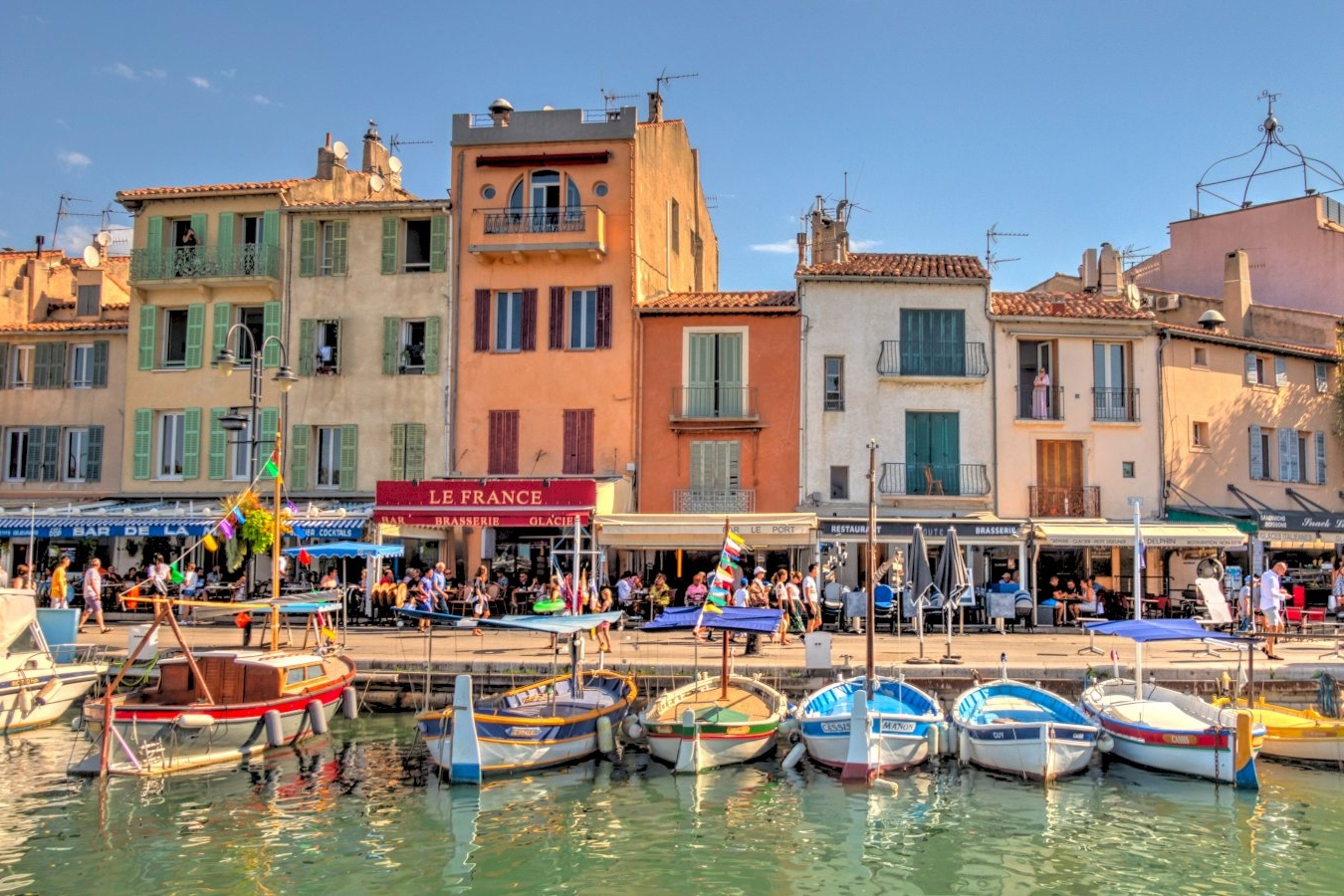
Cassis
30 km • Half day to full day
A picturesque fishing town known for its stunning calanques (rocky inlets) and beautiful beaches.
Lubéron
40 km • Full day
A scenic region known for its rolling hills, lavender fields, and charming villages.
Marseille
30 km • Full day
France's second-largest city, known for its vibrant culture, historic sites, and stunning views from Notre-Dame de la Garde.
Festivals
Festival d'Aix-en-Provence • July
Fête de la Musique • June 21
Festival d'Art Lyrique • July to August
Pro tips
- Visit the local markets for fresh produce, cheese, and other local specialties
- Take a cooking class to learn how to make traditional Provençal dishes
- Explore the surrounding countryside and villages for a more authentic experience
- Visit the city's museums and galleries to appreciate its rich artistic heritage
- Try the local rosé wine, which is a specialty of the region
From $25
per person
Price varies by option
Secure booking
Free cancellation available
Instant confirmation