Guided Old City Tour on Baku's Timeless Charm
Active
2h
For a full refund, cancel at least 24 hours before the scheduled departure time.
Instant confirmation
Mobile or paper ticket accepted
About this experience
Step into history with our exclusive Baku Old City Tour, where ancient walls, cobblestone streets, and centuries-old landmarks come alive through captivating stories. What sets us apart? It’s more than a tour—it’s a journey through time. Led by passionate local guides, our experience combines deep historical insights with personal anecdotes, unveiling secrets of the UNESCO-listed Icherisheher like no one else.
Explore iconic attractions such as the Maiden Tower, Shirvanshah's Palace, and the bustling old bazaar, all while enjoying a tailored approach that ensures you uncover hidden gems often missed by other tours. Whether you're marveling at intricate architecture or savoring local flavors along the way, every moment is designed to immerse you in the soul of Baku.
Our small group sizes ensure personalized attention, and we prioritize creating a warm, engaging atmosphere. Choose our tour for an authentic, unforgettable adventure through the heart of Azerbaijan's vibrant history!
Available options
Guided Old City Tour on Baku's Timeless Charm
What's included
Professional Tour Guide
Detailed itinerary
1
The Double Gates of Baku, also known as the Baku Old City Gate, is a historical and cultural landmark located in the heart of Azerbaijan’s capital city which is also named Gosha Gala in the Azerbaijani language. The gates, which date back to the 12th century, have played a significant role in the city’s fortifications throughout history and have been well-preserved as a UNESCO World Heritage Site. In this blog post, we will explore the rich history, cultural significance, and current state of the Double Gates.
2
It was built on the commercial highway of the Old City at the end of the 15th century. The courtyard of the caravanserai, square in plan, with a raised portal, was octagonal in shape. Perimeter balconies and private rooms are surrounded by cells. The comfortable eight-sided courtyard was a special open-air hall where travelers and merchants gathered after their daily trade. Along the entire perimeter of the inner space of the flat-framed courtyard, the reaching arch, which is combined with the general style, forms the main part of the architectural composition.
The restoration work carried out in 1964 completely freed the caravanserai building from the buildings and layers that were added later. This made it possible to reveal its large-scale structure against the background of surrounding buildings. As a result of archeological excavations, it was discovered that the water line of the kung pipe, which supplies water to Baku, passed under the caravanserai.
3
The Multani Caravanserai is a caravanserai located in Baku, Azerbaijan. It was established in the 14th century and is located in the Icherisheher old town, opposite the Bukhara Caravanserai.[1]
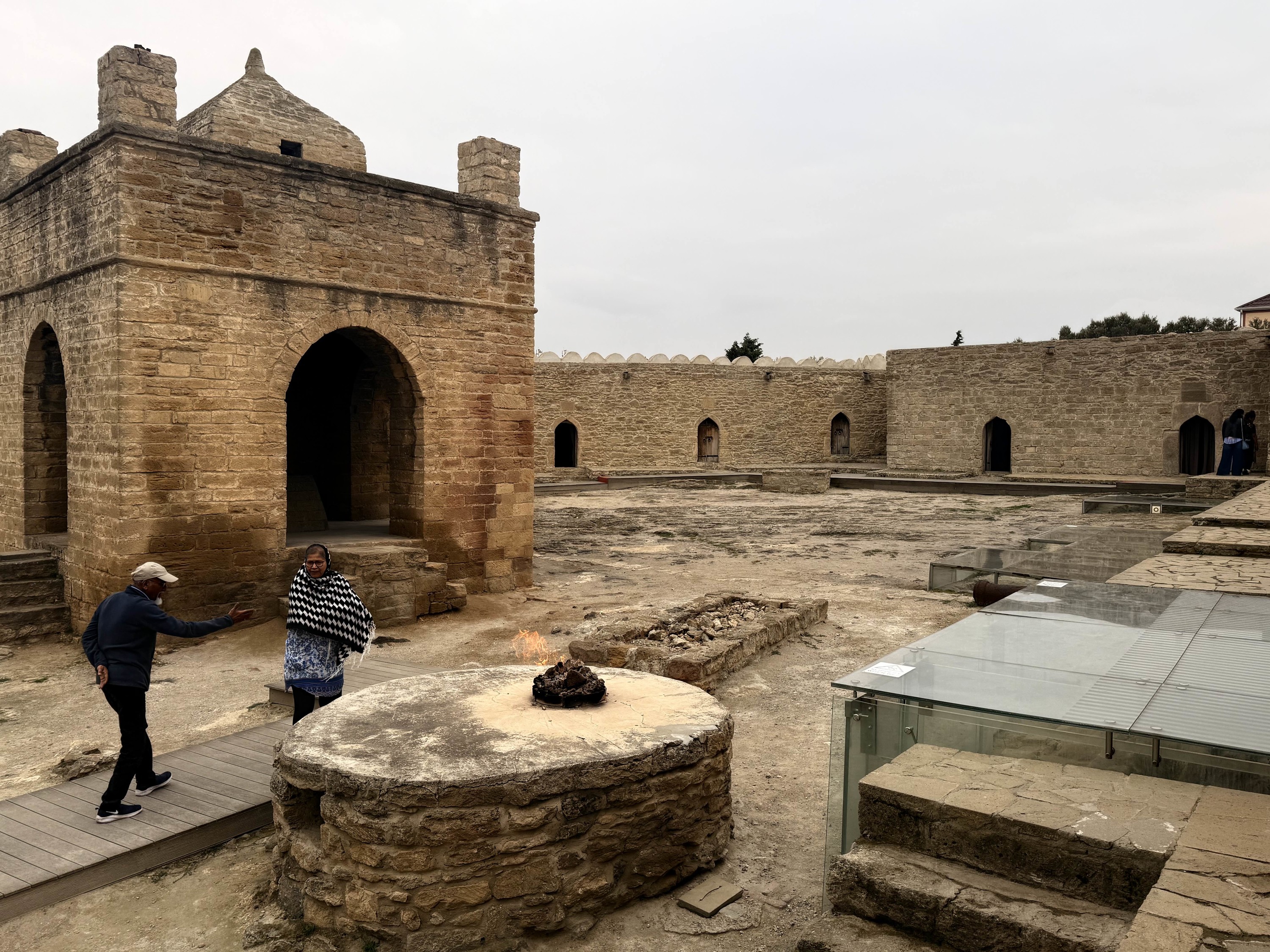
The caravanserai was built to house merchants from the medieval city of Multan (now in Punjab, Pakistan) who frequented the region for trade, and used this caravanserai as a stop.[2][3] They included Zoroastrians, who are also believed to have erected the Ateshgah Temple in Surakhani.
4
Stop 4
The Maiden Tower (Azerbaijani: Qız qalası) is a 12th-century monument in the Old City, Baku, Azerbaijan. Along with the Shirvanshahs' Palace, dated to the 15th century, it forms a group of historic monuments listed in 2001 under the UNESCO World Heritage List of Historical Monuments as cultural property, Category III. It is one of Azerbaijan's most distinctive national emblems, and is thus featured on Azerbaijani currency notes and official letterheads.
Some scientific sources indicate that the Maiden Tower is a paramount example of Zoroastrianism and the pre-Islamic architecture in Iran and Azerbaijan.[6][7] Davud A. Akhundov provides archeological and architectural evidence and argues that the Tower is Zoroastrians' Fire temple-Tower which had 7 fire exits on the top of the tower.[8] Zoroastrian believed that there are 7 Steps or 7 Sky to reach heaven.
5
Stop 5
Bazar square (Azerbaijani: Bazar meydanı) or Khanqah complex (Azerbaijani: Xanəgah kompleksi) is a historic religious-architectural complex with arcade of XII-XIII centuries. It is a part of Old City and located on Kichik Gala street, in the city of Baku, in Azerbaijan. It was also registered as a national architectural monument by the decision of the Cabinet of Ministers of the Republic of Azerbaijan dated August 2, 2001, The complex was discovered during archeological excavations carried out in 1964 on the northern side of the Maiden Tower
6
St. Bartholomew Church was built in 1892 at the expense of donations from the local Christian population on the site where the Apostle Bartholomew was believed to have been killed.[1] It is believed that in this area near the Maiden Tower the apostle Bartholomew was crucified and killed by local pagans in 71 AD.[2]
The interior of the small chapel-shaped orthodox church was decorated with icons of Bartholomew and other saints.[3] The church was built by architect Johann Edel in the architectural style of Russian churches. It was built on the foundations of the first and oldest church in Baku. The church continued to operate until 1936, then it was demolished as a part of the campaign against religion.
7
Stop 7
The bath has been underground for many centuries. In 1964, a medieval bath was discovered during archaeological research in this area.
The bath was built at the end of the 15th century. The customer of the bath was Haji Ghayib, and the architect was Haji Bani. That's why the bath is called Haji Ghayib or Haji Bani bath. As one of the main elements of Muslim cities, this bath is distinguished by its massive appearance on the caravan route.
The rich covering system of rooms available in architectural forms gives extremely artistic expressiveness even to the interior of small cells.
When entering the bathroom, one can feel that expressive architectural forms and full volume plastic style are used there.
8
Stop 8
Two-storey caravansary or Gasim bey caravansary is a historical-architectural monument of the 15th century located in Icherisheher. According to some sources, the caravanserai was built in the 15th century during the reign of Shirvanshah I Khalilullah . After the accession of the Baku Khanate to the Russian Empire , the caravanserai was given to the use of Gasim Bey, one of the Baku Beys, and his heirs
9
Stop 9
Juma Mosque (Azerbaijani: Cümə məscidi, or Friday Mosque), is a mosque in Baku, Azerbaijan.[1]
An inscription on the mosque mentions that “Amir Sharaf al-Din Mahmud ordered the restoration of this mosque in the month of Rajab 709 A.H. (1309)”. On the northern wall of the mosque a minaret was erected which a balcony supported by stalactites in the year of 1437.
Located in the historic Icheri Sheher, the mosque has been rebuilt several times. The present Friday Mosque was built in 1899 under the financing of Baku philanthropist merchant Haji Shikhlali Dadashov. There are traces of a Zoroastrian temple at the site.
10
Stop 10
The Small Cravanserai in Baku, Azerbaijan has a square shape and an inner quadrangular courtyard with cut corners. This caravanserai was built in the 12th century. There is a long balcony which surrounds the building of the caravanserai. The north and south entrances of the caravanserai are portal-shaped. During the Middle Ages, there was a main entrance from the sea. The caravanserai has a defensive construction and two floors on the southern side.
11
Stop 11
The Gasim bey Bath, built in the 17th century, is a medieval monument of national importance. Also named Sweet Bath for the sweets served to bathers with their tea, it is located near the Salyan gates of the fortress, Icheri Sheher, Azerbaijan. The bath has a traditional design, with an entrance hall, a cloakroom, baths, swimming pools and a boiler-house. Cross-shaped domes are in the dressing room and swimming pool. They were located on the sides of rooms with their chambers. Ceramic tubes were located in the walls and under the floor for supplying water and heating. In 1970, the bath was reconstructed, and turned into a pharmacy known as the “Green Pharmacy”.
12
The Agha Mikayil Bath was erected in the 18th century in the south-western part of the fortress, on one of its main streets, Kichik Gala, Old City where local people frequently call this place the neighborhood of bath amateurs. It bears the name of Haji Agha Mikayil from Shamakhi, who built it It differs from other baths in that it has a large interior and the dressing room and the baths are square. The architectural composition of the structure is articulated in pointed arches and domes, divided into proportional layers. The bath has a chimney above the building. In 2010, the bath underwent restoration works and remains a functioning bath.
13
Aliagha Vahid Monument (Azerbaijani: Əliağa Vahidin heykəli) is monument in Baku, capital of Azerbaijan, in honor of the Azerbaijani poet and ghazal singer Aliagha Vahid (1895–1965). It was built in 1990. A monument to Azerbaijan's poet and ghazal singer Aliagha Vahid was first proposed in 1989. It was designed and sculpted solely by Rahib Hasanov.The architect was Sanan Salamzade. The creative process that had lasted several months was completed in March 1990. The constant, intense endeavors and efforts undertaken by the three artists were artistically and architecturally addressed in the monument. The originality of the monument's form and shape is based on the famous hemistich of the poet nicknamed “Ghazalkhan (Khan of the ghazals) "I am the successor of great Fuzuli". The authors saw the tree trunks rising out of the ground as an artistic sign of the continuation by Vahid of the best tradition of Fuzuli.
14
The Baku Museum of Miniature Books is the only museum of miniature books in the world, settled in the old part of Baku, called Inner City. The museum started its operation on April 2, 2002. In 2015, the Museum of Miniature Books was presented the Certificate of the Guinness Book of Records as the largest private museum of miniature books. Exhibits in the museum were collected by Zarifa Salahova (the sister of Tahir Salahov) over a period of 30 years. Her collection consists of more than 6500 books from 64 different countries. The museum was opened to public viewing with the hope of promoting childhood literacy.
15
Stop 15
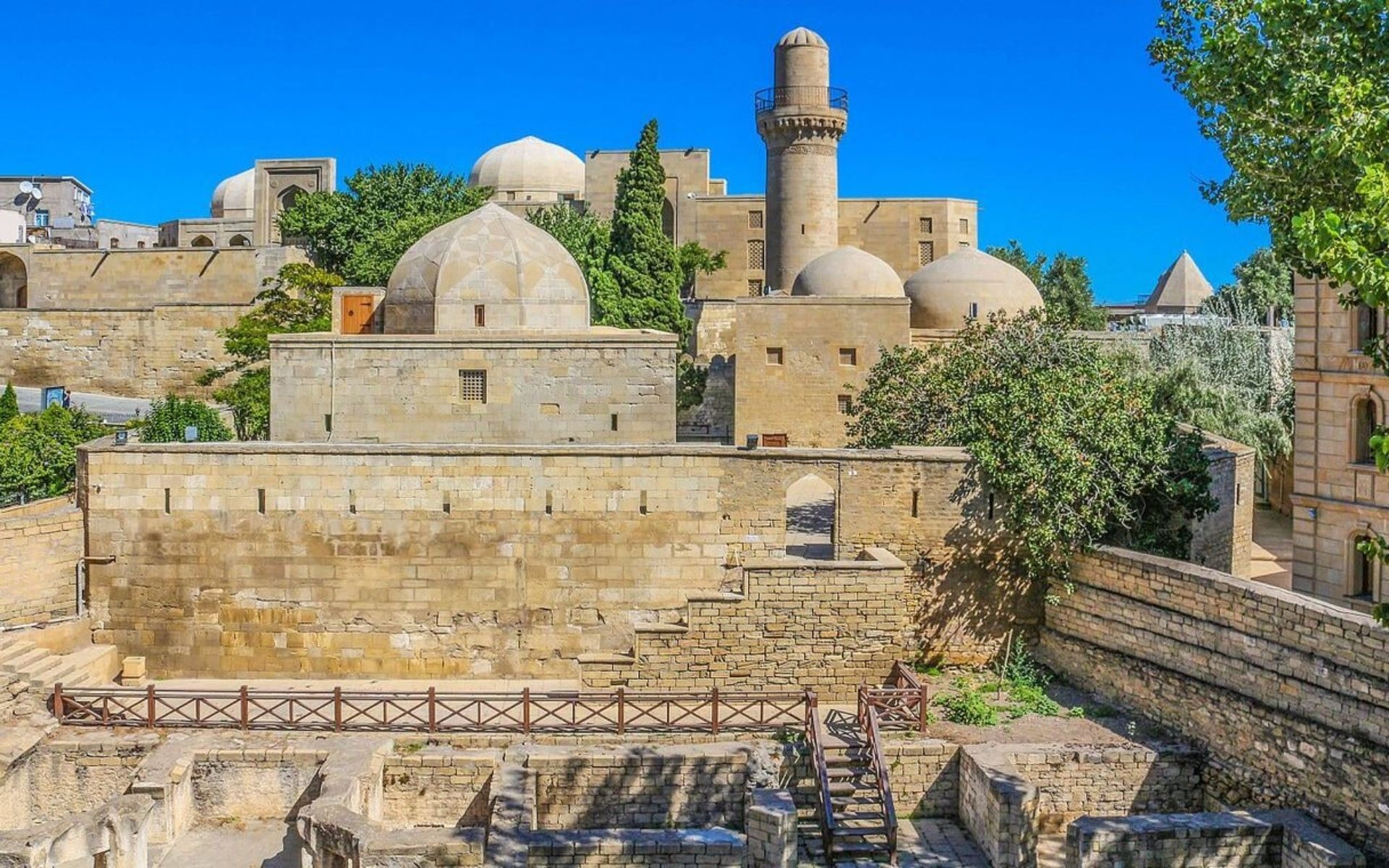
The Palace of the Shirvanshahs (Azerbaijani: Şirvanşahlar Sarayı, Persian: کاخ شروانشاهان) is a 15th-century palace built by the Shirvanshahs and described by UNESCO as "one of the pearls of Azerbaijan's architecture". It is located in the Inner City of Baku, Azerbaijan and, together with the Maiden Tower, forms an ensemble of historic monuments inscribed under the UNESCO World Heritage List of Historical Monuments. In the 15th century the Shirvanshah dynasty, under Ibrahim I of Shirvan, transferred his capital from Shemakha to Baku following a devastating earthquake. He committed himself to the construction of the "palace".
16
The Beyler Mosque is a historical and architectural monument which is located in the city of Baku, in a historical part of Icherisheher (Old City), opposite the “Murad” Gate of the Shirvanshah Palace Complex. According to the order of the Cabinet of Ministers of Azerbaijan on historical and cultural monuments, the Beyler Mosque has been included to the list of historical and cultural monument of national importance.
17
Nestled in the heart of Baku’s Old City, the Workshop Ali Shamsi serves not only as an art studio but also as a captivating attraction showcasing the works of Ali Shamsi, a renowned Azerbaijani artist. Born in Azerbaijan and having moved to Baku during his school years, Ali Shamsi’s artistic journey began at a boarding school focused on the arts, culminating in his graduation from the Azerbaijan State Institute of Arts in 1985.
Following his studies, Shamsi spent time living in a monastery near Kharkiv, where he honed his skills in painting icons. Since 1985, he has been an esteemed member of the Union of Artists of Azerbaijan. His studio, a pivotal part of Baku’s historical district, reflects his eclectic and broad artistic range, encompassing landscapes, still lifes, portraits, and abstract works. These pieces are not only visually stunning but are also imbued with a unique and peculiar charm that Shamsi is known for.
18
In the Middle Ages, the city of Baku was surrounded by two huge fortress walls from the north, east and west sides. The castle walls were often destroyed during enemy attacks, so they were rebuilt many times. The castle walls were restored for the last time in the 1950s. After the last restoration, 25 semi-circular and one quadrangular tower ("donjon" or "armorary") remained in the castle walls.
What's not included
All Fees and Taxes
Available languages
Guide guide
RU
EN
Reviews breakdown
Tripadvisor
5.0
4 reviews
5★
4
4★
0
3★
0
2★
0
1★
0
Important information
Service animals allowed
Public transportation options are available nearby
Suitable for all physical fitness levels
Meeting point
Meeting point is inside of Double Gate.
About Baku
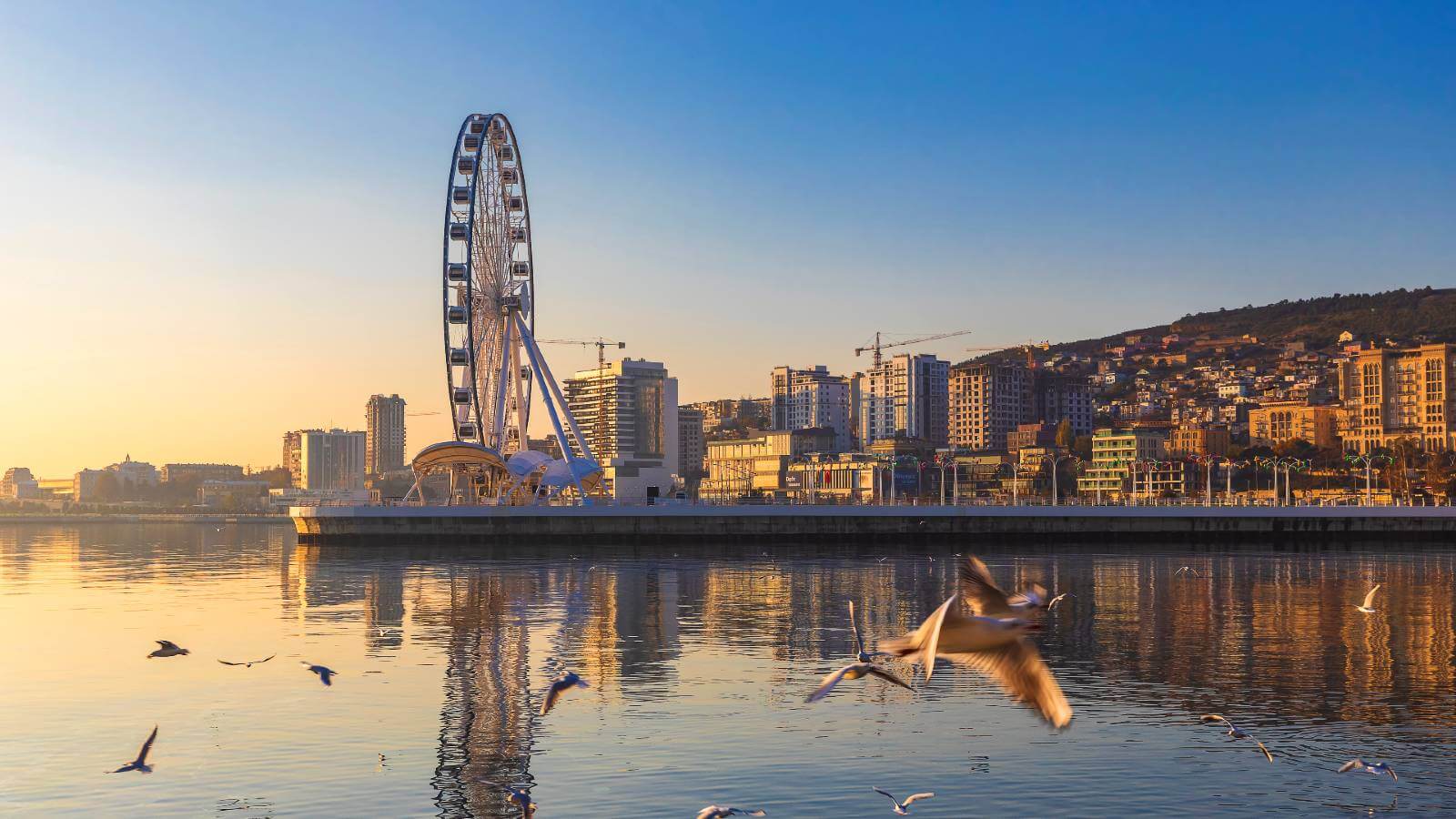
Baku, the capital of Azerbaijan, is a vibrant city where modernity meets tradition. Situated on the Caspian Sea, it's known for its futuristic skyline, historic sites, and rich cultural heritage, including the ancient Maiden Tower and the iconic Flame Towers.
Top Attractions
Maiden Tower
A 12th-century monument that is a symbol of Baku. Its exact purpose remains a mystery.
Historical
1-2 hours
Moderate (5 AZN)
Flame Towers
Three futuristic skyscrapers that are landmarks of modern Baku. The towers are designed to resemble flames, a reference to Baku's ancient history as a center of the fire-worshipping Zoroastrian religion.
Architecture
30 minutes to 1 hour
Free to view from outside
Old City (Icheri Sheher)
The historic core of Baku, a UNESCO World Heritage site with ancient walls, narrow streets, and historic buildings.
Historical
2-3 hours
Free to explore, attractions within have varying costs
Baku Boulevard
A scenic park along the Caspian Sea with walking paths, cafes, and entertainment options.
Nature
1-2 hours
Free to enter, activities have varying costs
Heydar Aliyev Center
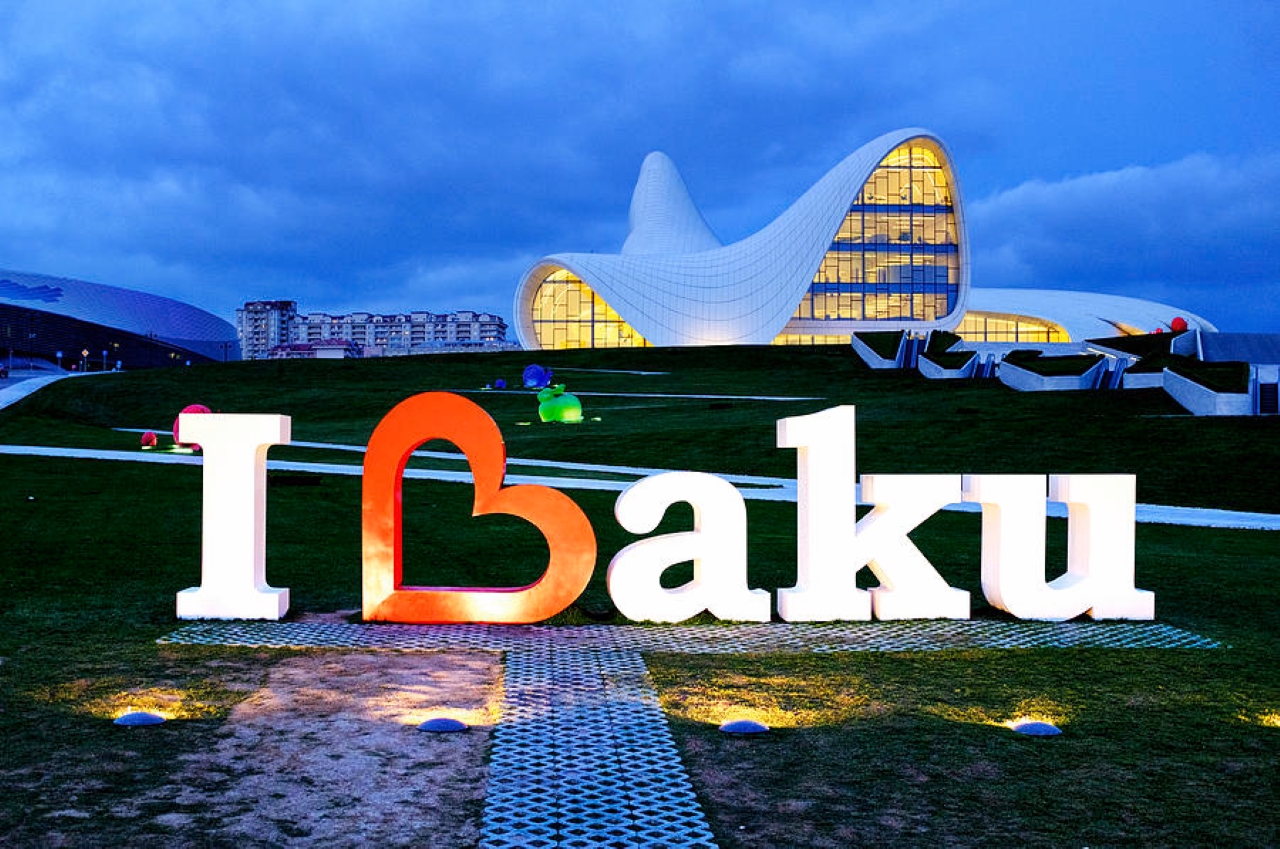
A stunning piece of modern architecture designed by Zaha Hadid. The center hosts exhibitions, concerts, and conferences.
Architecture
1-2 hours
Moderate (depends on the event)
Must-Try Local Dishes
Plov
A fragrant rice dish cooked with saffron, meat, and vegetables. It's often served at special occasions and is considered a national dish.
Main course
Contains meat, can be made vegetarian upon request
Dushbara
Tiny dumplings filled with minced meat and served in a broth. It's a popular street food in Baku.
Soup
Contains meat, can be made vegetarian upon request
Baku Piti
A traditional soup made with lamb, chickpeas, and noodles, served in a clay pot.
Soup
Contains meat, can be made vegetarian upon request
Baku Dolma
Grapes leaves or vegetables stuffed with a mixture of minced meat and rice, cooked in a spicy tomato sauce.
Appetizer
Contains meat, can be made vegetarian upon request
Popular Activities
Hiking in Gobustan National Park
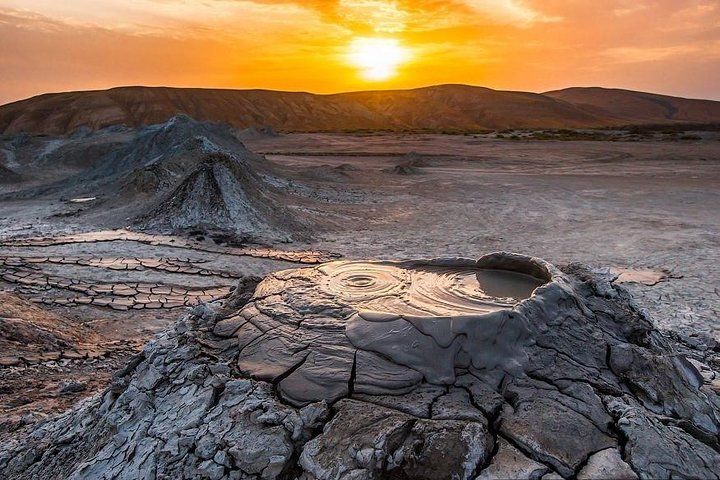
Exploring mud volcanoes
Visiting the Shamakhi Astrophysical Observatory
Strolling along Baku Boulevard
Enjoying a cup of tea in a traditional teahouse
Relaxing at a local hammam (bathhouse)
Exploring the Old City
Visiting museums and historic sites
Best Time to Visit
April to June, September to October
This is the best time to visit Baku with pleasant weather, ideal for sightseeing and outdoor activities. Crowds are moderate, and the city hosts several festivals during these months.
18°C to 28°C
64°F to 82°F
Practical Information
Language
- Official: Azerbaijani
- Widely spoken: Russian, English (in tourist areas)
- English: Moderately spoken in tourist areas, limited elsewhere
Currency
Azerbaijani Manat (AZN)
Time Zone
GMT+4
Electricity
220VV, 50HzHz
Safety Information
Overall Safety Rating: Generally safe
Baku is generally safe for travelers, with low crime rates. However, petty crime like pickpocketing can occur in crowded areas. Exercise caution at night, especially in less touristy areas.
Important Precautions:
- • Keep valuables secure
- • Use official taxis or ride-hailing apps
- • Be cautious of strangers offering help or services
Getting there
By air
- Heydar Aliyev International Airport • 20 km from city center
By train
Baku Railway Station
By bus
Baku International Bus Terminal
Getting around
Public transport
The metro is efficient, clean, and affordable. It's the best way to get around the city quickly.
Taxis
Available • Apps: Bina Taxi, Yandex.Taxi
Rentals
Car, Bike
Neighborhoods
Old City (Icheri Sheher)
Nizami District
Khatai District
Day trips
Gobustan National Park
60 km from Baku • Full day
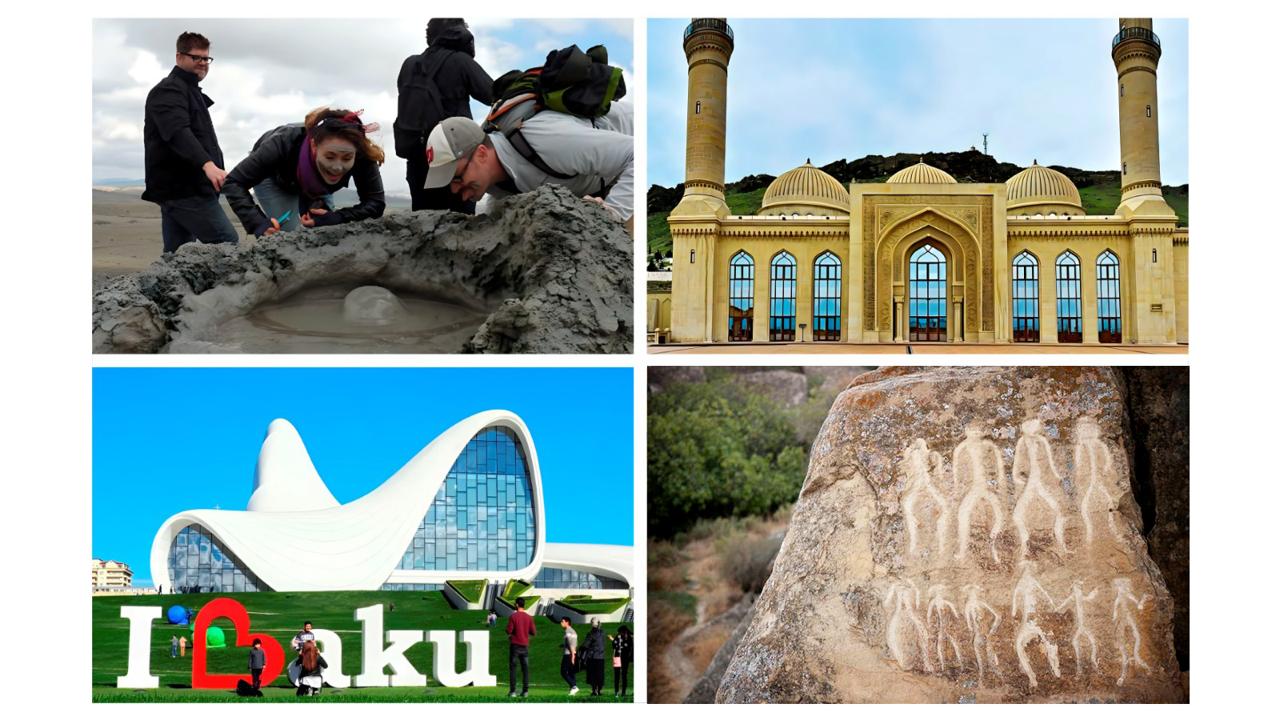
A UNESCO World Heritage site featuring ancient rock carvings, mud volcanoes, and a unique desert landscape. It's a great place for hiking and exploring.
Lankaran
220 km from Baku • Full day or overnight
A city in southern Azerbaijan known for its lush greenery, historic sites, and the nearby Hirkan National Park. It's a great place for nature lovers and history buffs.
Shamakhi
120 km from Baku • Full day
A historic city known for its ancient Juma Mosque, the Yeddi Gumbaz mausoleums, and the nearby Shamakhi Astrophysical Observatory. It's a great place for history lovers and those interested in astronomy.
Festivals
Baku International Jazz Festival • October
Baku International Film Festival (BAFTA) • October
Novruz Bayrami • March 20-21 (or around the spring equinox)
Pro tips
- Visit the Flame Fountain in Baku Boulevard, a unique attraction where natural gas flames continuously burn from a stone fountain
- Try traditional Azerbaijani tea in a local teahouse, such as Sazaghan Teahouse or Chaykhana #1
- Explore the Old City on foot, taking in the narrow streets, historic sites, and local markets
- Take a day trip to Gobustan National Park to see ancient rock carvings and mud volcanoes
- Visit the Heydar Aliyev Center, a stunning piece of modern architecture designed by Zaha Hadid
From $25
per person
Price varies by option
Secure booking
Free cancellation available
Instant confirmation