Padova Walking Tour with Audio and Written Guide by a Local
Active
3h - 4h
For a full refund, cancel at least 24 hours before the scheduled departure time.
Instant confirmation
Mobile or paper ticket accepted
About this experience
If you're looking for a fun and curious way to visit Padova, you've come to the right place! With this guide created with a local, you will be able to visit all the most important monuments at your own pace. You'll get to know the stories and curiosities of Padova! But also you will discover everything about local foods, Italian aperitivo in authentic local restaurants, and much more!
Available options
Padova Walking Tour with Audio and Written Guide by a Local
What's included
Text in different laguages (Eng, Deu, Esp, Ita)
Best advices for local restaurant with authentic food
Tips for monuments, history, curiosities and personal anecdotes
Audio and Text in multiple languages (Eng, Esp, Ita, Ger, Fr)
Digital written guide to visit the city by yourself
Detailed itinerary
1
Stop 1
A small church is hiding a monumental treasure.
The Scrovegni Chapel stands within the area of the Roman amphitheatre in Padua. The façade itself is built on the basis of an important Roman building, traces of which remain today. Inside you'll find the amazin paintings by Mr Giotto itself!
Ticket is not included (16€)
2
The Church of the Eremitani was erected as the Church of Saints Philip and James between 1260 and 1306 for the Eremitan friars of St Augustine. During the 14th century, it became one of the most important churches in Padua and was embellished with the works of the greatest artists active in the city, such as Andrea Mantegna and Guariento.
3
An institution in the city of Padua and a must do when you come here! I recommend a short visit to everyone and if you want, you can also consume their ‘Caffè Pedrocchi’: a drink that combines espresso coffee, cocoa, milk and mint syrup!
4
One of the city’s many (and beautiful) squares! So called because here stood the “Palazzo della Signoria”, or “Palace of the Carraresi”, who were the Lords of Padua from 1318 to 1405.
5
Dedicated to Saint Mary of the Assumption, it took its present form thanks to the architect Andrea da Valle, following a design by Michelangelo Buonarroti ( the famous Michelangelo! ) dating back to 1551.
6
For centuries this square was the ‘commercial centre’ of the city. Unlike the nearby Piazza dei Signori where the more ‘institutional’ celebrations were held, Piazza delle Erbe was home to the more popular festivities. The imposing Palazzo della Ragione overlooks the square.
7
The Studium Patavinum, i.e. the University of Padua, today one of the most popular universities in Italy, was founded in 1222 to accommodate students who had moved away from the Alma Mater in Bologna, considered too controlled by the Church. We'll find this into the Palazzo Bo!
8
Stop 8
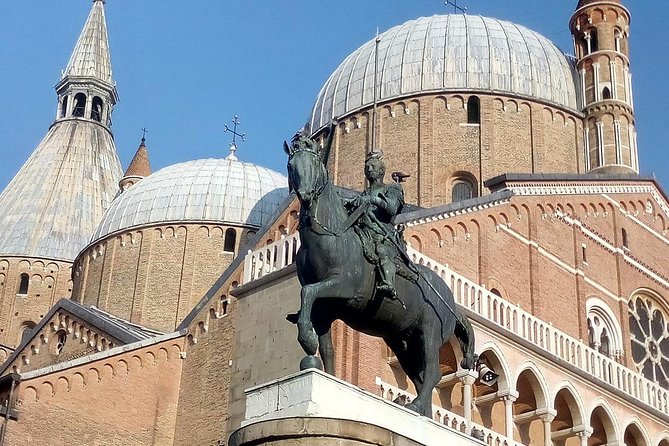
The “Basilica del Santo” is one of the most visited sanctuaries in the world. A treasure chest that also houses the remains of Saint Anthony of Padua, the Saint par excellence.
9
Stop 9
A great boast for the city of Padua! With an area of 88620 m², it is the second largest square in Europe, second only to Moscow’s Red Square.
What's not included
Cappella degli Scrovegni ticket (not mandatory): 16€
Available languages
Audio guide
DE
EN
IT
FR
ES
Written guide
DE
EN
IT
FR
ES
Reviews breakdown
Viator
4.3
12 reviews
5★
6
4★
4
3★
1
2★
1
1★
0
Tripadvisor
4.9
47 reviews
5★
41
4★
5
3★
1
2★
0
1★
0
Important information
Wheelchair accessible
Infants and small children can ride in a pram or stroller
Service animals allowed
Public transportation options are available nearby
Suitable for all physical fitness levels
You'll be able to hear the audio through your speakers or, if you have them, through your headphones
You will need a smartphone with internet connection to use the digital guide (details to activate the digital guide will be in your voucher, read it carefully!)
Meeting point
If you are already in the city there is no need to go to the train station: you can easily start your tour from here!
Important notes
⚠️TO ACTIVATE YOUR TOUR ⚠️ you can click here:
https://walkingcap.com/padovadigitalguide
(If you can't click on the link, just copy/paste it in your browser)
Password: 813912217
If you need some support (or you can't login) check the FAQ here: https://walkingcap.com/faq
Or contact me on whatsapp here: +390350311698
or with this link: https://wa.me/message/JSWUDT7IX3WTA1
About Padua
Padua is a historic city in northern Italy known for its rich cultural heritage and stunning architecture. It is home to one of the world's oldest universities and a vibrant art scene, making it a must-visit for history buffs and art enthusiasts alike.
Top Attractions
Scrovegni Chapel
The Scrovegni Chapel is famous for its stunning frescoes by Giotto, which are considered some of the most important works of the early Renaissance.
Historical/Art
1 hour
€13 (includes audio guide)
Padua Cathedral (Duomo di Padova)
The Padua Cathedral is a beautiful example of Renaissance architecture and is dedicated to the Virgin Mary and Saint Anthony of Padua.
Religious/Architecture
30 minutes
Free (donations welcome)
Basilica of St. Anthony of Padua
This basilica is one of the most important religious sites in Italy and is dedicated to Saint Anthony, the patron saint of Padua.
Religious/Historical
1-2 hours
Free (donations welcome)
Prato della Valle
Prato della Valle is one of the largest squares in Europe and is surrounded by beautiful statues and a picturesque canal.
Historical/Landmark
30 minutes
Free
University of Padua Botanical Garden
This botanical garden is one of the oldest in the world and is a UNESCO World Heritage Site. It features a wide variety of plants and a beautiful historic greenhouse.
Nature/Historical
1-2 hours
€10
Must-Try Local Dishes
Risotto al Tastasal
A traditional Paduan risotto made with a spiced sausage called tastasal, which is a mix of pork, garlic, and spices.
Main Course
Contains pork
Bigoli con l'Anatra
A dish of duck ragout with bigoli, a type of thick spaghetti, served with a rich duck sauce.
Main Course
Contains duck
Frittelle di Riso
Sweet rice fritters, a traditional dessert from Padua, often filled with cream or jam.
Dessert
Vegetarian (check for dairy or egg content)
Popular Activities
Hiking in the nearby Euganean Hills
Biking along the city's bike paths
Visiting the University of Padua Botanical Garden
Enjoying a coffee at Caffè Pedrocchi
Exploring the Scrovegni Chapel
Visiting the Basilica of St. Anthony
Boating on the Brenta River
Visiting the historic cafes and museums
Best Time to Visit
April to June, September to October
The best time to visit Padua is during the spring and fall when the weather is mild, and the crowds are smaller. This period offers pleasant temperatures and fewer tourists.
15-25°C
59-77°F
Practical Information
Language
- Official: Italian
- Widely spoken: English, French, German
- English: Moderately spoken
Currency
Euro (EUR)
Time Zone
GMT+1 (CET), GMT+2 (CEST during daylight saving time)
Electricity
230VV, 50HzHz
Safety Information
Overall Safety Rating: Generally safe
Padua is a generally safe city with low crime rates. However, as with any destination, it is important to take basic precautions to ensure a safe and enjoyable trip.
Important Precautions:
- • Keep valuables secure and be aware of your surroundings in crowded areas
- • Use metered taxis or ride-sharing apps to avoid overcharging
- • Be cautious of distractions and common scams
Getting there
By air
- Marco Polo Airport • 35 km from Padua
- Treviso Airport • 60 km from Padua
By train
Padua Railway Station
By bus
Padua Bus Station
Getting around
Public transport
The bus system in Padua is extensive and covers most of the city. Buses are the primary mode of public transportation and are efficient and affordable.
Taxis
Available • Apps: FreeNow
Rentals
Car, Bike, Scooter
Neighborhoods
Centro Storico (Historic Center)
Prato della Valle
Arcella
Day trips
Venice
35 km • Full day
Venice is a unique and romantic city built on water, known for its canals, gondolas, and historic architecture.
Verona
100 km • Full day
Verona is a historic city known for its Roman amphitheater, medieval architecture, and as the setting of Shakespeare's Romeo and Juliet.
Vicenza
35 km • Half day
Vicenza is a city known for its Palladian architecture and historic landmarks, including the famous Teatro Olimpico.
Festivals
Festa del Santo • June 13
PadovaFiere • Various dates throughout the year
Pro tips
- Visit the Scrovegni Chapel early in the morning to avoid long queues and crowds
- Explore the historic center on foot to discover hidden gems and local charm
- Try local specialties like Risotto al Tastasal and Frittelle di Riso for an authentic culinary experience
- Use the bus system for efficient and affordable travel within the city
- Consider a day trip to nearby cities like Venice or Verona for a well-rounded Italian experience
From $25
per person
Price varies by option
Secure booking
Free cancellation available
Instant confirmation