Private Day Trip to Timisoara from Belgrade
Active
10h
For a full refund, cancel at least 24 hours before the scheduled departure time.
Instant confirmation
Mobile or paper ticket accepted
About this experience
Spend the day in Romania and get a taste for a different culture on this private day trip. Visit the historic city of Timișoara, one of Romania’s biggest cities, built on the site of an ancient Roman fortress. Hear stories about the 1989 revolution against the Communist regime and take your time to explore on your own and find a nice spot for lunch.
Available options
Private Day Trip to Timisoara from Belgrade
Pickup included
What's included
All fuel costs, parking fees, and road tolls
Professional English-speaking guide
Entrance fee to Memorialul Revolutiei
Tour organization and 24/7 assistance from a licensed incoming tour operator
Transport by air-conditioned minivan (4-7 pax) or private sedan car (1-3 pax)
Free hotel pick-up and drop-off
A bottle of water per person
Detailed itinerary
1
Meet your driver at your accommodation in Belgrade and settle into your private vehicle for the 2.5-hour journey to Timisoara.
2
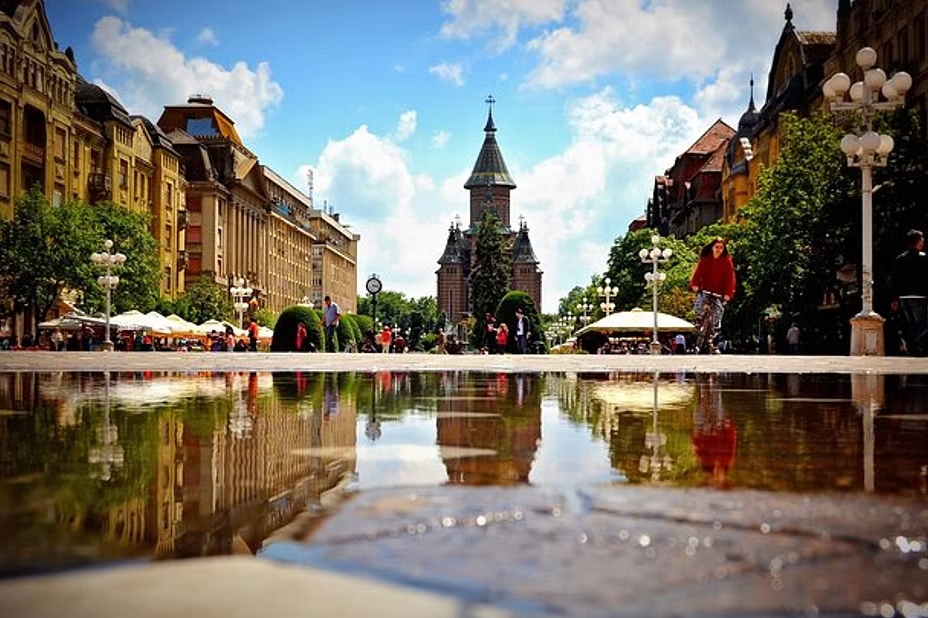
This walking tour of Timisoara starts with the downtown quarter of Cetate to see the essential image of Timisoara – many old buildings in the styles of Art Nouveau or Baroque, large pedestrianized squares touched by European history, as well as the multicultural character of the city and the Banat region.
3
Stop 3
We will start our sightseeing here. The cathedral was built in the late 1930s in the eclectic neo-Moldavian style, which combines Byzantine, Gothic, Ottoman, and Renaissance elements. Inside, notice the fragments of the 18th-century altar, executed in the Baroque style. The basement houses collections of religious objects, including rare books, icons, and paintings. Search for bullet marks on the steps in front of the cathedral, which are part of the story of the people's revolution that started in Timisoara.
4
We'll continue our tour with a visit to Victory Square, also known as Opera Square. Laid out in 1906, the square features several theaters, a museum, a monument to King Ferdinand, and a memorial to the victims of the 1989 revolution. You'll also find an old artesian well and the sculpture of a Capitoline she-wolf, a gift from the city of Rome. The ground floors of the 19th-century buildings house bookshops, art galleries, cafes, and restaurants.
5
Next is Liberty Square, which hosts the Old City Hall with the Turkish inscription and shows the mixture of cultures, religions, and civilizations. It's surrounded by important buildings, one of which is the oldest in the city, the Casino Military Museum, as well as the old town hall and the Foreign Ministry. The Sf Ioan Nepomuk Monument (the Catholic Patron in Banat) is in the middle. It was built with sandstone in 1756 by the Viennese sculptor Wasserburger Blim in honor of those who died during the 1738 plague epidemic.
6
Union Square is the oldest square in Timisoara, and its dominant architecture differentiates from that of the much younger Victory Square. It is flanked by imposing 18th and 19th Centuries buildings of St. George Roman-Catholic Cathedral and Serbian Orthodox Cathedral with a Bishop's Residence.
It seems that these two “not-so-in-union” Christian churches (here facing each other in peace) gave the symbolic name to the square - Union. Till 1919 the square was known as “Lasonczy Market”, honoring the 16th-century commandant Stefan (Istvan) Lasonchy, who bravely defended the city from the Turks.
7
The Serbian Orthodox Cathedral (built between 1745 and 1748) represents the baroque style. The structure of the church beautifully contrasts with the façade of the Bishop’s Residence (Vicariate)standing next to it. Both structures give testimony to the strong Serbian presence in Banat (indeed, in the past, Timisoara was shortly under the control of the Serbian Kingdom, but even today, it is still located very close to the Serbian border).
8
Viennese architect Emanuel Fisher von Erlach designed the imposing Roman Catholic Cathedral similarly – it represents the baroque style. The construction works started in 1736 and lasted for 18 years. After the death of Fisher von Erlach in 1742, local architects from Timisoara - Theodor Kostka and Alexander Steinlein took the leading role in the project. The painting of St. George on the main altar is a work of Michelangelo Unterberger, while the organ was made by Austrian master - Carl Leopold Wegenstein.
9
We'll end our sightseeing here. It is an ideal venue to brush up on the December 1989 anti-communist revolution that began here in Timişoara. Displays include documentation, posters, and photography from those fateful days, capped by a graphic 20-minute video (not suitable for young children) with English subtitles.
After the Museum, enjoy your free time wandering around the city independently or hitting the shops. For lunch (own expense), enjoy some traditional Romanian cuisine at a local restaurant that our guide will gladly recommend.
10
After free time, meet up with your guide for the return trip to Belgrade and finish your tour with a drop-off at your hotel.
What's not included
Gratuities
Available languages
Guide guide
EN
Reviews breakdown
Viator
4.9
14 reviews
5★
13
4★
0
3★
1
2★
0
1★
0
Tripadvisor
5.0
7 reviews
5★
7
4★
0
3★
0
2★
0
1★
0
Important information
Infants and small children can ride in a pram or stroller
Service animals allowed
Public transportation options are available nearby
Specialized infant seats are available
Suitable for all physical fitness levels
Important notes
• A current valid passport is required on the day of travel
• You MUST confirm and obtain any visa requirements prior to border crossing. All visa requirements are the sole responsibility of the traveler
About Belgrade
Belgrade, the vibrant capital of Serbia, is a city where ancient history and modern life intersect. Known for its lively nightlife, rich cultural heritage, and strategic location at the confluence of the Sava and Danube rivers, Belgrade offers a unique blend of Eastern and Western European influences. Its resilient spirit and diverse attractions make it a captivating destination for travelers.
Top Attractions
Belgrade Fortress
The Belgrade Fortress is one of the city's most iconic landmarks, offering stunning views of the confluence of the Sava and Danube rivers. The fortress has a rich history dating back to the Roman era and has been the site of numerous battles and sieges.
Historical/Architecture
1-2 hours
Free
Knez Mihailova Street
Knez Mihailova Street is one of the most famous pedestrian streets in Belgrade, lined with historic buildings, shops, and cafes. It's a great place to experience the city's vibrant atmosphere and do some shopping.
Shopping/Cultural
1-2 hours
Free to explore
Saint Sava Temple
Saint Sava Temple is one of the largest Orthodox churches in the world and a significant religious and cultural landmark in Belgrade. The temple is dedicated to Saint Sava, the founder of the Serbian Orthodox Church, and features stunning Byzantine-style architecture and intricate mosaics.
Religious/Architecture
1-2 hours
Free
Skadarlija
Skadarlija is a charming, bohemian street in the heart of Belgrade, known for its traditional restaurants, live music, and artistic atmosphere. It's a great place to experience the city's vibrant nightlife and sample some delicious Serbian cuisine.
Cultural/Entertainment
1-2 hours
Moderate (for dining and drinks)
Ada Ciganlija
Ada Ciganlija is a popular recreational area and artificial lake in Belgrade, often referred to as the 'Belgrade Sea'. It's a great place to escape the city's hustle and bustle, with numerous beaches, sports facilities, and picnic areas.
Nature/Recreation
Half day to full day
Free (some activities may have fees)
Must-Try Local Dishes
Ćevapi
Ćevapi are small, grilled sausages made from a mixture of minced meats, usually beef and pork. They are typically served with flatbread, onions, and ajvar (a red pepper and eggplant spread).
Main course
Contains meat
Pljeskavica
Pljeskavica is a Serbian-style burger made from a mixture of minced meats, usually beef and pork, and seasoned with various spices. It is typically served with flatbread, onions, and ajvar.
Main course
Contains meat
Sarma
Sarma is a traditional Serbian dish made from cabbage leaves stuffed with a mixture of minced meat, rice, and spices. It is usually served with mashed potatoes and ajvar.
Main course
Contains meat
Burek
Burek is a flaky, layered pastry filled with a variety of ingredients, such as minced meat, cheese, or spinach. It is a popular street food and can be found in bakeries and fast-food restaurants throughout the city.
Snack/Dessert
Can be vegetarian or vegan (cheese or spinach filling)
Popular Activities
Hiking in Tara National Park
Boat tours on the Danube River
Skiing in Zlatibor
Picnicking in Ada Ciganlija
Spa treatments in luxury hotels
Wine tasting in Oplenac
Visiting museums and galleries
Attending traditional music and dance performances
Best Time to Visit
May to September
This period offers warm weather and numerous outdoor festivals, making it the most popular time to visit. However, it can be crowded, especially in July and August.
15°C to 30°C
59°F to 86°F
Practical Information
Language
- Official: Serbian
- Widely spoken: English, Russian, German
- English: Moderately spoken
Currency
Serbian Dinar (RSD)
Time Zone
CET (GMT+1) / CEST (GMT+2, during daylight saving time)
Electricity
220VV, 50HzHz
Safety Information
Overall Safety Rating: Generally safe
Belgrade is generally a safe city for travelers, with low levels of violent crime. However, petty crime, such as pickpocketing and bag snatching, can occur in crowded areas and on public transportation. It's important to be aware of your surroundings and take precautions to protect your belongings.
Important Precautions:
- • Be aware of your surroundings and keep your belongings secure
- • Use licensed taxis or ride-sharing services, and insist on the meter being turned on
- • Check the menu and prices before ordering in restaurants and bars
Getting there
By air
- Belgrade Nikola Tesla Airport • 18 km (11 miles) from city center
By train
Belgrade Central Station
By bus
Lasta Bus Terminal, Lasta Bus Terminal 2
Getting around
Public transport
Belgrade's bus network is extensive and covers most of the city. Buses are generally reliable and affordable, but can be crowded during peak hours.
Taxis
Available • Apps: Yandex.Taxi, Bolt
Rentals
Car, Bike, Scooter
Neighborhoods
Stari Grad (Old Town)
Savski Venac
Palilula
Zvezdara
New Belgrade
Day trips
Novi Sad
90 km (56 miles) from Belgrade • Full day
Novi Sad is a charming city in northern Serbia, known for its historic architecture, vibrant cultural scene, and proximity to the Danube River. It's a great destination for a day trip from Belgrade, offering a mix of history, culture, and natural beauty.
Golubac Fortress
100 km (62 miles) from Belgrade • Half day to full day
Golubac Fortress is a stunning medieval fortress located on the banks of the Danube River, near the town of Golubac. It's a great destination for a day trip from Belgrade, offering a mix of history, architecture, and natural beauty.
Oplenac
130 km (81 miles) from Belgrade • Full day
Oplenac is a small town in central Serbia, known for its stunning Byzantine-style churches and royal mausoleums. It's a great destination for a day trip from Belgrade, offering a mix of history, architecture, and natural beauty.
Festivals
Belgrade Beer Fest • Late August to early September
Belgrade International Theatre Festival (BITEF) • September
Belgrade Jazz Festival • October
Pro tips
- Visit the Belgrade Fortress at sunset for a romantic and breathtaking view of the city
- Explore the city's vibrant nightlife in Skadarlija, a charming, bohemian street lined with traditional restaurants and live music venues
- Try some local delicacies, such as ćevapi, pljeskavica, and burek, at one of the city's many street food stalls and markets
- Take a day trip to Novi Sad, a charming city in northern Serbia known for its historic architecture, vibrant cultural scene, and proximity to the Danube River
- Visit the Ada Ciganlija, a popular recreational area and artificial lake in Belgrade, offering a variety of beaches, sports facilities, and picnic areas.
From $25
per person
Price varies by option
Secure booking
Free cancellation available
Instant confirmation