Full Day Cultural Tour of Guadalajara
Active
8h
All sales are final. No refund is available for cancellations.
Instant confirmation
Mobile or paper ticket accepted
About this experience
Discover the city of Las Rosas, get to know its attractions accompanied by a professional tour guide, which will show you the secrets, legends, traditions, culture and gastronomy.
You will know the Historic Center and other places where you can enjoy the beauty of Guadalajara, capital of Jalisco.
This experience will transmit to you the history of interesting places, monuments and colonial buildings of great architectural richness.
Available options
Full Day Cultural Tour of Guadalajara
Pickup included
What's included
Bus
Air-conditioned vehicle
Tour Guide
Traveler's Insurance
Detailed itinerary
1
Symbol of the most important of modern Guadalajara is, without a doubt, La Minerva. This colossal figure became a meeting center to celebrate the triumphs of the Mexican national team and the Chivas and a must-see for tourists, who come to take the photo of the memory.
The statue depicts the Roman goddess Minerva with indigenous features. It's eight meters tall and made of bronze. At the foot of the sculpture is read the motto "Justice, Wisdom and Strength, guard this loyal City".
2
It is a sculpture of 14 galloping horses, each of these horses has its own movement (they are not the same).
This monument represents the foundation of the city and the Coat of Arms of Guadalajara. It is made of bronze and represents the escape of 14 horses, artistically very well achieved.
It was designed and elaborated by Jorge de la Peña
The sculpture of the horses was removed from the López Portillo Garden in 1997 and was taken to the junction of López Mateos Avenue and Niños Héroes, a point that the Jaliscienses have called the Glorieta de los Caballos because it is the place where the piece now resides.
3
Stop 3
The history of the Expiatory dates back to 1897 when a group of Catholic faithful led by then-Archbishop Pedro Loza organized a competition to decide who would be in charge of building this church. The chosen one was the Italian Adamo Boari who at the time was in Mexico, brought by President Porfirio Díaz to perform works as important as the Palace of Fine Arts in present-day Mexico City.
In August 1897 it began its construction, but was interrupted in 1911 due to the Mexican Revolution that paralyzed the country. Years later, on January 6, 1927, it was resumed by architect Ignacio Díaz Morales and completed until 1972.
Built of hand-carved quarry stone, its impressive facade is divided into three sections topped in pinnacle. In each section stand out its doors of granadillo wood, and white marble in its medallions, as well as the figures embedded in bronze on Eucharistic themes.
4
Stop 4
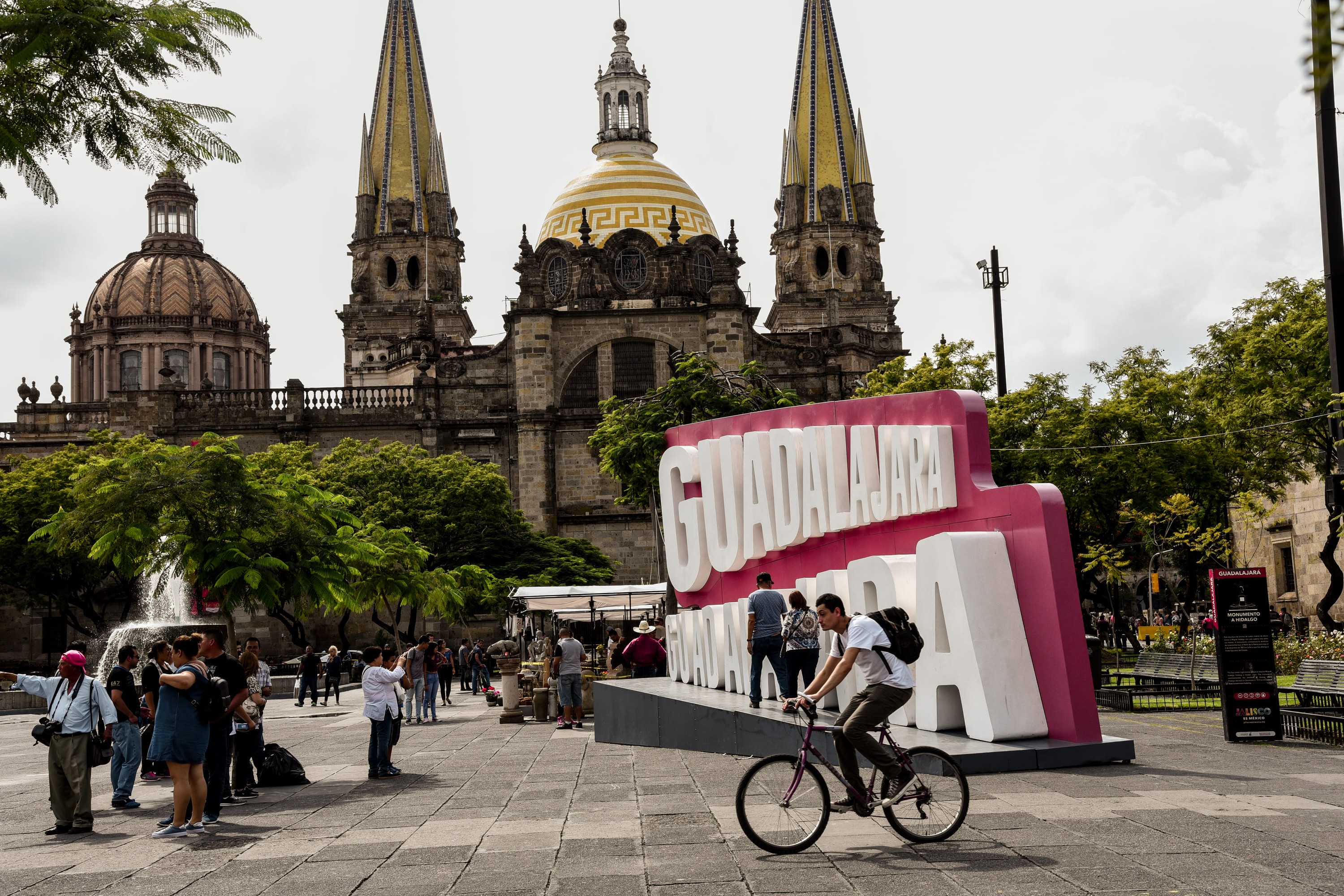
The cathedral of Guadalajara, or cathedral basilica of the Assumption of Maria Santísima is a cathedral of Mexico, parish seat of the archdiocese of Guadalajara and one of the most representative buildings of the city, for its towers with neo-Gothic needles and for its beautiful history.
5
Stop 5
Teatro Santos Degollado is a mid-19th century building located in the Mexican city of Guadalajara. The property is the usual setting for recitals, concerts, classical and contemporary dance shows. It is also the seat of the Jalisco Philharmonic Orchestra.
6
Tonalá is a municipality in the state of Jalisco, in the Metropolitan Zone of Guadalajara. It is part of the macroregion of the Bajío Occidente or Central West of Mexico.
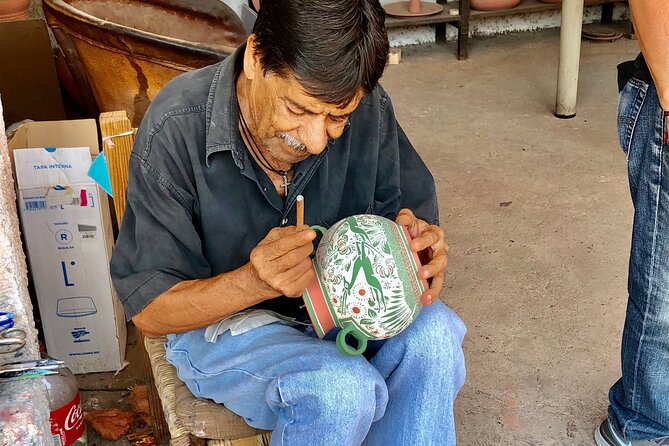
The most memorable points are its art galleries, which overflow with creativity; the culinary delicacy of its restaurants, which fuse traditional Mexican and international cuisine; museums, including ceramics; and the colonial-inspired streets, which transport you to a small Mexican town.
7
With a privileged location, just 30 minutes from the center of Guadalajara, we find the town of San Pedro Tlaquepaque. It is one of the most beautiful places in the state and certainly visits unmissable when you visit the state capital.
8
Guadalajara is a city worth exploring, even for the tapatíos themselves. Its center or first painting surprises those who walk it, for its beautiful buildings full of history, its temples, museums and meeting points where locals and strangers enjoy small pleasures.
The historic center of the city has been characterized by changing over time, and although several buildings dating from the century of the city's foundation are still preserved, many of these were demolished to give way to more functional buildings, wider avenues, as well as to build the Square Cross that surrounds the Cathedral of Guadalajara and Plaza Tapatía. In recent years, efforts have been made to pedestrianize and reassure the streets of the center.
What's not included
Foods
Beberage
Tips
Available languages
Guide guide
ES
Important information
Infants are required to sit on an adult’s lap
Suitable for all physical fitness levels
About Guadalajara
Guadalajara, the vibrant capital of Jalisco, is a city rich in history, culture, and traditions. Known as the birthplace of mariachi music and tequila, it offers a blend of colonial architecture, modern attractions, and a lively arts scene. The city's warm hospitality and diverse culinary offerings make it a must-visit destination in Mexico.
Top Attractions
Hospicio Cabañas
A UNESCO World Heritage Site, this 18th-century complex houses a museum and stunning frescoes by José Clemente Orozco.
Historical
1-2 hours
Moderate
Guadalajara Cathedral
This iconic cathedral is a must-visit for its stunning architecture and historical significance.
Religious
30 minutes to 1 hour
Free
Instituto Cultural Cabañas
This cultural center hosts various exhibitions, performances, and events throughout the year.
Cultural
1-2 hours
Moderate
Must-Try Local Dishes
Birria
A spicy stew made with goat or beef, traditionally served with tortillas and consommé.
Main Course
Contains meat
Tortas Ahogadas
A sandwich drowned in a spicy tomato sauce, typically made with pork.
Main Course
Contains meat
Tejuino
A fermented corn drink, often served with lime and chili powder.
Drink
Vegetarian
Popular Activities
Hiking
Zip-lining
Spa treatments
Boating
Museum visits
Art galleries
Fishing
Skiing (in nearby areas)
Best Time to Visit
November to April
This is the best time to visit Guadalajara, with pleasant weather and minimal rainfall. It's ideal for outdoor activities and exploring the city's attractions.
15°C to 28°C
59°F to 82°F
Practical Information
Language
- Official: Spanish
- Widely spoken: English (limited)
- English: Limited
Currency
Mexican Peso (MXN)
Time Zone
CST (UTC -6)
Electricity
127VV, 60HzHz
Safety Information
Overall Safety Rating: Generally safe with exercise caution
Guadalajara is generally safe for tourists, but petty crime can occur. Exercise caution in crowded areas and at night.
Important Precautions:
- • Keep valuables secure
- • Use official taxis or app-based services
- • Avoid walking alone at night in unfamiliar areas
Getting there
By air
- Don Miguel Hidalgo y Costilla International Airport • 16 km (10 miles) from city center
By bus
Central de Autobuses de Guadalajara (CAEG)
Getting around
Public transport
The bus system is the most extensive public transport option in Guadalajara, with routes covering the entire city.
Taxis
Available • Apps: Uber, Didi
Rentals
Car, Bike, Scooter
Neighborhoods
Centro Histórico
Zapopan
Chapalita
Day trips
Tlaquepaque
10 km (6 miles) • Half day
A charming town known for its artisan shops, galleries, and traditional restaurants.
Tequila
60 km (37 miles) • Full day
The birthplace of tequila, offering distillery tours, agave fields, and historic sites.
Lake Chapala
50 km (31 miles) • Full day
Mexico's largest freshwater lake, offering boating, fishing, and scenic views.
Festivals
Feria Internacional del Libro (FIL) • November
Festival de Maríachi y Charro • September
Día de los Muertos • November 1-2
Pro tips
- Learn a few basic Spanish phrases to enhance your experience and interact with locals.
- Visit local markets for authentic souvenirs and culinary experiences.
- Explore the city's neighborhoods to discover hidden gems and local culture.
- Try traditional Jalisco dishes like birria and tortas ahogadas.
- Attend a mariachi performance for an authentic cultural experience.
From $25
per person
Price varies by option
Secure booking
Free cancellation available
Instant confirmation