Biblical Corinth Taste Faith & History with wine & Oil Tasting
Active
5h
For a full refund, cancel at least 24 hours before the scheduled departure time.
Instant confirmation
Mobile or paper ticket accepted
About this experience
This unique experience blends *archaeological wonder, deep religious significance, and authentic local flavors* into an unforgettable narrative.
Stand in the very place where Paul preached, was tried before Gallio, and wrote his letters to the Thessalonians. Explore the *Agora and the Bema*, the monumental platform where he stood, bringing the teachings of Christ to the heart of the classical world..
Apostle Paul's Corinth : Stand at the Bema, explore the Agora, and see the ruins that formed the background of his missionary work.
* Ancient History: Discover the majestic Temple of Apollo, the Fountain of Glauce, and the renowned Archaeological Museum.
* Byzantine Legacy : Visit beautiful churches that symbolize the enduring faith of the region.
* Gastronomic Delights : Enjoy a memorable wine and olive oil tasting, sampling the finest local produce from the hills Paul once traveled.
Available options
Small Group Up To 8 Pax
Pick up included <br/>Half Day Ancient Corinth Canal<br/>Duration: 5 hours: Tour Start From Athens and finish back to Athens . All travrelers will be picked up from Syntagma Square at Filelinon Avenue <br/>Mini van : Tour will be done with a Luxury Mini Van. All our vehicles are with Full equipment including WiFi connectivity <br/>Pickup included
Biblical Corinth Taste Faith &
Biblical Corinth Wine & Olive<br/>Pickup included
What's included
Pick-up and drop-off service: Athens Hotel, Airbnb residence or Port
Fuels Tolls
Groups of 1-3 people are transported in luxurious sedan vehicles.
Car Seats: Book in advance if you require infant or child seats.
Transportation via modern, first-class private vehicle
All vehicles with WiFi, A/C, Bottled Water
Groups of 4-7 people are transported in comfortable mini vans.
English-speaking tour driver well-versed in Greek history.
Detailed itinerary
1
Stop 1
Pass by
The Rich and Powerful Ancient Corinth
With abundant water, important natural resources for export, an imposing acropolis (Acrocorinth), large fertile land, and its unique strategic position, the city soon became one of the greatest commercial centers of the Greek world.
Visiting Corinth and the Acrocorinth is a must-do for history buffs and fans of ancient Greek mythology. These two important historic sites are some of the most important in the Peloponnese and can easily be seen together in one day
these cities, Corinth retains a number of impressive ancient Greek ruins that are worth visiting today. For hundreds of years, Corinth was a major Greek city until the Romans destroyed the city in 146 BC but they built a new city in its place
Ancient Corinth was one of the largest and most important cities of Greece, with a population of 90,000 in 400 BC. The Romans demolished Corinth in 146 BC, built a new city in its place in 44 BC, and later made it the provincial capital of Greece
2
Stop 2
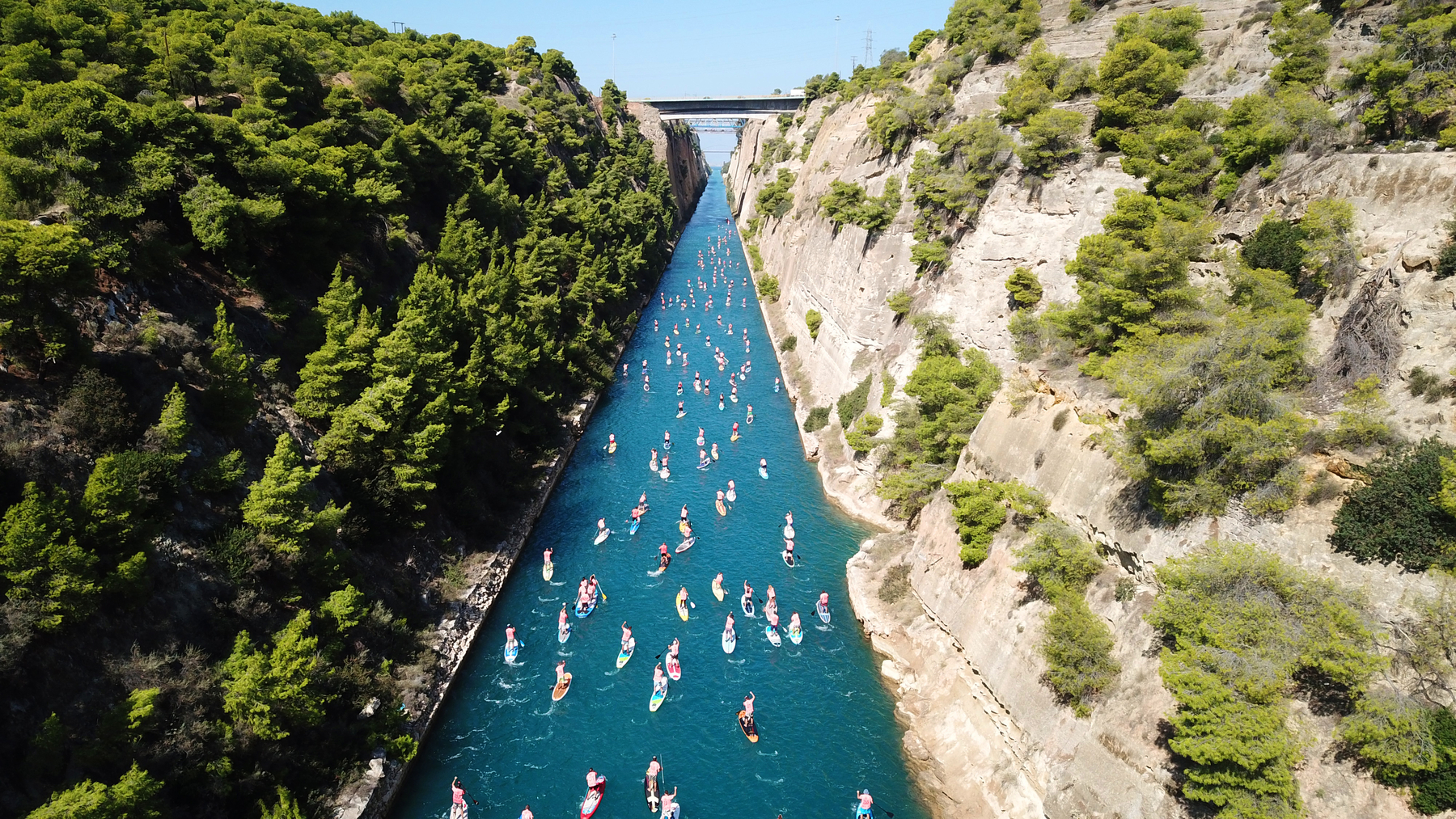
Corinth Canal
The Corinth Canal is a waterway that crosses the narrow isthmus of Corinth to link the Gulf of Corinth to the Saronic Gulf. As such, the canal separates the Greek mainland from the Peloponnese, turning it into an island
The canal, though executed in the late 19th century, has been a 2000-year-old dream. Before its construction, ships in the Aegean Sea that wanted to cross to the Adriatic or anchor in Corinth, a rich shipping city, had to circle the Peloponnese, which would prolong their journey an extra 185 nautical miles.
It is believed that Periander, the tyrant of Corinth (602 BC), was the first to conceive of the idea of digging the Corinth Canal. As the project was too complicated given the limited technical capabilities of the times, Periander constructed the diolkos, a stone road which allowed ships to be transferred on wheeled platforms.
3
The Diolkos was a paved trackway near Corinth in Ancient Greece which enabled boats to be moved overland across the Isthmus of Corinth. The shortcut allowed ancient vessels to avoid the long and dangerous circumnavigation of the Peloponnese peninsula. The phrase "as fast as a Corinthian", penned by the comic playwright Aristophanes, indicates that the trackway was common knowledge and had acquired a reputation for swiftness.
The main function of the Diolkos was the transfer of goods, although in times of war it also became a preferred means of speeding up naval campaigns. The 6 km (3.7 mi) to 8.5 km (5.3 mi) long roadway was a rudimentary form of railway, and operated from c. 600 BC until the middle of the 1st century AD. The Diolkos combined the two principles of the railway and the overland transport of ships, on a scale that remained unique in antiquity.
4
At a short distance from the Corinth Canal, the largest technical project in our country in the 19th century, we find a place that has a glorious history, given that the second most important sports competitions were held there not only in Greece, but also throughout the ancient world, the Isthmians. It is located in a topical and pivotal position at the point where the Peloponnese joins Central Greece.
The presence of the Apostle Paul in the Isthmian region is considered very important and the reference made in the Bible about his presence at the Isthmian games was very important because it is the first official presence of a Christian at the games. The apostle Pavkos worked at the Isthmian games as a tent maker for the accommodation of athletes and visitors to the Isthmian games, which were the second most important games after the Olympic games in Ancient Olympia. The apostle Paul proclaimed the son of Christ in the eyes of the visitors and athletes of the games, his action helped
5
Archaic marble pediment dated to the end of the 7th BC. h. and was placed at the entrance of the first Temple of Poseidon.
Glazing of Kechreon. They arrived packed in twos on a ship from Alexandria, Egypt and were found submerged on the floor of the Temple of Isis on the south pier of the harbor. These are colored sections of glass reminiscent of today's stained glass windows. In them we see harbor panoramas, exotic landscapes, animals and plants, full-length figures of philosophers such as Homer and Plato, ships and geometric decorative bands
Imperial statue in the type of Zeus (mid 2nd century BC)
Epinician stele with a portrait of the Corinthian musician Lefkios Cornelius (150 AD) Animal figurines. It is worth noting the golden figurine of a bull, a vow to the Sanctuary (6th BC century)
Commercial amphorae from Isthmia, Rachi, Kechrees.
Cult and weapon offerings.
Artifacts from the Mycenaean cemetery of Almira and the Roman cemetery of Rachi Koutsogila Cenchreon
6
Give us the chance to make this icon live and feel together the fundamentals of our culture.
Trust the locals !!!
Corinth was a city-state on the Isthmus of Corinth, the narrow stretch of land that joins the Peloponnese to the mainland of Greece, roughly halfway between Athens and Sparta. The modern city of Corinth is located approximately 5 kilometers (3.1 mi) northeast of the ancient ruins.
For Christians, Corinth is well known from the two letters of Saint Paul in the New Testament, First and Second Corinthians. Corinth is also mentioned in the Acts of the Apostles as part of Paul the Apostle's missionary travels. In addition, the second book of Pausanias' Description of Greece is devoted to Corinth.
Ancient Corinth was one of the largest and most important cities of Greece, with a population of 90,000 in 400 BC. The Romans demolished Corinth in 146 BC, built a new city in its place in 44 BC, and later made it the provincial capital of Greece.
7
Archaeological Museum of Corinth
The Archaeological Museum of Ancient Corinth was constructed between 1931-1932, with intentions to display the numerous recent archaeological excavations. The museum is located within the archaeological site of Ancient Corinth, Greece, and lies under the jurisdiction of the 37th Ephoreia of the Greek Archaeological Service.
Key aspects of the Archaeological site of Ancient Corinth include:
Hadgimoustafa spring
Lechaion Road
Basilica
Fountain of Peirene
Stoa
Agora
Odien
8
Temple of Apollo, Ancient Corinth, Corinth 20007 Greece
The Temple of Apollo at Corinth was constructed in 550 BC.
Temple of Apollo: One of the earliest Doric temples in the Peloponnese and the Greek mainland with monolithic columns, rare in the ancient world, built around 560 BCE.
9
Free time for Lunch Shopping
10
Visit one of the Most emblematic Castles The Acropolis of Corinth and enjoy The Breath Taking View
Acrocorinth, "Upper Corinth", the acropolis of ancient Corinth, is a monolithic rock overseeing the ancient city of Corinth, Greece.
With its secure water supply, Acrocorinth's fortress was repeatedly used as a last line of defense in southern Greece because it commanded the Isthmus of Corinth, repelling foes from entry by land into the Peloponnese peninsula.
What's not included
Entrance fees for all the attractions
Licensed tour guide OPTIONAL (upon request and depending on availability& Extra cost
Kindly note that gratuities and tips are not included in the price and are left to your discretion.
Meal in Ancient Corinth - Lunch stops are scheduled, but meal costs are not included.
Optional airport pick-up, available at an additional cost.
Oil Tasting Finger Food
Wine Tasting
Archaeological Site of Ancient Corinth
Available languages
Guide guide
EN
Reviews breakdown
Viator
4.7
10 reviews
5★
8
4★
1
3★
1
2★
0
1★
0
Tripadvisor
5.0
18 reviews
5★
18
4★
0
3★
0
2★
0
1★
0
Important information
Specialized infant seats are available
Infants and small children can ride in a pram or stroller
Suitable for all physical fitness levels
Important notes
we do not issue tickets
About Athens
Athens, the capital of Greece, is a city rich in history and culture, often considered the cradle of Western civilization. It is home to iconic ancient landmarks, vibrant neighborhoods, and a thriving modern scene.
Top Attractions
Acropolis of Athens
The Acropolis is the most iconic landmark in Athens, featuring ancient ruins and temples, including the Parthenon.
Historical
2-3 hours
€20 (combined ticket for multiple sites)
Ancient Agora of Athens
The heart of ancient Athens, featuring the Temple of Hephaestus and the Stoa of Attalos.
Historical
1-2 hours
€8 (included in the combined ticket)
Plaka
A charming, historic neighborhood with narrow streets, neoclassical houses, and vibrant nightlife.
Cultural
2-3 hours
Free to explore
Acropolis Museum
A modern museum showcasing artifacts from the Acropolis and its surroundings.
Museum
1-2 hours
€10
Temple of Olympian Zeus
An ancient temple dedicated to Zeus, once the largest temple in Greece.
Historical
30 minutes to 1 hour
€6 (included in the combined ticket)
Must-Try Local Dishes
Moussaka
A baked dish with layers of eggplant, minced meat, and béchamel sauce.
Dinner
Vegetarian versions available
Souvlaki
Grilled meat skewers, often served with pita bread and tzatziki.
Snack
Can be made with chicken, pork, or vegetarian options
Tzatziki
A yogurt-based dip with cucumber, garlic, and herbs.
Snack
Vegetarian and vegan options available
Baklava
A sweet pastry made with layers of filo, nuts, and honey syrup.
Dessert
Vegetarian
Popular Activities
Hiking in the mountains
Rock climbing
Scuba diving
Beach visits
Spa treatments
Café hopping
Museum visits
Theater performances
Best Time to Visit
April to June, September to October
The best time to visit Athens is during the spring and autumn months when the weather is pleasant and the tourist crowds are smaller.
18°C to 32°C
64°F to 90°F
Practical Information
Language
- Official: Greek
- Widely spoken: English, French, German
- English: Moderately spoken
Currency
Euro (EUR)
Time Zone
GMT+2 (EET)
Electricity
230VV, 50HzHz
Safety Information
Overall Safety Rating: Generally safe
Athens is generally safe for travelers, but petty crime and pickpocketing can occur in tourist areas. Be cautious with your belongings and avoid poorly lit areas at night.
Important Precautions:
- • Keep valuables secure
- • Use licensed taxis or ride-sharing apps
- • Be cautious with ATMs and credit cards
Getting there
By air
- Eleftherios Venizelos International Airport • 30 km from city center
By train
Athens Central Railway Station
By bus
KTEL Bus Station
Getting around
Public transport
Clean, efficient, and air-conditioned. Easy to navigate with clear signage in English.
Taxis
Available • Apps: Beat, Uber
Rentals
Car, Bike, Scooter
Neighborhoods
Plaka
Monastiraki
Psiri
Koukaki
Kolonaki
Day trips
Cape Sounion
65 km from Athens • Half day to full day
A scenic coastal area featuring the Temple of Poseidon with stunning views of the Aegean Sea.
Delphi
180 km from Athens • Full day
An ancient archaeological site and home to the famous Oracle of Delphi.
Meteora
350 km from Athens • Overnight
A unique landscape featuring rock formations and medieval monasteries perched atop cliffs.
Festivals
Athens Festival • May to October
Athens Epidaurus Festival • June to August
Athens International Film Festival • October
Pro tips
- Visit major attractions early in the morning or late in the afternoon to avoid crowds and heat
- Use the metro for easy and efficient travel around the city
- Explore local neighborhoods for an authentic Greek experience
- Try local street food for a quick and delicious meal
- Learn a few basic Greek phrases to enhance your experience and connect with locals
From $25
per person
Price varies by option
Secure booking
Free cancellation available
Instant confirmation