Unforgettable private tour to Belgium’s most delightful cities Bruges and Ghent
Active
8h
All sales are final. No refund is available for cancellations.
Instant confirmation
Mobile or paper ticket accepted
About this experience
Bruges and Ghent are two beautiful medieval Belgian cities, often called "Northern Venice" and "the most Flemish". There is no other place like Bruges in Belgium. With its authentic medieval architecture and scenic canals, the so-called "reien", the city really is fairy tale material and on thу other hand, there is no other place in Belgium like Ghent where contemporary design, art, fashion, gastronomy, and music blend so perfectly with the past.
Available options
Unforgettable private tour to Belgium’s most delightful cities Bruges and Ghent
Pickup included
What's included
All fees and taxes
Pick up and drop off
Transportation by air-conditioned vehicle
Professional licensed guide
Detailed itinerary
1
Your guide will pick you up at the Cruise Port after your ship will dock at the port. Tour is timed to your’s ship’s arrival and departure.
Depending on the time of day and the situation on the road, you will start the tour either from Ghent or from Bruges. You will have sightseeing tours of Bruges and Ghent with all the main sights of these cities discovering them both – by private car and on foot.
The Bruges townscape contains many small, whitewashed almshouses, usually grouped around an inner voice. This social housing " Avant la Lettre " were established from the 14th century by wealthy citizens or guilds. Scattered throughout the city, there are 46 church complexes have been preserved, which are mainly inhabited by elderly people. A beautiful complex is the Almshouse De Meulenaere and Sint-Jozef (Nieuwe Gentweg 8-22) Bruges has a total of 46 almshouses in the city center.
2
Stop 2
This chapel is located in a corner of the Burg square and judging by the richely decorated facade you would not immediately expect a chapel behind it. This flamboyant facade is actually a 16th century staircase that connects two underlying chapels: the Romanesque Saint-Basiliuschapel and the (neo)gothic Holy Bloodchapel. The Basilica of the Holy Blood is a Roman Catholic minor basilica in Bruges. Originally built in the 12th century as the chapel of the residence of the Count of Flanders, the church houses a venerated relic of the Holy Blood allegedly collected by Joseph of Arimathea and brought from the Holy Land by Thierry of Alsace, Count of Flanders. Built between 1134 and 1157, it was promoted to minor basilica in 1923.
3
Stop 3
The Belfry of Bruges is a medieval bell tower in the center of Bruges, Belgium. One of the city's most prominent symbols, the belfry formerly housed a treasury and the municipal archives and served as an observation post for spotting fires and other danger. A narrow, steep staircase of 366 steps, accessible by the public for an entry fee, leads to the top of the 83 m (272 feet) high building, which leans 87 centimeters to the east. To the sides and back of the tower stands the former market hall, a rectangular building only 44 m broad but 84 m deep, with an inner courtyard. The belfry, accordingly, is also known as the Halletoren (tower of the halls). The belfry is a key component of the UNESCO world heritage site of the historic center of Bruges. The building is a central feature of the 2008 film In Bruges and is also mentioned in the novel Cloud Atlas.
4
Stop 4
The 'Princely Beguinage Ten Wijngaarde' with its white-colored house fronts, tranquil convent garden, and beguinage museum was founded in 1245. This little piece of world heritage was once the home of the beguines, emancipated lay-women who nevertheless led a pious and celibate life. Nowadays, the Beguinage is inhabited by the Sisters of the Order of Saint Benedict. In the small beguine house, you can still gain insights into what daily life was like in the 17th century. Please note: the entrance gates are always closed (and remain closed) at 6.30 p.m. The Bruges Begijnhof (beguinage) has been a World Heritage Site since 1998.
5
Stop 5
The monumental City Hall (1376-1421) is one of the oldest in the Low Countries. It is from here that the city has been governed for more than 600 years. An absolute masterpiece is the Gothic Hall, with its impressive vault and 20th-century murals depicting the history of Bruges. The adjacent historic hall sheds further light on the governance of Bruges over the centuries, using original documents and paintings. On the ground floor, you are brought face to face with life-size portraits of the city’s rulers and can also learn more about the evolution of the Burg.
6
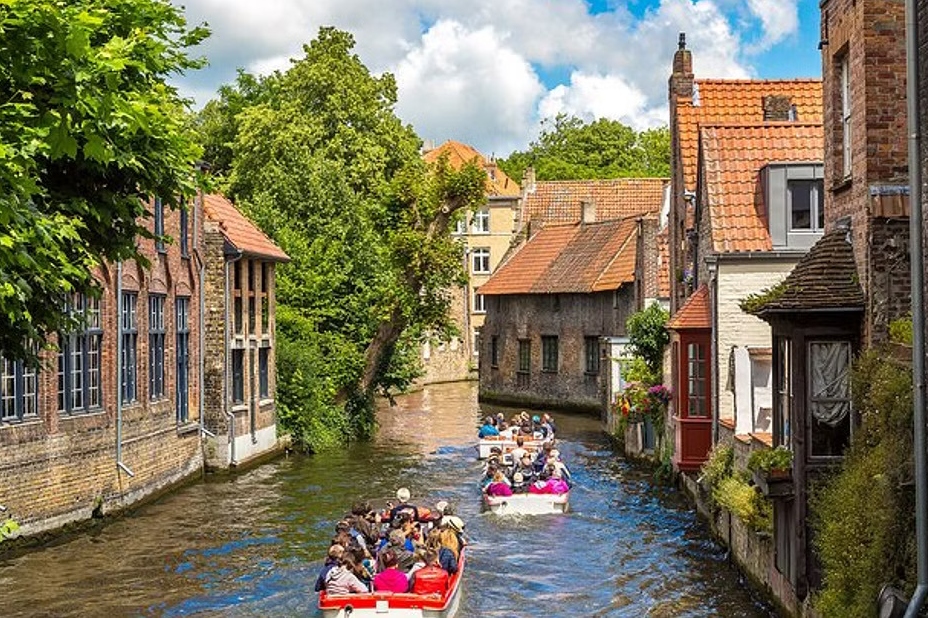
Summer or winter, morning or evening, sun or rain…Rozenhoedkaai has the enthralling ability to always make a stunning impression. It should come as no surprise that this continues to be one of the most photographed spots in Bruges. Here anyone can create his or her picture-perfect postcard of Bruges. Rozenhoedkaai’s sophisticated class makes it the ideal location to pause for a moment and together with your loved one enjoy one of Bruges’ most timeless sceneries.
7
Stop 7
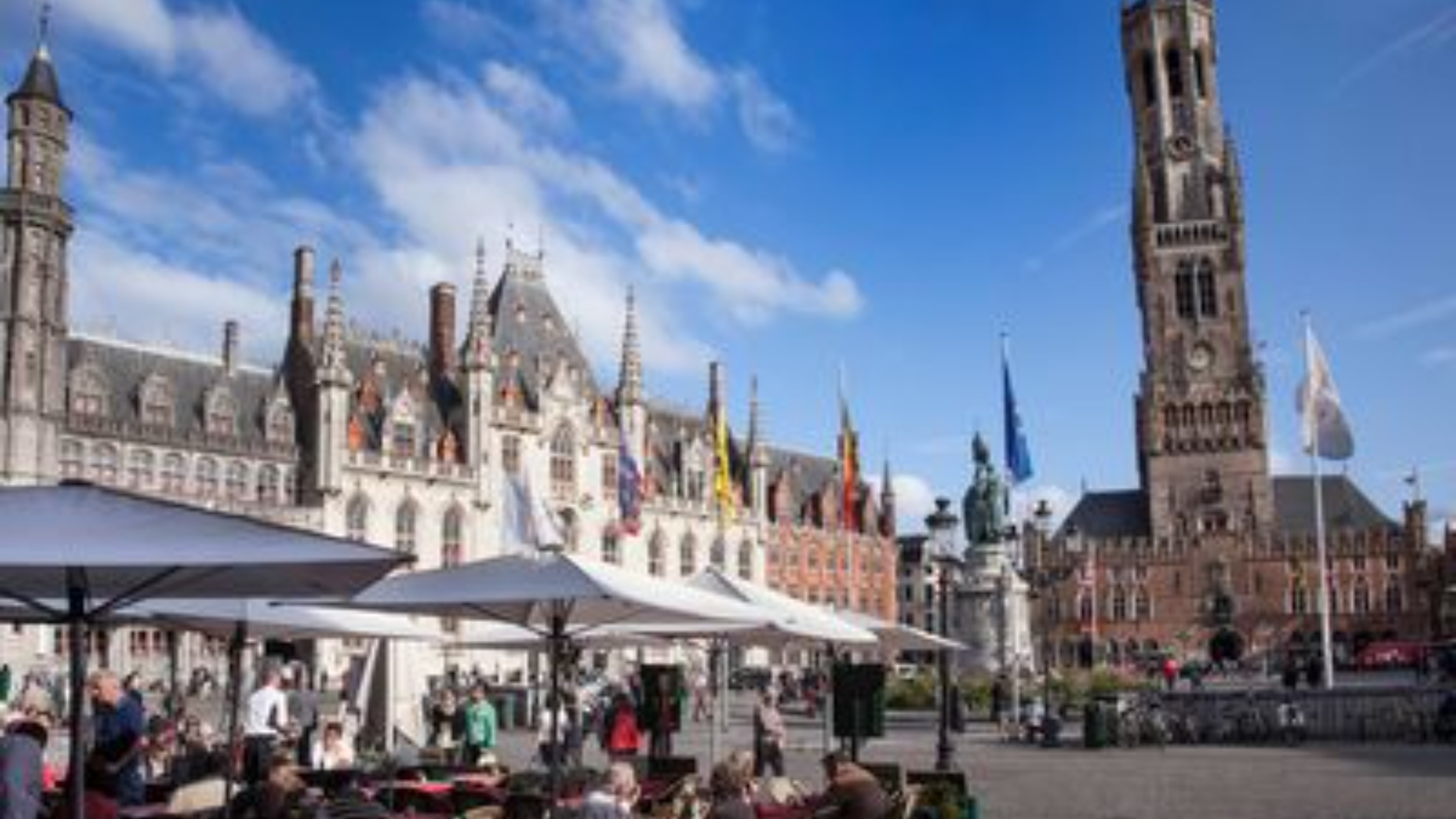
The Markt ("Market Square") of Bruges is located in the heart of the city and covers an area of about 1 hectare. Some historical highlights around the square include the 12th-century belfry and the West Flanders Provincial Court (originally the Waterhall, which in 1787 was demolished and replaced by a classicist building that from 1850 served as a provincial court and after a fire in 1878 was rebuilt in a neo-Gothic style in 1887. In the center of the market stands the statue of Jan Breydel and Pieter de Coninck. In 1995 the market was completely renovated. Parking in the square was removed and the area became mostly traffic-free, thus being more celebration friendly. The renovated market was reopened in 1996 with a concert by Helmut Lotti.
8
Stop 8
The 91-meter-tall belfry of Ghent is one of three medieval towers that overlook the old city center of Ghent, Belgium, the other two belonging to Saint Bavo Cathedral and Saint Nicholas Church. Its height makes it the tallest belfry in Belgium. The belfry of Ghent, together with its attached buildings, belongs to the set of belfries of Belgium and France inscribed on UNESCO's World Heritage List.
9
Stop 9
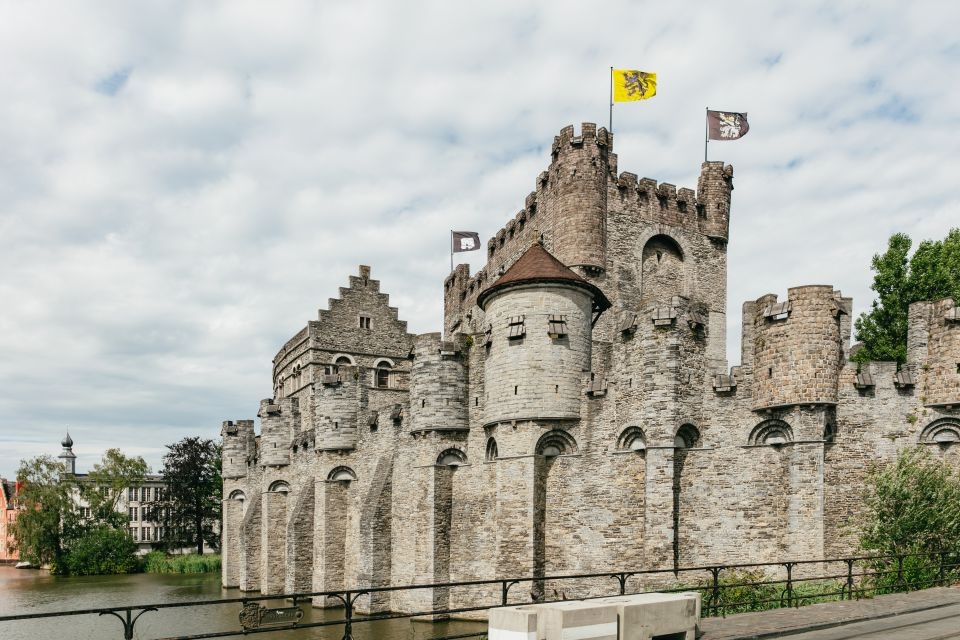
The Gravensteen (literally "Castle of the Counts") is a medieval castle at Ghent, East Flanders in Belgium. The current castle dates from 1180 and was the residence of the Counts of Flanders until 1353. It was subsequently re-purposed as a court, prison, mint, and even as a cotton factory. It was restored over 1893–1903 and is now a museum and a major landmark in the city.
10
Stop 10
If you’re walking down the street and find yourself stepping over rice and rose petals, you’ve discovered Ghent Townhall (Stadhuis) where one gets married. The building is hard to miss, as the detailed, ornate Gothic style in which the building was originally built is in stark contrast to the clean lines of the plainer Renaissance style, which the building was completed in. Inside is equally interesting with wooden vaulted ceilings, stained glass windows, Wedding Chapel, a labyrinth, and more.
11
Stop 11
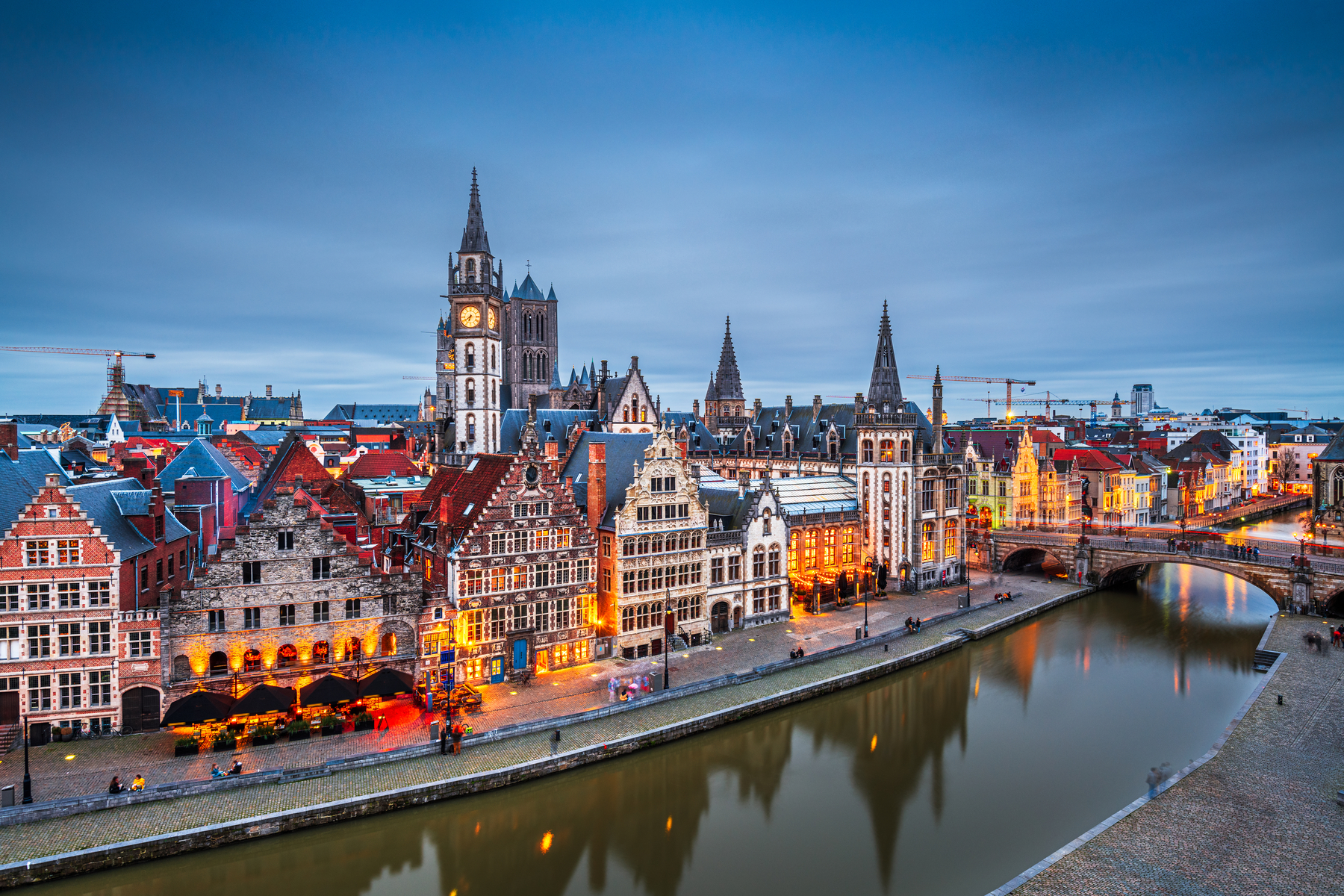
From Saint Michael's bridge you have an astonishing view over the medieval city harbour. On the right-hand side you see old warehouses, some of them are now exquisite restaurants or shops with a very refined collection. On the left the houses are slightly younger and more elegant.
12
Stop 12
The Saint Bavo Cathedral (also known as Sint-Baafs Cathedral, or in Dutch Sint Baafskathedraal) is an 89-meter-tall Catholic, Gothic cathedral in Ghent, Belgium. It is the seat of the diocese of Ghent, is named for Saint Bavo of Ghent, and contains the well-known Ghent Altarpiece.
During the tour, you will have opportunities to experience local cuisine and famous Belgian chocolate and beer if you’d like.
After the tour, your guide will return you to your ship.
What's not included
Food and drinks (own expense)
Available languages
Guide guide
EN
ES
Reviews breakdown
Tripadvisor
5.0
1 reviews
5★
1
4★
0
3★
0
2★
0
1★
0
Important information
Suitable for all physical fitness levels
About Bruges
Bruges is a picturesque medieval city in the Flemish Region of Belgium, known for its well-preserved historic center, charming canals, and cobblestone streets. With its fairy-tale architecture and rich cultural heritage, Bruges offers a unique glimpse into Europe's medieval past.
Top Attractions
Markt (Market Square)
The heart of Bruges, surrounded by medieval buildings, the Belfry, and the Provincial Court. A bustling square with cafes, shops, and often markets and events.
Historical
1-2 hours
Free
Belfry of Bruges
A 13th-century bell tower offering a climb of 366 steps to the top for stunning views of the city.
Historical
1 hour
€14
Burg Square
A charming square with a mix of historic buildings, including the Basilica of the Holy Blood and the City Hall.
Historical
1 hour
Free (Basilica entry is €3)
Grote Markt
A large square surrounded by historic buildings, including the City Hall and the Belfry. A hub of activity with cafes, shops, and events.
Historical
1-2 hours
Free
Basilica of the Holy Blood
A historic church that houses a relic of the Holy Blood, believed to have been collected by Joseph of Arimathea at the crucifixion of Jesus.
Religious
30 minutes
€3
Bruges Beer Museum
A museum dedicated to the history and culture of Belgian beer, with a tasting room offering a variety of local brews.
Museum
1-2 hours
€10
Must-Try Local Dishes
Moules-frites
Mussels cooked in a variety of sauces, typically served with French fries. A classic Belgian dish.
Main Course
Contains seafood, can be made with gluten-free bread if requested.
Carbonnade flamande
A traditional Flemish beef and beer stew, slow-cooked with onions, brown sugar, and spices.
Main Course
Contains beef and beer, not suitable for vegetarians or vegans.
Waffles
Belgian waffles are a popular sweet treat, often topped with whipped cream, chocolate, or fruit.
Dessert
Can be made vegetarian or vegan with plant-based toppings.
Flemish stew
A hearty stew made with beef, beer, onions, and spices, often served with potatoes or bread.
Main Course
Contains beef and beer, not suitable for vegetarians or vegans.
Popular Activities
Bike tours
Boat tours
Walking tours
Spas and wellness centers
Cafes and restaurants
Parks and gardens
Museum visits
Historical tours
Best Time to Visit
June to August
This is the busiest time of year with warm weather, festivals, and long daylight hours. However, it's also the most crowded and expensive.
15-25°C
59-77°F
Practical Information
Language
- Official: Dutch
- Widely spoken: English, French
- English: Widely spoken
Currency
Euro (EUR)
Time Zone
CET (GMT+1), CEST (GMT+2) during daylight saving time
Electricity
230VV, 50HzHz
Safety Information
Overall Safety Rating: Very safe
Bruges is a very safe city with a low crime rate. Violent crime is rare, and petty crime such as pickpocketing and bag snatching is the main concern for visitors. Common sense precautions and awareness of your surroundings can help ensure a safe and enjoyable visit.
Important Precautions:
- • Keep valuables secure and out of sight
- • Be cautious of your surroundings, especially in crowded areas
- • Use common sense and trust your instincts
Getting there
By air
- Brussels Airport • 110 km
- Ostend-Bruges International Airport • 30 km
By train
Bruges Station
By bus
Bruges Central Bus Station
Getting around
Public transport
The bus system is efficient and covers most of the city and surrounding areas. Buses are frequent and reliable.
Taxis
Available • Apps: Taxis Bruges, Uber
Rentals
Car, Bike, Scooter
Neighborhoods
City Center
Zand
St. Giles Quarter
Dijver
Day trips
Ghent
50 km • Full day
A vibrant and historic city with a mix of medieval and modern architecture, museums, and cultural attractions.
Ypres
40 km • Full day
A historic city with a rich history and cultural heritage, known for its role in World War I and its well-preserved medieval architecture.
Ostend
30 km • Full day
A coastal city with a long sandy beach, a lively promenade, and a variety of attractions and activities.
Festivals
Bruges Christmas Market • Late November to early January
Bruges Beer Festival • Early September
Bruges Historic Festival • Mid-May
Pro tips
- Visit the Belfry of Bruges for panoramic views of the city, but be prepared for a steep and narrow climb of 366 steps.
- Try a variety of Belgian beers at the Bruges Beer Museum, and don't miss the chance to sample a local brew at one of the many beer bars and cafes.
- Sample a variety of Belgian chocolates at the Choco-Story Bruges museum, and don't miss the chance to purchase some as souvenirs.
- Take a boat tour of the canals for a unique and picturesque perspective of the city, and be sure to visit the historic Begijnhof complex.
- Visit the Basilica of the Holy Blood to see the relic of the Holy Blood, and check for special events and exhibitions.
From $25
per person
Price varies by option
Secure booking
Free cancellation available
Instant confirmation