Rome Chauffeured Private Tour & Catacombs Underground Guided Tour
Active
4h
For a full refund, cancel at least 24 hours before the scheduled departure time.
Instant_then_manual confirmation
Mobile or paper ticket accepted
About this experience
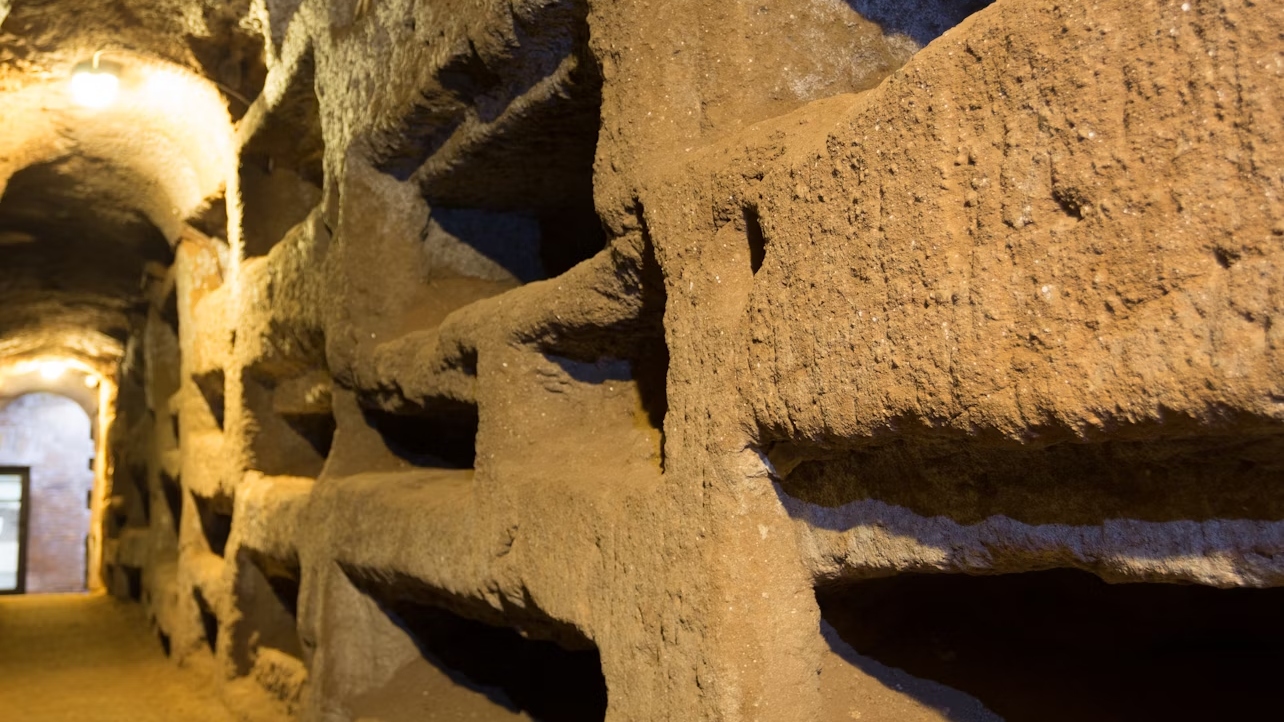
BEST OF ROME AND CATACOMBS | Underground Guided Tour, De Luxe Sightseeing By Deluxe Car or Minivan | Enjoy a special daily sightseeing Tour of Roman's historical center chauffeured by your driver, admiring the main sites in the city and many unique Eternal City treasures... Be amazed by the most breathtaking view of Rome from the terrace of Janiculum Hill. Continue your experience with an in-depth excursion to one of the most exciting places in Rome, the Catacombs on the Ancient Appian Way. You'll descend into a complex network of underground tunnels, among the longest in the world, where you can admire ancient frescoes, crypts, mausoleums, and much more. You'll also find the burial of famous people like popes, martyrs, and, according to legends, even some apostles. The catacombs that we'll visit (San Calisto, San Sebastiano, or Santa Domitilla) will change depending on the day.
Long the way, you will have time for a short break.
Available options
Sightseeing+Catacombs
Sightseeing+Catacombs<br/>Pickup included
What's included
Hotel pick-up
Shared transport by air-conditioned vehicle for the Catacombs
Guide Service only inside the Catacombs
Private City Center Sightseeing Tour
Detailed itinerary
1
Stop 1
Admire the beauty of the Spanish Square, one of the most famous squares in Rome. Located in the heart of the roman's historic City center, the square hosts fascinating and incredible masterpieces.
2
Stop 2
Take a stop to admire the Trevi Fountain, that is the largest Baroque fountain in the city and one of the most famous fountains in the world, even appeared in several iconic movies like "La Dolce Vita" and "Roman Holiday",the great decorating sculptures of this baroque masterpiece, creating a magical and romantic atmosphere.
Belonging to the fountain is the legend whereby throwing a coin in the fountain you will ensure your return in Rome.
3
Stop 3
Take a look at one of the most important squares in Rome admiring form the external side the greatness of the Vatican. In the middle of the square rises an elegant ancient Egyptian obelisk flanked by two granite fountains, Gian Lorenzo Bernini and Carlo Maderno designed, all surrounded by a massive Doric colonnades.
Located directly in front of St. Peter's Basilica in the Vatican City, is enriched by an ancient Egyptian obelisk, erected at the current site in 1586. Gian Lorenzo Bernini designed the square almost 100 years later, including the massive Doric colonnades,[1][2] four columns deep, which embrace visitors in "the maternal arms of Mother Church". A granite fountain constructed by Bernini in 1675 matches another fountain designed by Carlo Maderno in 1613.
4
Enjoy the breathtaking views of Rome from the terrace of Gianicolo, one of the best locations in the town for a scenic view of central Rome with its domes and bell towers. While enjoying one of the most incredible and breathtaking panoramic views of the sparkling Eternal City raise a toast to celebrate this magical moment before being carried to our office in Via Della Polveriera 8, where the first part of your tour ends.
Take a short lunch break (lunch is not included) and then come back to our office where the second part of your tour starts.
5
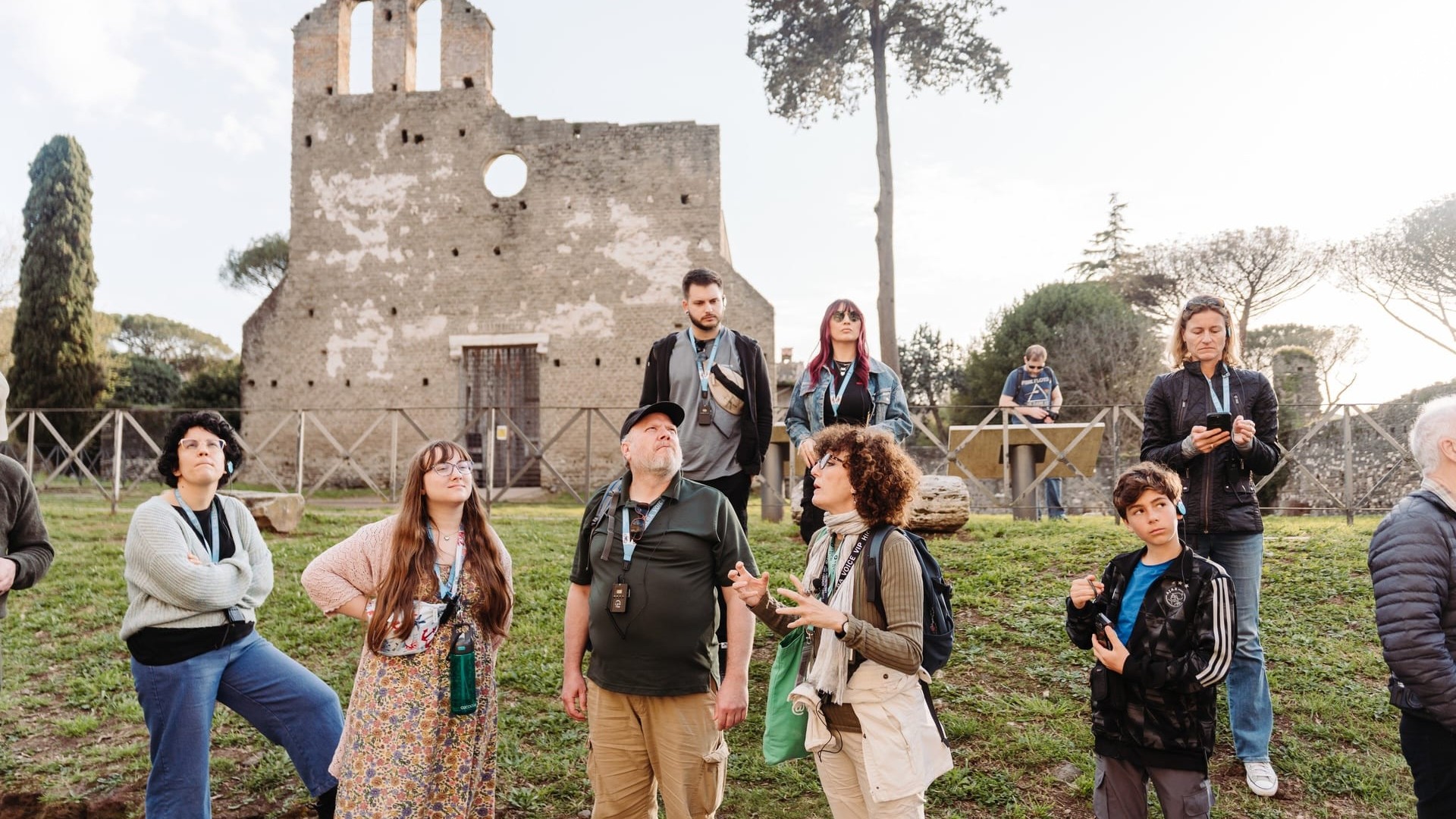
After your lunch break, get ready to start again! Starting, with a small group, from our travel agency, near the Colosseum, you will be comfortably transported on an air-conditioned vehicle, in one of the most interesting and visited places in Rome, the "catacombs" on the Via Appia Antica.
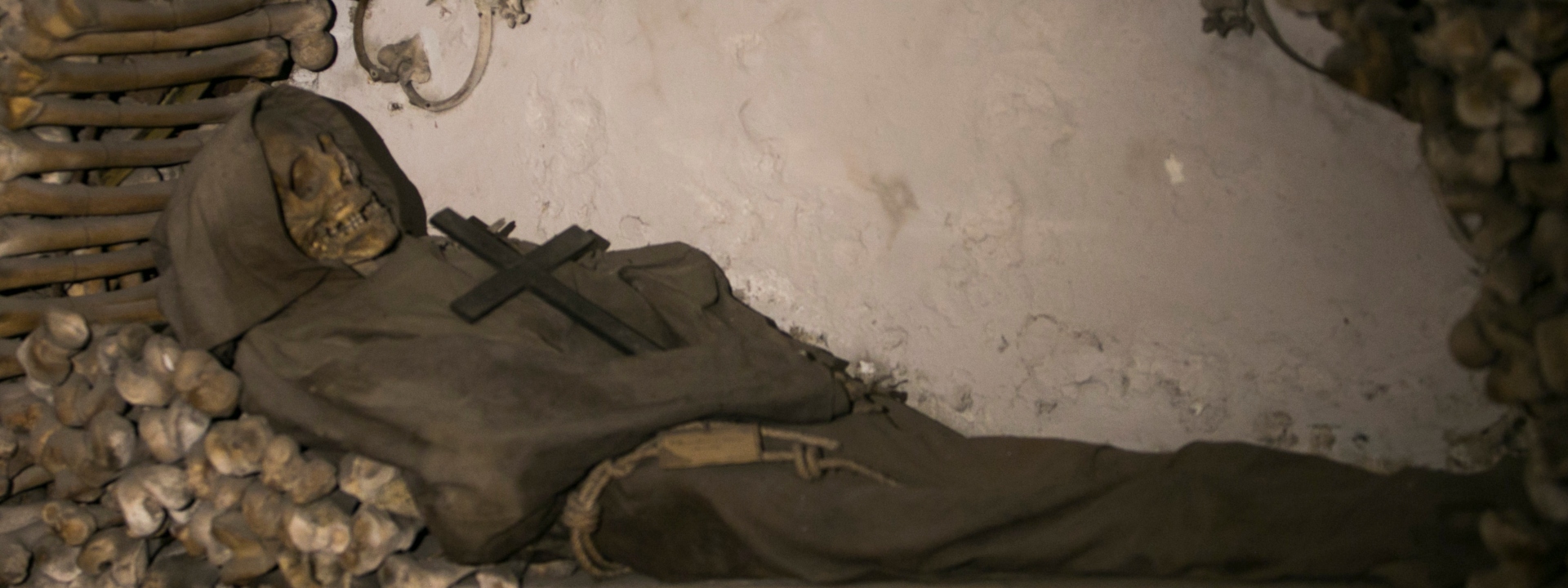
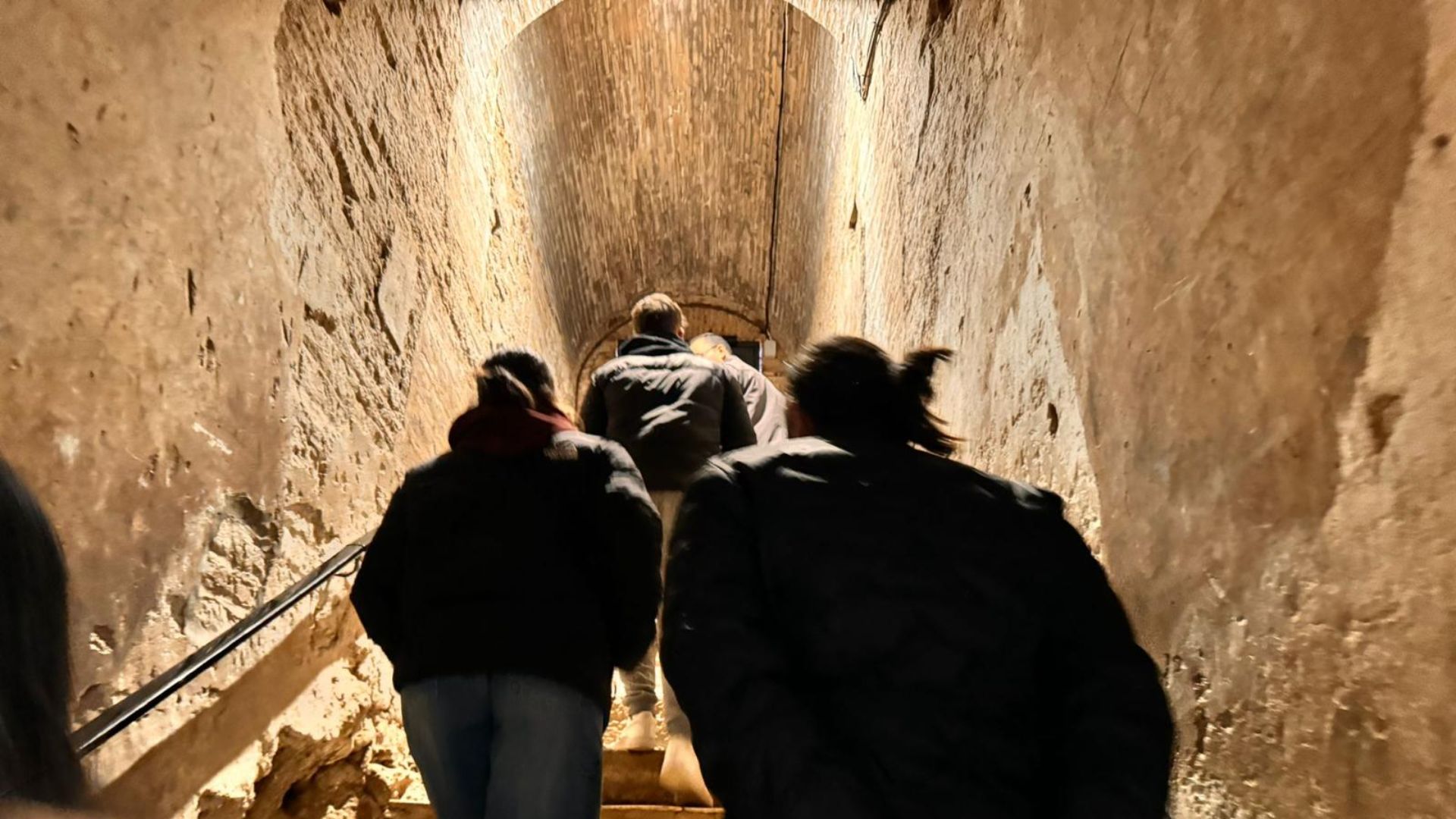
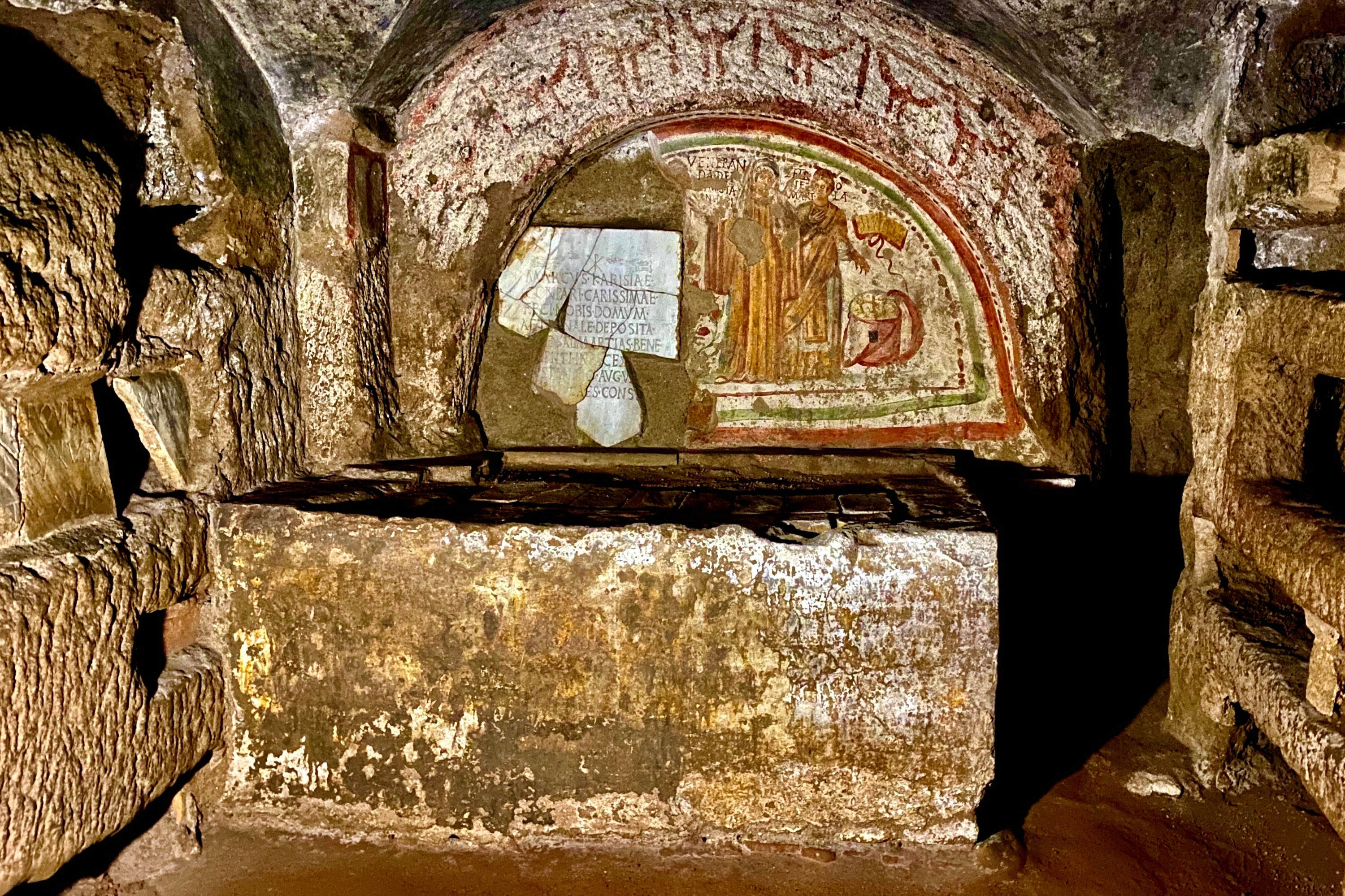
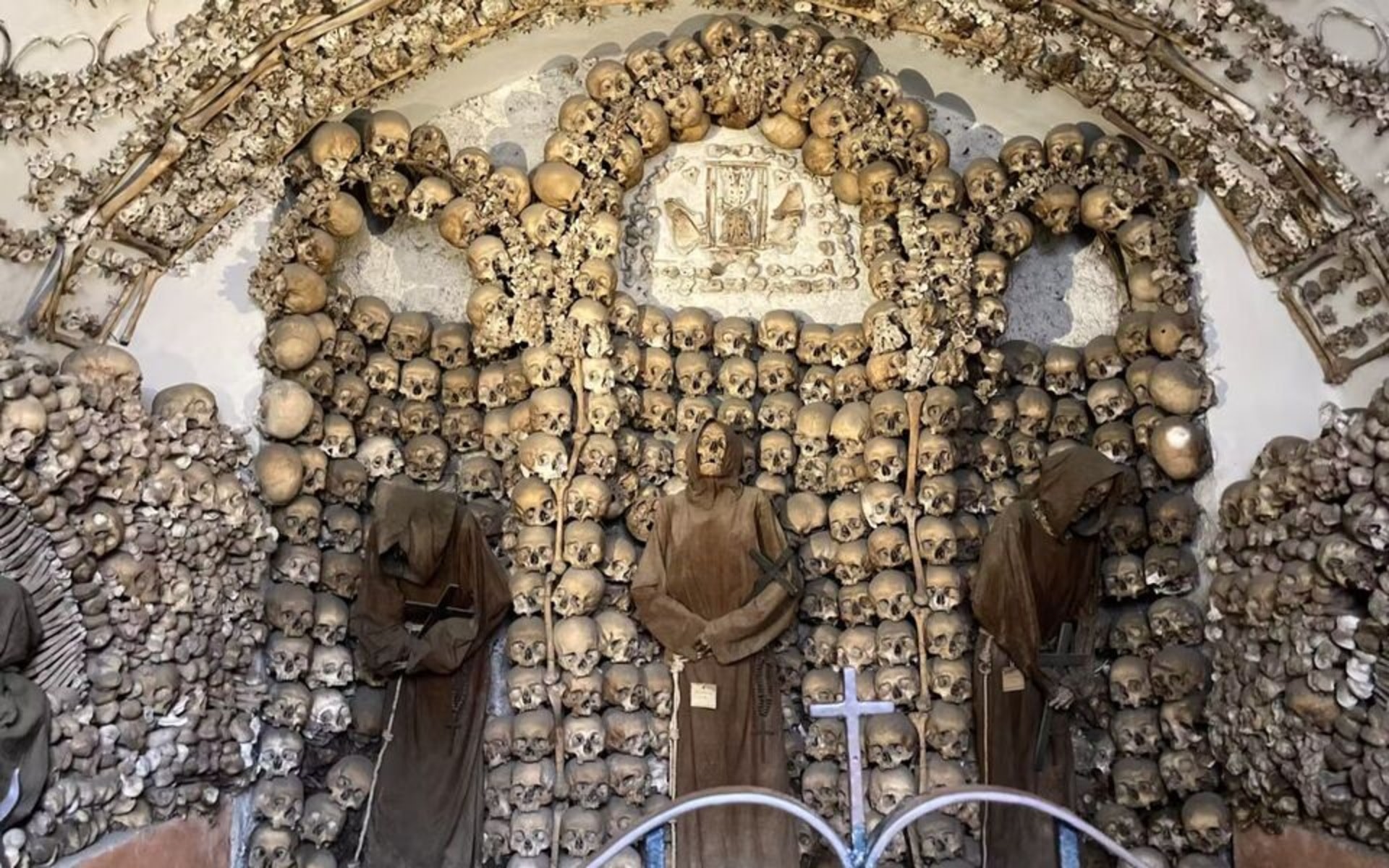
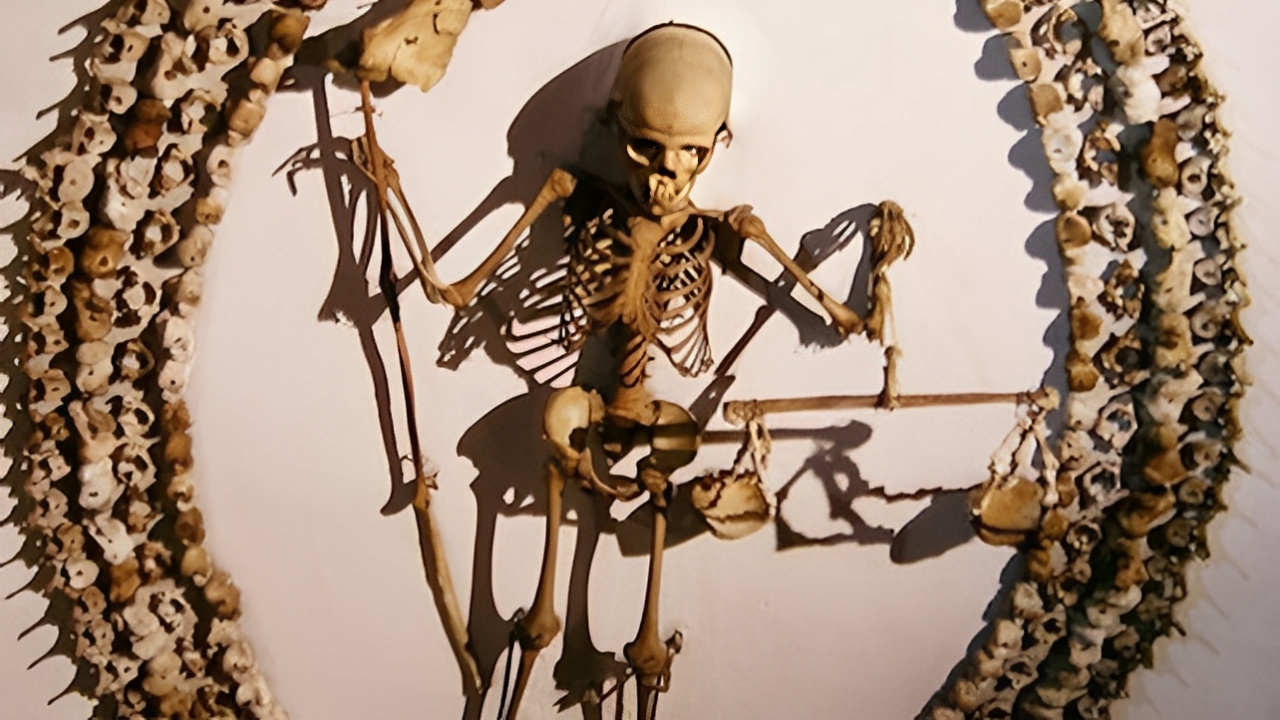
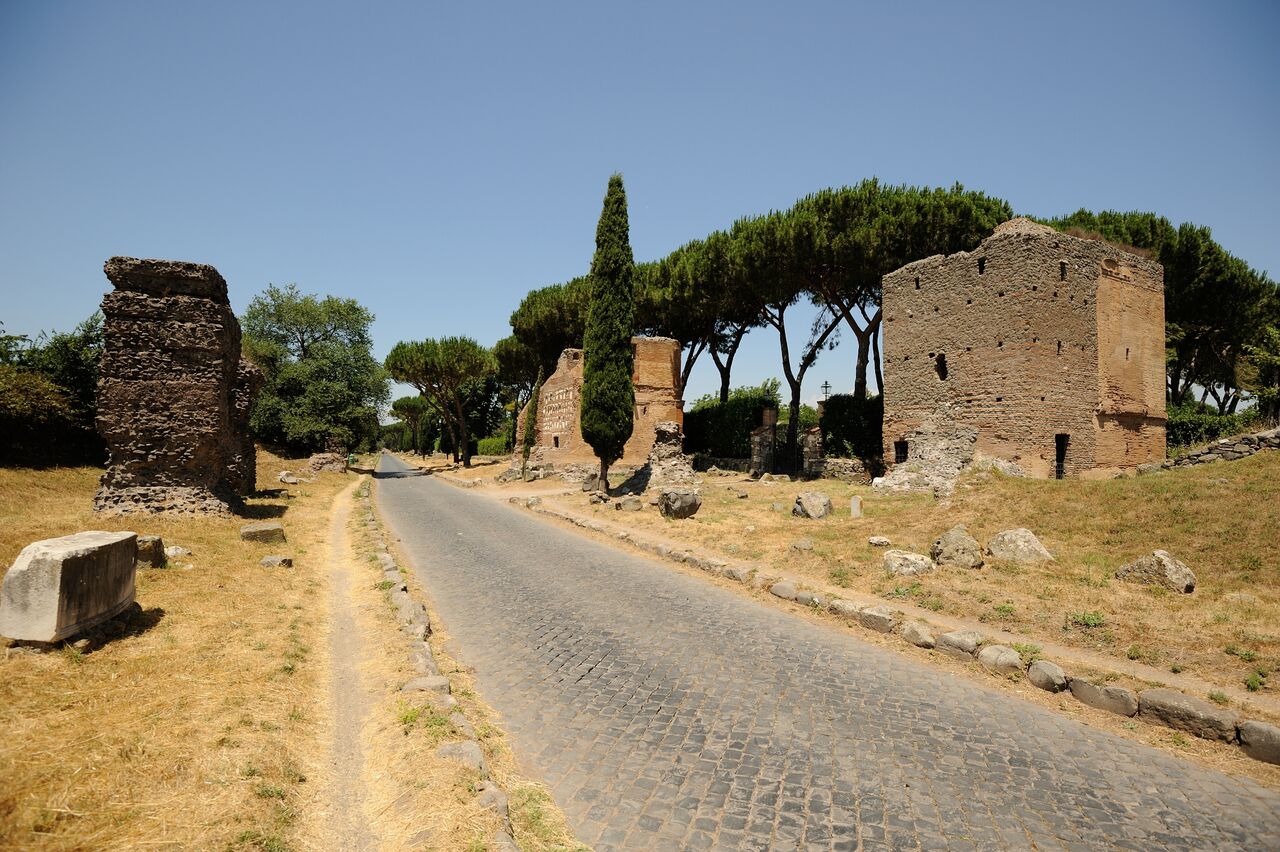
Walk along the majestic Aurelian Walls and come to the archaeological area of the Via Appia Antica, immersed in the green Roman countryside, you will descend into the ancient world of the Catacombs, a complex network of underground tunnels among the longest in the world, which occupies an area of about fifteen hectares, consisting of about 60 kilometers of tunnels on several levels. The catacombs that we will visit (San Calisto, San Sebastiano or Santa Domitilla), for your tour will change depending on the day, but from where we go, you will have the opportunity to see ancient frescoes, crypts rich in inscriptions carved in the walls, niches with still remains of skeletons, small mausoleums, sarcophagi, tombs and small chapels that still today, after about 2000 years, are still used to celebrate religious rites.
6
Stop 6
Pass by
The Mausoleum of Hadrian, usually known as Castel Sant'Angelo (Italian pronunciation: [kaˈstɛl sanˈtandʒelo]; English: Castle of the Holy Angel), is a towering cylindrical building in Parco Adriano, Rome, Italy. The Roman Emperor Hadrian initially commissioned it as a mausoleum for himself and his family. The popes later used the building as a fortress and castle and are now a museum. The structure was once the tallest building in Rome.
7
Stop 7
Piazza Navona (pronounced [ˈpjattsa naˈvoːna]) is a public open space in Rome, Italy. It is built on the site of the Stadium of Domitian, built in the 1st century AD, and follows the form of the open space of the stadium.[1] The ancient Romans went there to watch the agones ("games"), and hence it was known as "Circus Agonalis" ("competition arena"). Over time, it is believed that the name changed to in avone to navone and eventually to navona.
8
Stop 8
Pass by
Piazza Venezia (Italian: [ˈpjattsa veˈnɛttsja]) is a central hub of Rome, Italy, in which several thoroughfares intersect, including the Via dei Fori Imperiali and the Via del Corso. It takes its name from the Palazzo Venezia, built by the Venetian Cardinal, Pietro Barbo (later Pope Paul II), alongside the church of Saint Mark, the patron saint of Venice. The Palazzo Venezia served as the embassy of the Republic of Venice in Rome.
One side of the Piazza is the site of Italy's Tomb of the Unknown Soldier in the Altare Della Patria, part of the Monument to Vittorio Emanuele II, the first king of Italy.
The piazza or square is at the foot of Capitoline Hill and next to Trajan's Forum. The main artery, the Via di Fori Imperiali begins there and leads past the Roman Forum to the Colosseum.
9
Stop 9
Pass by
The Capitolium or Capitoline Hill (/ˈkæpɪtəlaɪn, kəˈpɪt-/ KAP-it-ə-lyne, kə-PIT-;[1][2] Italian: Campidoglio [kampiˈdɔʎʎo]; Latin: Mons Capitolinus [ˈmõːs kapɪtoːˈliːnʊs]), between the Forum and the Campus Martius, is one of the Seven Hills of Rome.
The hill was earlier known as Mons Saturnius, dedicated to the god Saturn.[citation needed] The word Capitolium first meant the temple of Jupiter Optimus Maximus later built here, and afterward it was used for the whole hill (and even other temples of Jupiter on other hills), thus Mons Capitolinus (the adjective-noun of Capitolium). In an etymological myth, ancient sources connect the name to caput ("head", "summit"), and the tale was that, when laying the foundations for the temple, the head of a man was found,[3] some sources even saying it was the head of some Tolus or Olus. The Capitolium was regarded by the Romans as indestructible and was adopted as a symbol of eternity.[4][5]
10
Stop 10
Pass by
The Theatre of Marcellus (Latin: Theatrum Marcelli, Italian: Teatro di Marcello) is an ancient open-air theatre in Rome, Italy, built in the closing years of the Roman Republic. At the theatre, locals and visitors alike were able to watch performances of drama and song. Today its ancient edifice in the rione of Sant'Angelo, Rome, once again provides one of the city's many popular spectacles or tourist sites. Space for the theatre was cleared by Julius Caesar, who was murdered before its construction could begin; the theatre was advanced enough by 17 BC that part of the celebration of the Ludi secular took place within the theatre; it was completed in 13 BC and formally inaugurated in 12 BC by Augustus,[1] named after his nephew Marcus Claudius Marcellus who had died in 23 BC.
What's not included
Food and drinks
Gratuities
Guide service during the transportation
Drop off to your hotel
Available languages
Guide guide
DE
EN
IT
FR
ES
Important information
Public transportation options are available nearby
Not recommended for travelers with spinal injuries
Not recommended for travelers with poor cardiovascular health
Suitable for all physical fitness levels
You must exchange your voucher at the meeting point to join the tour
Children must be accompanied by an adult
Panoramic tour by car with private Driver but without a Guide
Please bring your passport or ID card
Transpostation will be lead by a professional dirver (not a guide)
small group tour (max 25 people) for the Catacombs Tour
The catacomb temperature is about 16°C/60°F and the moisture content is high; please dress appropriately
No one can visit the catacombs on their own, nor stray from their group along the route, nor cross the gates that delimit the paths open to the public
It is forbidden to touch the exhibits along the visit path
It is forbidden to remove any object and/or material
No photos allowed inside the Catacombs
Food and drink are not allowed inside the Catacombs
Pets are not allowed
Reservation fees and tickets of monuments that are closed due to event is out of our control.
Every refund request MUST be done within and not later than 48 hours from the day of the tour.
Not accessible for walker users
Not recommended for people with motor difficulties
We kindly inform you that any kind of disability (visual impairment, hearing impairment,... ) or anything that might prevent you to regularly join the tour, MUST BE communicate in advance to our staff.
Important notes
If you are staying in a hotel with a lobby, please wait for your driver there.
If you are staying in an apartment without a lobby, please wait for the driver in the street, close to your street number.
PLEASE REMEMBER THAT THE SIGHTSEEING TOUR DOES NOT INCLUDE ANY GUIDE SERVICE, IT IS CONDUCTED BY A DRIVER.
PROGRAM:
Pick up at your hotel
Catacombs tour - 1 hour
Sightseeing tour in Rome centre - 3 hours
Drop off at your hotel
- Every refund request MUST be done within and not later than 48 hours from the day of the tour.
About Rome
Rome, the capital of Italy, is a city of ancient ruins, artistic masterpieces, and vibrant culture. Known as the Eternal City, it is a living museum where every corner tells a story of its rich history spanning over 2,500 years.
Top Attractions
Colosseum
The Colosseum is an iconic symbol of Rome and one of the most famous ancient amphitheaters in the world. It was used for gladiatorial contests and public spectacles.
Historical
1-2 hours
€16 (combined ticket with Roman Forum and Palatine Hill)
Vatican City
Vatican City is an independent city-state enclaved within Rome. It is the spiritual and administrative center of the Roman Catholic Church.
Religious
Half day
€17 (Vatican Museums and Sistine Chapel), Free (St. Peter's Basilica)
Roman Forum
The Roman Forum was the political, commercial, and legal hub of the Roman Republic and Empire. It is a sprawling ruin of temples, basilicas, and arches.
Historical
1-2 hours
€16 (combined ticket with Colosseum and Palatine Hill)
Pantheon
The Pantheon is a former Roman temple, now a church, known for its large dome and oculus. It is one of the best-preserved ancient buildings in Rome.
Historical
30 minutes to 1 hour
Free
Trevi Fountain
The Trevi Fountain is a Baroque masterpiece and the largest fountain in Rome. It is a popular spot for visitors to throw coins and make wishes.
Architecture
15-30 minutes
Free
Must-Try Local Dishes
Cacio e Pepe
A simple yet delicious pasta dish made with Pecorino Romano cheese and black pepper.
Pasta
Vegetarian
Carbonara
A rich pasta dish made with eggs, Pecorino Romano, guanciale (cured pork cheek), and black pepper.
Pasta
Contains pork and eggs
Supplì
Fried rice balls filled with mozzarella and tomato sauce.
Snack
Vegetarian (some variations may contain meat)
Carciofi alla Romana
Artichokes braised with garlic, mint, and olive oil.
Vegetable
Vegetarian
Popular Activities
Hiking in the Appian Way Regional Park
Biking along the Tiber River
Rock climbing in the nearby mountains
Picnicking in Villa Borghese Gardens
Boating on Lake Albano
Enjoying a spa day at a luxury hotel
Visiting the Vatican Museums
Attending an opera at the Teatro dell'Opera di Roma
Best Time to Visit
April to June, September to October
Spring and fall offer pleasant weather and fewer crowds compared to the summer peak. Ideal for sightseeing and outdoor activities.
15-30°C
59-86°F
Practical Information
Language
- Official: Italian
- Widely spoken: English, Spanish, French
- English: Moderately spoken
Currency
Euro (EUR)
Time Zone
GMT+1 (CET), GMT+2 (CEST during daylight saving time)
Electricity
230VV, 50HzHz
Safety Information
Overall Safety Rating: Generally safe
Rome is generally safe for tourists, but pickpocketing and scams can be a problem in crowded areas. Be aware of your surroundings and take precautions to protect your belongings.
Important Precautions:
- • Keep valuables secure and out of sight
- • Use official taxis or ride-sharing services
- • Be cautious of strangers approaching you with petitions or bracelets
Getting there
By air
- Leonardo da Vinci International Airport • 35 km from city center
- Ciampino Airport • 15 km from city center
By train
Roma Termini, Roma Tiburtina
By bus
Tiburtina Bus Station, Roma Termini
Getting around
Public transport
The metro system is efficient and covers major tourist areas. It operates from 5:30 AM to 11:30 PM.
Taxis
Available • Apps: Uber, FreeNow
Rentals
Car, Bike, Scooter
Neighborhoods
Trastevere
Monti
Prancipio
Testaccio
Day trips
Ostia Antica
30 km from Rome • Half day
An ancient Roman port city with well-preserved ruins, including a theater, baths, and mosaics. It offers a glimpse into daily life in ancient Rome.
Tivoli
30 km from Rome • Full day
A picturesque town known for its stunning villas and gardens, including the famous Villa d'Este with its elaborate fountains and gardens.
Orvieto
120 km from Rome • Full day
A charming hilltop town known for its stunning cathedral, underground caves, and local wine. It offers a mix of history, culture, and scenic views.
Festivals
Natale di Roma • April 21
Festa de' Noantri • July
Rome Film Festival • October
Pro tips
- Visit major attractions early in the morning or late in the afternoon to avoid crowds
- Use public transport or walk instead of taking taxis to save money and experience the city like a local
- Try local specialties and ask for recommendations from locals and restaurant staff
- Dress modestly when visiting religious sites and be respectful of local customs and traditions
- Be aware of pickpockets and scams, especially in crowded areas and tourist hotspots
From $25
per person
Price varies by option
Secure booking
Free cancellation available