Outlander Tour
Active
8h
For a full refund, cancel at least 24 hours before the scheduled departure time.
Manual confirmation
Mobile or paper ticket accepted
About this experience
Outlander is a massive worldwide show, huge production, loved by millions the whole world over, and filmed and shot on location here in Scotland at some of the most stunning and historic venues we have.
So why don’t you book your exclusive, private and luxurious (in name but not in price) Outlander tour with us, and revel in making the show come to life.
The tour is exclusively for you and your party and not shared with anyone else. It is designed to be enjoyed by between 1 to 7 people with your very own guide who will not only enthral you with your Outlander tour but will also introduce you to other wonderful sights and stories as you travel through our beautiful country here in Scotland. We have listed only some of the most popular Outlander destinations, but you can choose others. Our tours are either ½ day (4hrs), full day (8hrs), or multi day tours. We will pick you up from wherever you are (at the dock if you are off a cruise ship, at your hotel, guesthouse, holiday cottage..
Available options
1/2 day Tour (4hr)
Duration: 4 hours: This is a half day tour and we will advise what tour destinations can be visited in the time you have, but you have choice.<br/>Mercedes-Benz V Class - AMG<br/>Pickup included
Outlander Tour - Full Day-8hr
Duration: 8 hours<br/>Mercedes-Benz V Class - AMG
Multi Day Tour - Price Per Day
Duration: 2 days<br/>Mercedes-Benz v class - AMG<br/>Pickup included
What's included
Private transportation
Charging facilities for lap-tops, cell phones and tablets
WiFi on board
Air-conditioned vehicle
Fresh bottled water is supplied on every trip
Detailed itinerary
1
Stop 1
Although Falkland Palace, technically, is still the property of the Crown, since it’s acquisition by the 3rd Marquess of Bute in 1887, the property has been in the keepership of the Crichton Stuart family. The village and palace have appeared a few times in the series. I season 1, the village is used to portray post war Inverness in 1946, where Claire & Frank spend their 2nd honeymoon. Whilst looking in to Frank’s ancestral history, they both secretly watch a pagan ritual at the standing stones. Claire returns alone to the stones and falls through time to 1743.
2
Stop 2
This is top of the list for many Outlander enthusiasts, and simply must be visited. Highly regarded as one of the finest examples of a Royal Burgh (a Burgh which has been granted a Royal charter from the Crown), from the 17th & 18th century, and a fine jewel in the crown within the Kingdom of Fife. It is one of the most picturesque villages in Scotland, whether you are an Outlander fan or not.
3
Stop 3
Built in the 1400’s on the site of an earlier fort, Blackness was the main port serving Linlithgow, which was one of Scotland’s monarch’s main residence. It has served both as a state prison and a minor garrison. Although thought to be one of the best and most advanced (at the time) artillery fortifications in the land, after a long siege it fell into the hands Cromwell’s New Model Army.
In Outlander, it was used to represent Fort William, where Jamie had received lashes from Captain Randall. It’s also where Jamie’s father died, after watching his son being punished. Later in the season 1, Jamie breaks into the castle, rescuing Claire from the hands of Black Jack, jumping into the water below (I don’t think you would catch me doing that anytime soon).
4
Stop 4
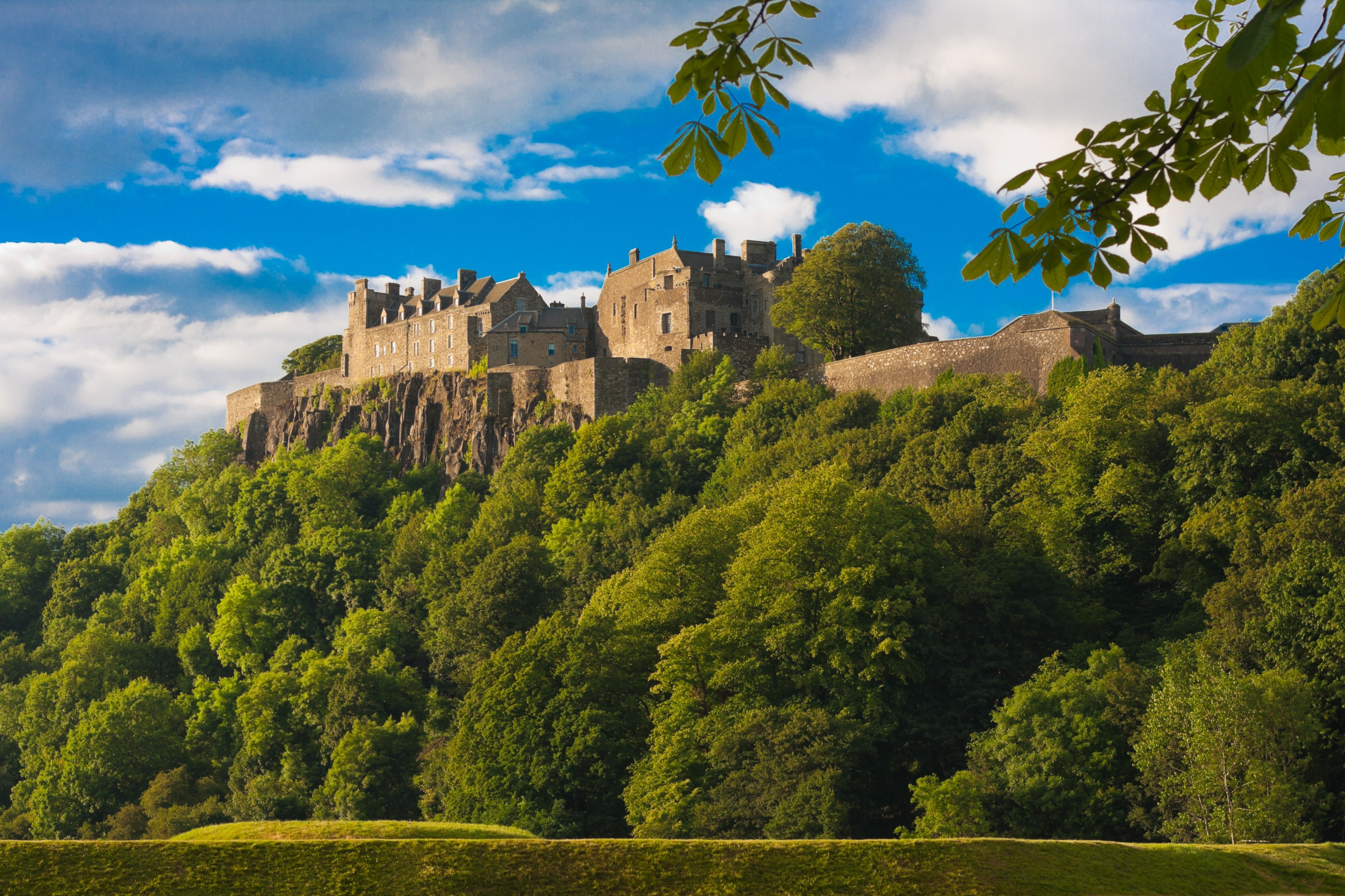
Doune (pronounced as in June) is a village on the banks of the River Teith, just outside Stirling. In Scottish dialect, we say “let’s go up te Doune” IE the word “down” in Scotland is often pronounced as “doon”, which sound’s the same as the village name of Doune and the word “te” meaning “to”, so, when said together it gives a positive/negative up/down :-)
The castle is very dramatic looking and has been used in a few productions, some of which you may recognise the name of, such as Game of Thrones and Monty Python & The Holygrail to name a couple. Built towards the end of the 1300’s it has an absolutely stunning 100ft high Gatehouse, and also has one of the very best preserved “Great Halls” in the whole of Scotland. The castle plays an integral role in Outlander as the fictional Castle Leoch, home to the Clan MacKenzie. It also features in one of the scenes from the 20th century where Claire & Frank visit the castle ruins (as you would see it now), on a day trip they are on.
5
Stop 5
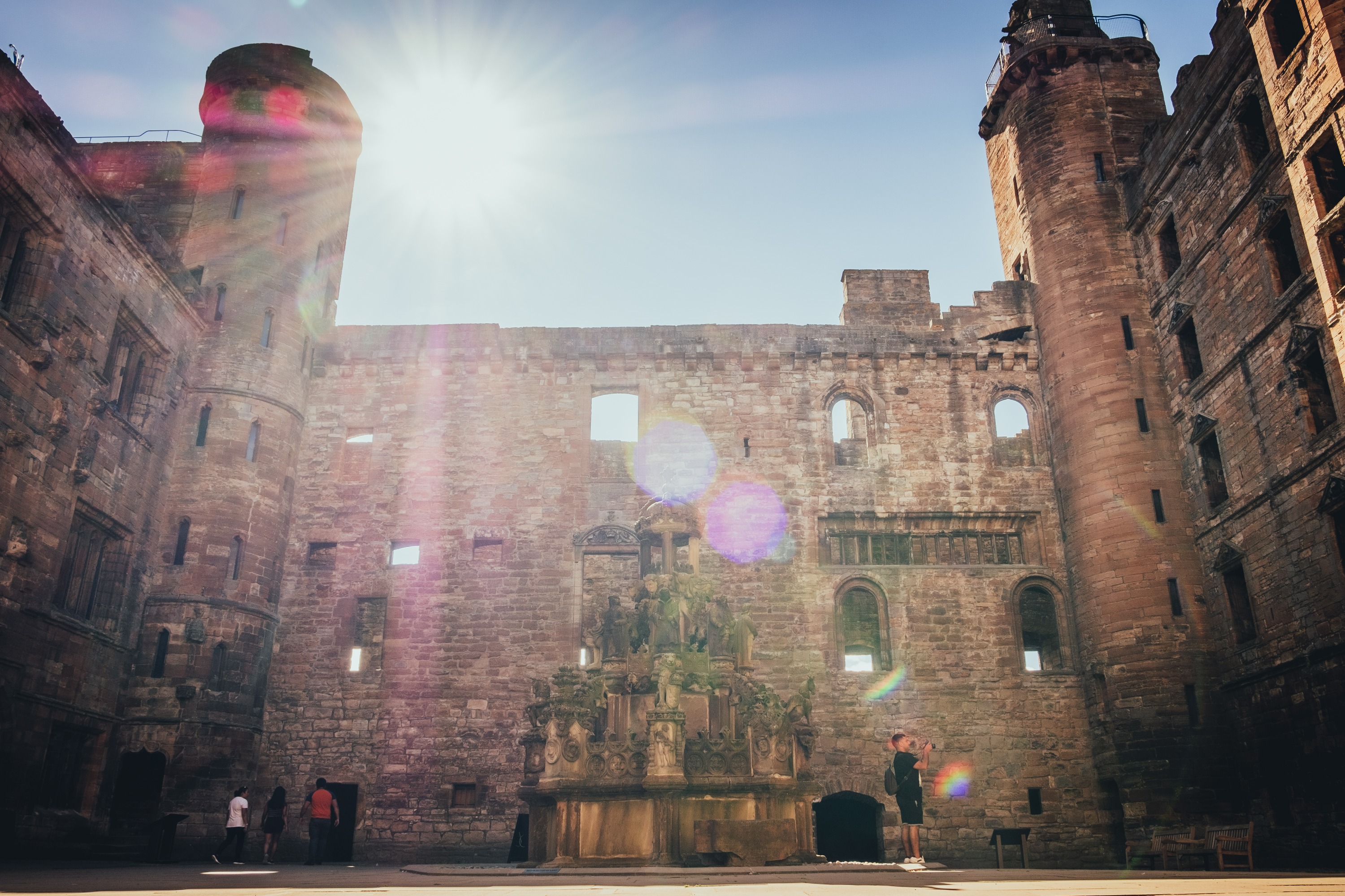
This is the site of what we Outlander enthusiasts would recognise as Wentworth Prison (where Jamie was tortured by Captain Black Jack Randall.
Dating back to the 12th century, Linlithgow Palace was the birthplace of Mary Queen of Scots, as well as some other Scottish monarchs, and was jovially referred to as the “pleasure palace” because of this. The ruins of the palace can be found in the town of Linlithgow, west of Edinburgh, and they are spectacular!
Some of the exterior scenes of Wentworth Prison were actually shot at Bamburgh Castle in Northumberland. The castle shape acted as a model for the CGI exterior of Wentworth Prison.
In one scene, after a conversation with Mr Fletcher, Claire can be seen being sick. Claire & Murtagh walk out of an entrance gate which is definitely Linlithgow palace, but from a distance shot, it is Bamburgh Castle that can be seen.
6
Stop 6
A “Doocot” is a structure to house pigeons. Broken down, a “doo” is a Scottish name for a Dove/Pigeon. A “cot” is where someone would sleep (as in a child’s cot). In Scottish pronunciation it would be doo (as in boo) and cot (as in kit) so we would say “dookit”
The Mill is very picturesque in a wonderful setting and situated near to the Doocot, and guided tours are available for a small fee.
In Outlander, filming took place on a couple of occasions in Season 1. In one of the scenes, Jamie has to hide under the water at the Mill as Claire & Jenny are questioned by the Redcoats (soldiers).
The Mill’s exhibition room was also used as a room in the court, where the preliminary hearing of Claire and Geillis took place when they were accused of witchcraft.
What's not included
Landing and facility fees
Restroom on board
Available languages
Guide guide
EN
Reviews breakdown
Viator
4.6
5 reviews
5★
4
4★
0
3★
1
2★
0
1★
0
Tripadvisor
5.0
2 reviews
5★
2
4★
0
3★
0
2★
0
1★
0
Important information
Infants and small children can ride in a pram or stroller
Service animals allowed
Public transportation options are available nearby
Specialized infant seats are available
Suitable for all physical fitness levels
Meeting point
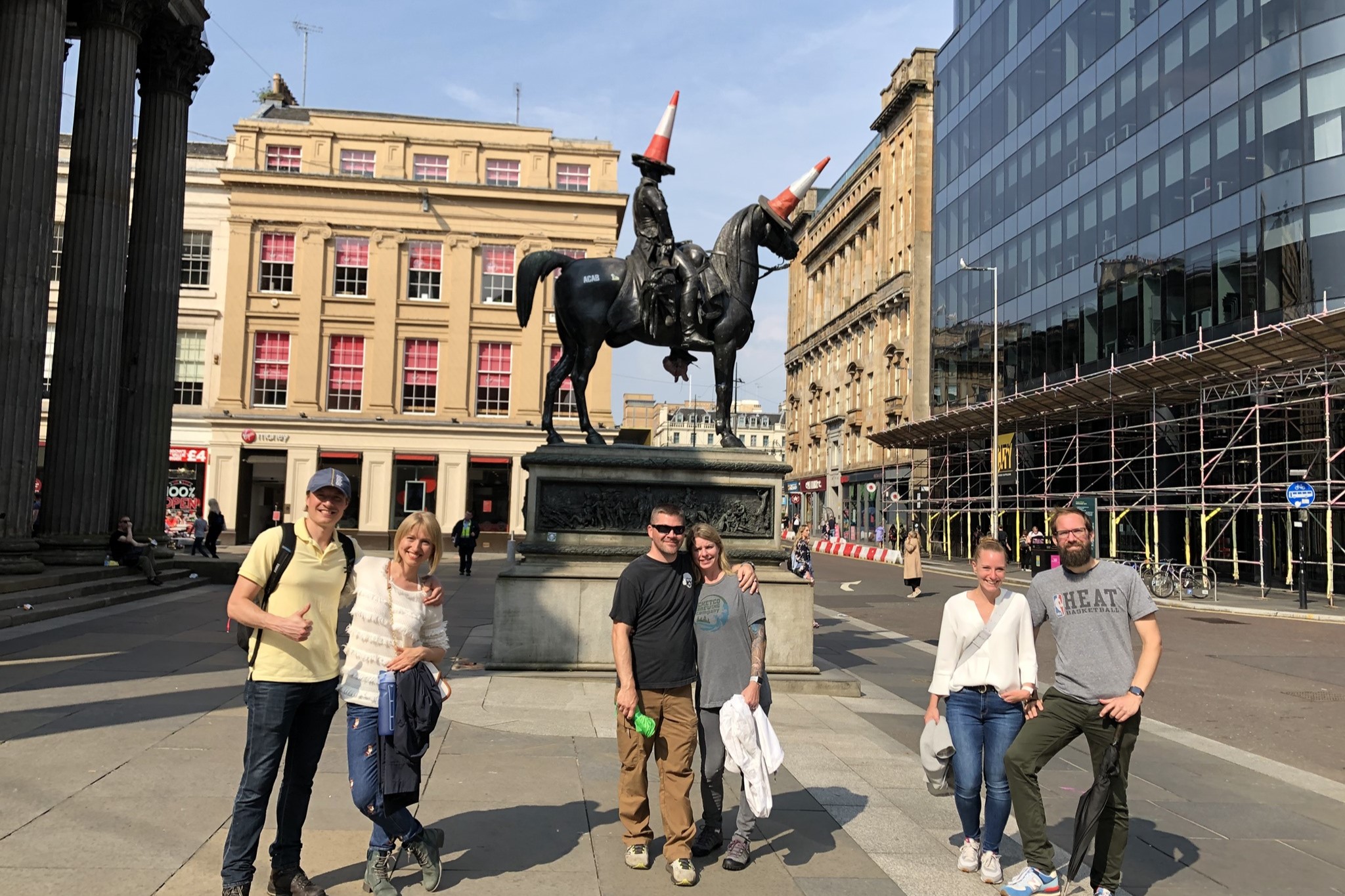
Directly across from the City Chambers on George Square, Glasgow
About Glasgow
Glasgow, Scotland's largest city, is a vibrant urban hub known for its rich architectural heritage, thriving arts scene, and friendly locals. With a mix of grand Victorian and modern buildings, the city offers a dynamic blend of culture, history, and innovation.
Top Attractions
Kelvingrove Art Gallery and Museum
One of Scotland's most popular free attractions, this museum features a diverse collection of art, artifacts, and natural history exhibits.
Museum
2-3 hours
Free
Glasgow Cathedral
A stunning example of Scottish Gothic architecture, this cathedral is one of the few medieval buildings to survive in Glasgow.
Historical
1 hour
Free (donations welcome)
Riverside Museum
Award-winning museum showcasing Glasgow's rich transport and industrial heritage with interactive exhibits and historic vehicles.
Museum
2-3 hours
Free
Glasgow School of Art
A masterpiece of Art Nouveau architecture designed by Charles Rennie Mackintosh, the Glasgow School of Art is a must-see for architecture enthusiasts.
Architecture
1 hour
Free (donations welcome)
Buchanan Street
One of Glasgow's premier shopping destinations, Buchanan Street offers a mix of high-street brands, luxury boutiques, and department stores.
Shopping
1-2 hours
Varies by store
Must-Try Local Dishes
Haggis
A traditional Scottish dish made from sheep's heart, liver, and lungs, mixed with onions, oatmeal, suet, and spices, typically served with neeps and tatties (turnips and potatoes).
Main Course
Contains meat and offal.
Cullen Skink
A creamy smoked haddock soup with potatoes and onions, originating from the town of Cullen in the northeast of Scotland.
Soup
Contains fish.
Scotch Pie
A small, double-crust meat pie filled with minced mutton or beef, seasoned with pepper and spices.
Snack
Contains meat.
Cranachan
A traditional Scottish dessert made with whipped cream, honey, fresh raspberries, and toasted oats.
Dessert
Vegetarian, but may contain dairy.
Popular Activities
Hiking in the Trossachs
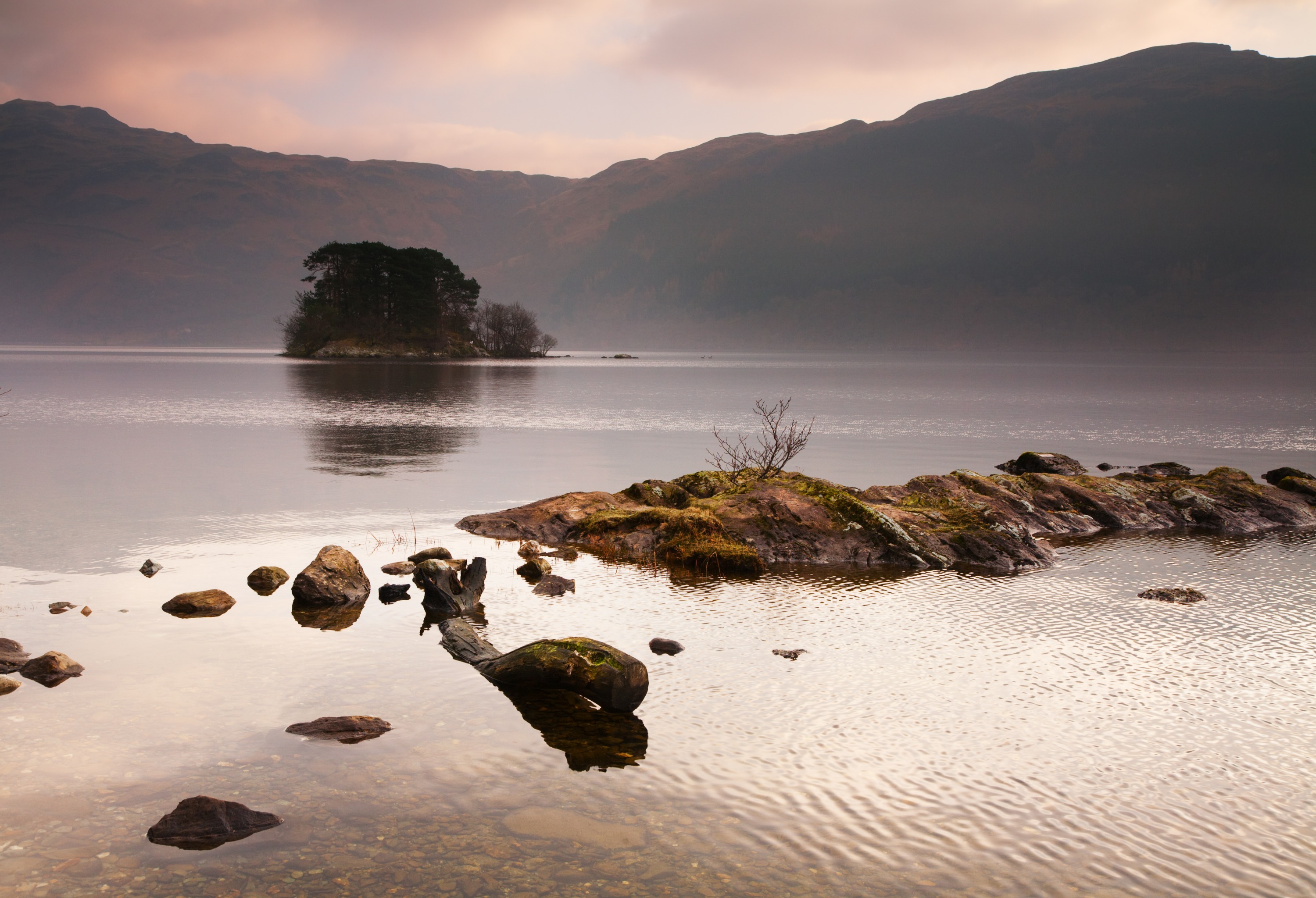
Kayaking on Loch Lomond
Mountain biking in the Campsie Fells
Climbing at the Rucksack Club
Spas and wellness centers
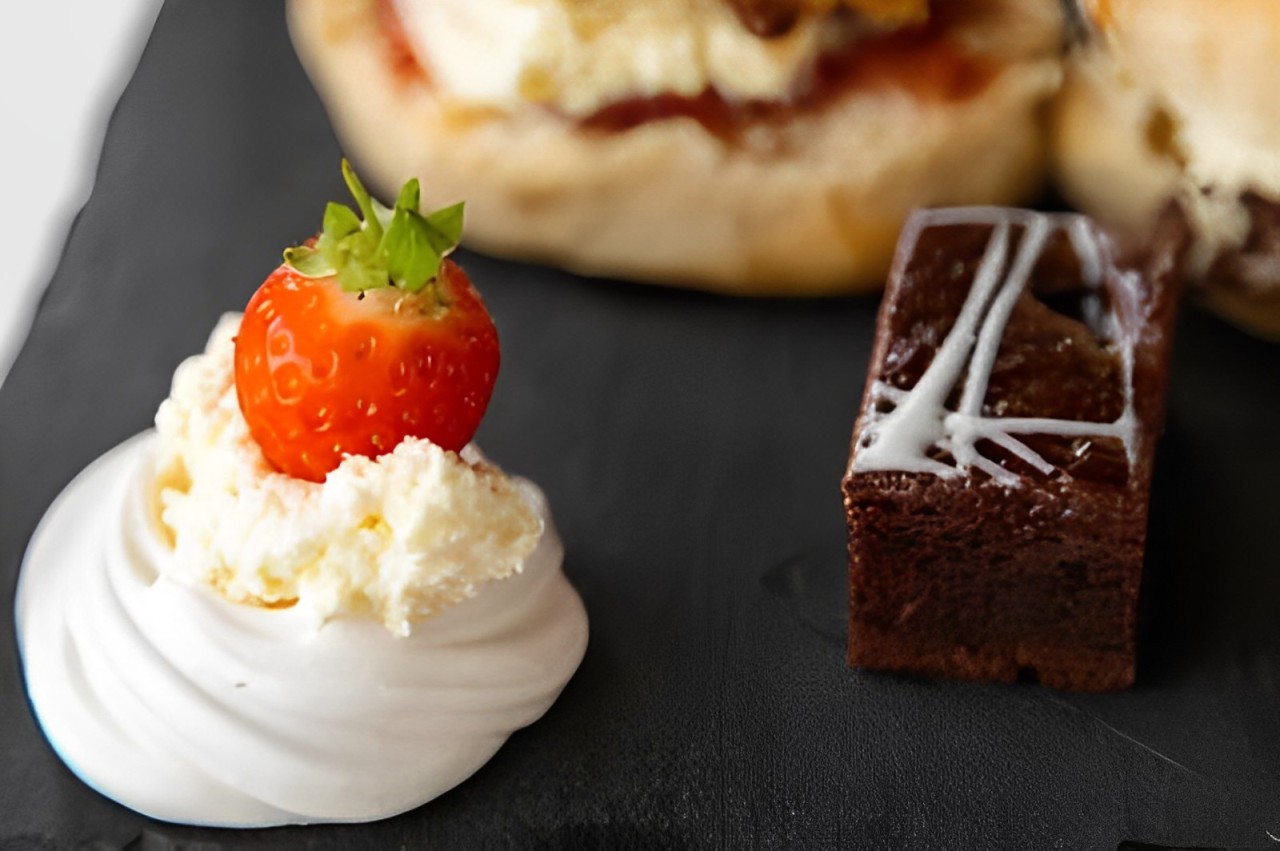
Afternoon tea at the Willow Tea Rooms
Strolling through the Botanic Gardens
Relaxing in Kelvingrove Park
Best Time to Visit
June to August
Summer is the peak tourist season with warm temperatures and long daylight hours. This is the best time for outdoor activities and festivals.
15°C to 20°C
59°F to 68°F
Practical Information
Language
- Official: English
- Widely spoken: Scottish Gaelic, Scots
- English: Widely spoken
Currency
British Pound (GBP)
Time Zone
GMT (UTC+0) or BST (UTC+1) during daylight saving time
Electricity
230VV, 50HzHz
Safety Information
Overall Safety Rating: Generally safe
Glasgow is generally safe for travelers, but like any city, it has its share of petty crime and safety concerns. Exercise caution in crowded areas and at night.
Important Precautions:
- • Keep valuables secure and out of sight
- • Be cautious in crowded areas and at night
- • Use licensed taxis and avoid unmarked cabs
Getting there
By air
- Glasgow Airport • 10.5 km (6.5 miles) west of the city center
- Glasgow Prestwick Airport • 50 km (31 miles) southwest of the city center
By train
Glasgow Central Station, Glasgow Queen Street Station
By bus
Buchanan Bus Station, Glasgow Central Bus Station
Getting around
Public transport
The subway is easy to use and affordable, with a circular route connecting key areas.
Taxis
Available • Apps: Uber, FreeNow
Rentals
Car, Bike, Scooter
Neighborhoods
West End
City Center
East End
Southside
Day trips
Loch Lomond and The Trossachs National Park
30 km (19 miles) northwest of Glasgow • Full day
A stunning national park offering a variety of outdoor activities, including hiking, boating, and wildlife spotting.
Stirling
40 km (25 miles) northeast of Glasgow • Full day
A historic city offering a mix of medieval architecture, museums, and scenic views.
Edinburgh
75 km (47 miles) east of Glasgow • Full day or overnight
Scotland's capital city offers a rich history, stunning architecture, and a vibrant cultural scene.
Festivals
The Glasgow International Comedy Festival • March
The Glasgow International Festival of Visual Art • July
The Celtic Connections Festival • January to February
Pro tips
- Explore the city's diverse neighborhoods, each with its own unique character and attractions
- Take advantage of the city's free museums and galleries, such as the Kelvingrove Art Gallery and Museum and the Riverside Museum
- Visit the Necropolis for a unique perspective on the city's history and a stunning view of Glasgow
- Experience the city's vibrant nightlife, from traditional pubs to trendy bars and live music venues
- Try local Scottish dishes, such as haggis, neeps, and tatties, and enjoy a traditional ceilidh (Scottish dance)
From $25
per person
Price varies by option
Secure booking
Free cancellation available