Kyoto Self-Guided Audio Experience
Active
3h - 9h
For a full refund, cancel at least 24 hours before the scheduled departure time.
Instant confirmation
Mobile or paper ticket accepted
About this experience
Experience ancient Kyoto on your terms with our immersive self-guided audio tour. Unlike rigid group tours, you'll explore at your own pace, lingering where you choose and skipping what doesn't interest you. Our expertly crafted narration reveals hidden stories and historical insights that even locals don't know, connecting you to Kyoto's soul in ways guidebooks cannot. Discover secret spots and authentic local perspectives as our professional narrators and refined sound design transport you through time. Each attraction comes alive through carefully researched storytelling that brings context to what you're seeing. Enjoy the freedom to customize your journey—visit attractions in any order, take breaks when desired, and truly absorb Kyoto's magic without being rushed. This isn't just information; it's a personal journey through Japan's cultural heart, designed for the curious traveler who seeks deeper connection and memorable experiences.
Available options
Kyoto Self-Guided Audio Experience
What's included
Private access link to a tour itinerary map of 23 attractions with audio guide individually
Private access link to the audio guide in one playlist for all 23 attractions
Private access links are valid until your tour is complete (maximum 6 days)
Detailed itinerary
1
Stop 1
Step into the architectural marvel that serves as Kyoto's modern gateway. This striking steel-and-glass structure, designed by renowned architect Hiroshi Hara, symbolizes Kyoto's harmonious blend of ancient tradition and cutting-edge innovation. Our audio guide reveals the fascinating architectural symbolism embedded throughout the building—from the massive exposed steel beams representing ancient temple structures to the futuristic sky garden offering panoramic views of the city. Discover how this controversial design sparked heated debates during its construction, yet has become an iconic landmark. Learn about the hidden symbols within the station that tell the story of Kyoto's evolution from imperial capital to contemporary cultural treasure, details that even regular visitors overlook.
2
Enter this magnificent wooden temple complex, headquarters of the Shinshū Ōtani-ha branch of Jōdo Shinshū Buddhism. Our audio guide unveils the dramatic history behind this spiritual powerhouse, including how it was built to rival its western counterpart and the political intrigue surrounding its construction. As you explore the massive Goei-dō (Main Hall)—one of Japan's largest wooden structures—you'll hear the remarkable story of how thousands of female devotees donated their hair to create ropes for moving the massive wooden pillars during construction. The audio experience guides you through the temple's architectural features, explaining their religious significance and revealing the hidden meanings behind the ornate decorations that most visitors miss entirely.
3
Stop 3
Journey through the mesmerizing path of thousands of vermilion torii gates at this ancient shrine dedicated to Inari, the Shinto god of rice and prosperity. Our audio guide explains the fascinating symbolism behind the gates—each donated by a Japanese business—and reveals why fox statues guard the shrine grounds. You'll discover the lesser-known mountain trails that lead to sacred spots where few tourists venture, and learn about the ancient rituals still practiced here by local businesses seeking good fortune. The narration decodes the meaning behind the various offerings and inscriptions you'll encounter, transforming what might seem like a simple photo opportunity into a profound cultural experience that connects you with centuries of Japanese spiritual tradition.
4
Stop 4
Immerse yourself in the tranquil beauty of this expansive Zen Buddhist temple complex, home to Japan's oldest Zen meditation hall. Our audio guide reveals how the temple was designed to represent the four great Buddhist temples of Nara, creating a spiritual microcosm within Kyoto. As you explore the temple's multiple gardens—each masterfully designed to showcase different natural elements—you'll learn about the philosophical principles encoded in their arrangement. Discover the secret meanings behind the distinctive cloud-shaped windows of the Hojo and how the celebrated Tsutenkyo Bridge was designed to create different emotional experiences with each seasonal change. The narration explains how to truly appreciate the temple's famous maple tree views from perspectives most visitors miss.
5
Stop 5
Enter the remarkably long wooden hall housing 1,001 life-sized statues of Kannon, the goddess of mercy. Our audio guide decodes the mesmerizing symmetry and symbolism of this extraordinary collection, explaining the unique features that make each statue subtly different despite their identical appearance at first glance. Learn about the 28 guardian deities representing Hindu and Buddhist traditions that protect the Kannon figures, and hear the dramatic tale of how the temple survived fires and wars through the centuries. The narration reveals the ancient archery contests once held along the temple's lengthy verandah and the remarkable craftsmanship techniques used to create the statues—details that transform your visit from mere sightseeing to a profound cultural immersion.
6
Stop 6
Perched dramatically on the hillside with its famous wooden stage extending over the valley, this UNESCO World Heritage site offers more than just spectacular views. Our audio guide explains the engineering marvel of the temple's construction—built without a single nail—and the sacred spring that gives the temple its name ("Pure Water Temple"). Discover the fascinating love rituals at the Jishu Shrine within the complex, where visitors test their romantic fate by walking between two stones with their eyes closed. Learn about the daring Edo-period tradition of jumping from the stage to have wishes granted and the hidden meanings behind the temple's vibrant three-storied pagoda. The narration reveals how different sections of the complex align with ancient beliefs about purification and spiritual transcendence.
7
Stop 7
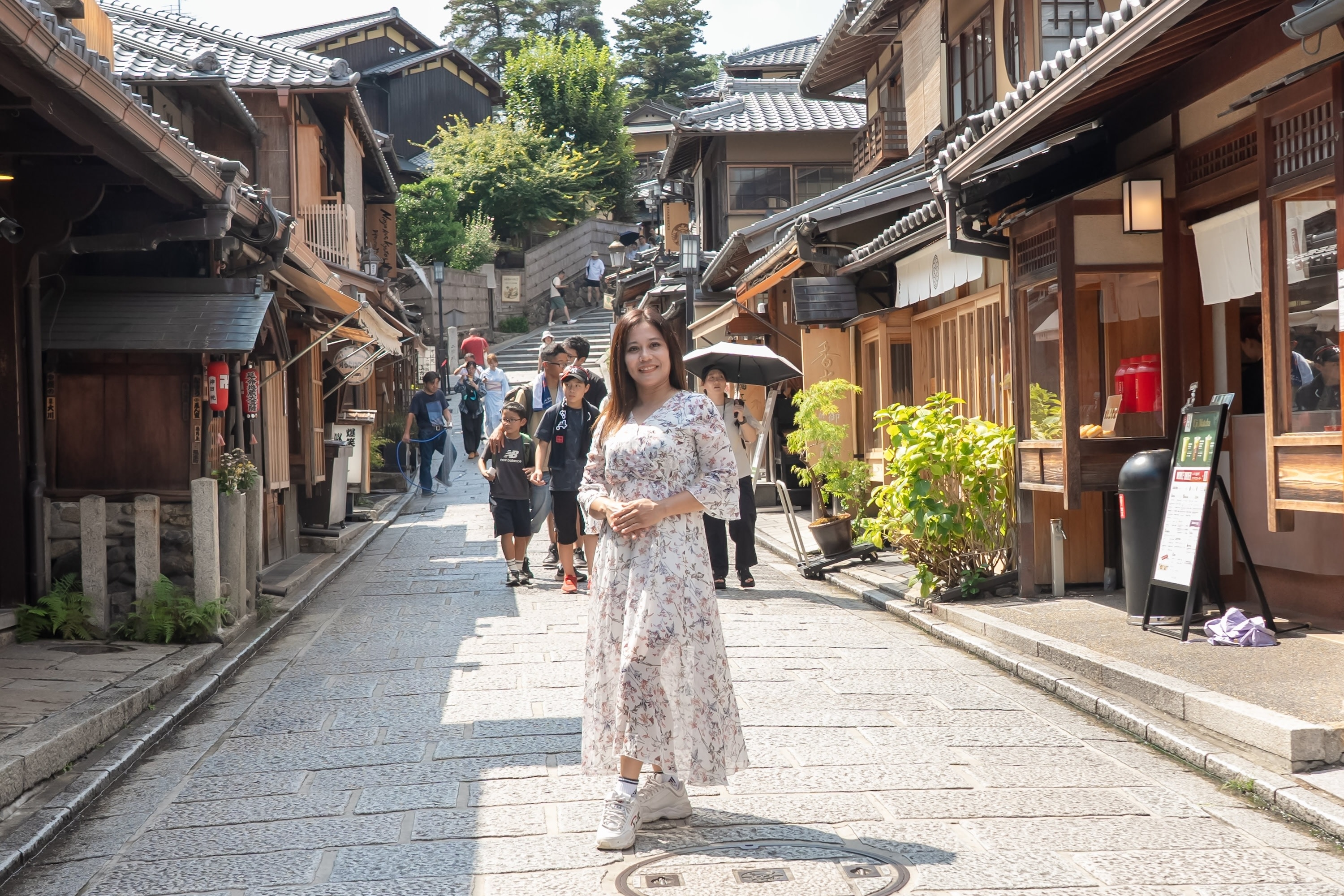
Stroll through these perfectly preserved historic streets, where modern Kyoto dissolves into the atmosphere of ancient Japan. Our audio guide reveals how these sloping stone pathways have retained their Edo-period character while continuing to serve as vibrant commercial thoroughfares. Learn about the superstitions surrounding Sannenzaka ("Three-Year Slope") and Ninenzaka ("Two-Year Slope"), including why locals are careful not to stumble here. Discover the stories behind the traditional machiya townhouses lining the streets, their distinctive architectural features, and how they've been repurposed while maintaining their historic integrity. The narration points out easily missed details that reveal the area's evolution over centuries and guides you to hidden spots where you can experience authentic local culture away from the main tourist flow.
8
Stop 8
Step into this exquisite temple founded by Nene, the widow of the powerful warlord Toyotomi Hideyoshi, as an expression of her undying love. Our audio guide reveals the personal history behind the temple's creation and Nene's fascinating transformation from political wife to Buddhist nun. Discover the symbolic meanings encoded in the temple's spectacular gardens designed by the famous landscape architect Kobori Enshu, including how the unique "Moon Viewing Pavilion" was designed to create perfect reflections. Learn about the temple's stunning maki-e lacquerware with gold and silver inlay—some of Japan's finest—and the hidden symbolism in the bamboo grove that few visitors understand. The narration explains how the temple's design represents Buddhist principles of impermanence and reveals restoration secrets that preserve its 400-year-old beauty.
9
Stop 9
Enter Kyoto's oldest Zen temple, established in 1202, and discover a spiritual haven that helped transform Japanese culture. Our audio guide explains how the temple's founder, Eisai, introduced both Zen Buddhism and tea cultivation to Japan after studying in China—two elements that would become fundamental to Japanese identity. Learn to properly interpret the temple's famous twin dragons ceiling painting, a masterwork created in 2002 for the temple's 800th anniversary, and discover the subtle design elements that enhance meditation throughout the complex. The narration reveals how to experience the temple's exquisite rock gardens from the perfect vantage points and explains the profound symbolism behind the seemingly simple arrangement of stones, gravel, and moss that casual visitors often miss entirely.
10
Stop 10
Explore this expansive Zen Buddhist temple complex that once served as the imperial villa before its conversion to a temple in the 13th century. Our audio guide reveals the historical significance of the imposing Sanmon gate, explaining how it commemorates soldiers who died in the civil war that ended Japan's Warring States period. Discover the surprising story behind the temple's massive brick aqueduct—a remnant of Kyoto's modernization efforts during the Meiji period that now creates a unique juxtaposition of Western industrial and traditional Japanese architectural styles. Learn about the temple's connection to Japan's most famous Zen garden designer and how to properly view the enigmatic Hojo garden from different perspectives to unlock its deeper meaning. The narration guides you to hidden sub-temples within the complex that most visitors overlook.
11
Stop 11
Discover the temple famous for its "Looking-Back Buddha" statue and spectacular autumn colors. Our audio guide reveals the touching legend behind the unique Buddha statue that appears to be looking over its shoulder, explaining how this singular image represents compassion waiting for those who are slow to reach enlightenment. Learn about the temple's origins as a healing center and how its architecture was designed to create perfect harmony with the natural landscape through each season. The narration explains the symbolic journey represented by the temple's circular promenade and guides you to the hidden Tahoto Pagoda offering panoramic views of Kyoto. Discover the temple's connection to Pure Land Buddhism and how its design incorporates elements that represent the journey to paradise—details that transform your visit into a deeper cultural experience.
12
Stop 12
Walk through the massive vermilion torii gate into this relatively young shrine, built in 1895 to commemorate Kyoto's 1100th anniversary as Japan's capital. Our audio guide explains how the shrine was designed as a partial replica of the original Heian Palace, offering insights into the layout of the ancient imperial compound that no longer exists. Discover the significance of the shrine's dedication to Emperor Kammu and Emperor Komei—the first and last emperors to rule from Kyoto—and what this symbolized during Japan's rapid modernization period. Learn about the shrine's stunning gardens designed by Japan's revered landscape architect Ogawa Jihei, including the hidden meanings behind the four distinct garden sections representing different seasons. The narration reveals how the shrine's annual Jidai Matsuri festival recreates over a millennium of Kyoto's history.
13
Stop 13
Explore the famed "Silver Pavilion" that, contrary to its name, was never actually covered in silver. Our audio guide explains the fascinating historical circumstances that prevented shogun Ashikaga Yoshimasa from completing his vision for this temple and how this "imperfection" perfectly embodies the Japanese aesthetic concept of wabi-sabi. Discover the profound influence this temple had on Japanese culture, serving as the birthplace of both the tea ceremony and ikebana flower arrangement during Japan's cultural renaissance. Learn how to properly appreciate the temple's extraordinary dry sand garden, "The Sea of Silver Sand," with its perfectly formed sand cone representing Mount Fuji. The narration reveals how the temple's design deliberately creates a journey that raises visitors' awareness through carefully orchestrated spatial experiences—insights that transform your visit into a meditation on Japanese aesthetics.
14
Stop 14
Step into one of Kyoto's oldest Shinto shrines, established well before Kyoto became Japan's capital in 794 CE. Our audio guide reveals how this UNESCO World Heritage site was strategically positioned at the confluence of the Kamo and Takano rivers to harness sacred natural energy. Discover the shrine's ancient connection to water purification rituals and protection against malevolent forces believed to enter the city from the northeast—Japan's traditional direction of evil. Learn about the sacred Tadasu no Mori forest surrounding the shrine, one of the few remaining old-growth forests in Kyoto, and the ancient trees that have been venerated for centuries. The narration explains the symbolic meanings behind the shrine's annual Aoi Matsuri festival, one of Kyoto's most important, and guides you to spot architectural features that have influenced shrine design throughout Japan.
15
Stop 15
Walk the grounds of the former seat of Japan's imperial power, where emperors resided until the capital moved to Tokyo in 1868. Our audio guide unveils the historical significance of the various structures within the palace complex, explaining how their arrangement reflected the strict court hierarchy and ritual requirements. Discover how the palace's design intentionally incorporated elements from different periods of Japanese architectural history to emphasize the imperial family's ancient lineage. Learn about the elaborate court ceremonies once performed here and the hidden meanings behind the distinctive decorative elements found throughout the palace. The narration reveals fascinating details about the daily life of Japan's emperors and the political intrigues that unfolded within these walls—stories that bring the seemingly austere buildings to life with human drama and cultural significance.
16
Stop 16
Step behind the massive stone walls of this UNESCO World Heritage site, built by Tokugawa Ieyasu as a symbol of shogunal power in the ancient imperial capital. Our audio guide reveals the ingenious defensive features hidden throughout the castle, including the famous "nightingale floors" designed to chirp when walked upon—an early warning system against assassins. Discover the political symbolism encoded in the castle's elaborate painted screens, where subtle artistic choices conveyed the shogun's authority over the emperor. Learn about the castle's pivotal role in Japanese history, including how it witnessed both the height of samurai power and its eventual end when the last shogun relinquished authority here in 1867. The narration explains how to identify the status symbols incorporated into the architecture that would have been immediately recognized by visitors during the Edo period.
17
Explore this distinctive shrine dedicated to Sugawara no Michizane, a 9th-century scholar and politician who was deified after his death. Our audio guide explains how this shrine became a powerful symbol of scholarship and justice after Michizane suffered political exile but was later vindicated. Discover why students still visit before exams and why the shrine's plum trees hold special significance to visitors seeking academic success. Learn about the shrine's famous monthly market, one of Japan's oldest continuous flea markets, and the ancient artistic performances still preserved here. The narration reveals the shrine's connection to the development of the tea ceremony and guides you to the hidden sub-shrines with their own fascinating histories. Discover the symbolic meaning behind the ox statues found throughout the grounds and how touching them in specific ways is believed to transfer wisdom.
18
Stop 18
Venture to one of Japan's oldest Shinto shrines, established before Kyoto became the capital and recognized as a UNESCO World Heritage site. Our audio guide reveals the profound significance of the shrine's unique sandcone formations, which represent sacred mountains and appear throughout the grounds. Learn about the shrine's ancient connection to water purification and the Aoi Matsuri festival, which it shares with Shimogamo Shrine. Discover the fascinating architectural features of the shrine buildings, including the distinctive chigi (crossed roof finials) and katsuogi (short logs) that signify their sacred status. The narration explains the shrine's connection to ancient Japanese cosmology and guides you to experience the purification rituals in the traditional manner. Hear about the shrine's role in imperial ceremonies throughout history and its continuing importance in contemporary Shinto practice.
19
Stop 19
Behold the breathtaking Golden Pavilion, covered in gold leaf that shimmers magnificently over its reflecting pond. Our audio guide reveals the complex history behind this Zen temple, including how the current structure is actually a 1955 reconstruction after a mentally troubled monk burned down the original. Discover the symbolic meaning behind the pavilion's three distinct architectural styles—each floor representing a different era and philosophical concept in Japanese Buddhism. Learn about the temple's founder, shogun Ashikaga Yoshimitsu, and how his aesthetic choices reflected both his political ambitions and spiritual beliefs. The narration explains how to appreciate the garden's design as a representation of the Pure Land Buddhist paradise and points out easily missed details in the landscape that complete the temple's artistic conception—transforming your visit into a deeper cultural experience.
20
Stop 20
Contemplate Japan's most famous Zen rock garden, a masterpiece of minimalism featuring 15 stones arranged on a bed of raked white gravel. Our audio guide explains the profound philosophical concepts encoded in this seemingly simple design, including how the rocks are positioned so that viewers can never see all 15 simultaneously from any single vantage point. Discover the multiple interpretations of the garden's meaning, from islands in a sea to tigers carrying cubs across a river, and learn about the historical context of its creation during Japan's turbulent Warring States period. The narration reveals the garden's mathematical precision and how its design employs principles of perspective to create specific psychological effects. Hear about the garden's influence on modern minimalist art and architecture worldwide, and learn to experience it as a meditation rather than merely a visual attraction.
21
Stop 21
Wander through this scenic district where natural beauty, history, and culture create one of Kyoto's most diverse experiences. Our audio guide reveals how this area served as a playground for the imperial court and aristocracy since the Heian period, explaining the historical context behind the famous Togetsukyo Bridge and its poetic name meaning "Moon Crossing." Discover the hidden temples nestled in the hillsides and learn about the area's connection to classical Japanese literature. The narration guides you through the mesmerizing bamboo grove, explaining the spiritual significance of bamboo in Japanese culture and how to experience this natural phenomenon beyond mere photography. Learn about the area's connection to traditional cormorant fishing practices and how to spot evidence of this ancient technique still practiced on summer evenings. The guide points out seasonal highlights and when to visit specific spots to avoid crowds.
22
Stop 22
Explore the head temple of the Rinzai school of Zen Buddhism, established in 1339 by shogun Ashikaga Takauji. Our audio guide reveals the political and spiritual motivations behind the temple's founding—built to appease the spirit of Emperor Go-Daigo after a bitter power struggle. Discover the profound symbolic meaning behind the temple's Sogenchi Garden, designed by the renowned Zen master Musō Soseki to represent the Buddhist universe and considered one of Japan's finest historical landscapes. Learn about the temple's famous Cloud Dragon painting on the ceiling of the Dharma Hall and why dragons hold special significance in Zen Buddhism. The narration explains how the temple's architecture embodies Zen principles and guides you to experience the garden from specific vantage points that create perfect harmony between the buildings and nature—perspectives that casual visitors often miss entirely.
23
Stop 23
Culminate your journey at this UNESCO World Heritage site featuring Japan's tallest wooden pagoda, an impressive five-story structure standing at 57 meters. Our audio guide reveals how this temple, established in 796 CE, served as one of two guardian temples protecting Kyoto when it became the capital. Discover the esoteric Buddhist world represented by the temple's Kondo and Kodo halls, where intricately arranged statues create a three-dimensional mandala expressing Buddhist cosmology. Learn about the temple's connection to the influential monk Kobo Daishi (Kukai), founder of Shingon Buddhism, and how his teachings are reflected in the temple's design and artifacts. The narration explains the symbolic meaning behind the five stories of the pagoda, representing the five elements of Buddhist philosophy, and reveals the engineering secrets that have allowed this wooden structure to survive centuries of earthquakes—insights that transform your appreciation of this architectural marvel.
What's not included
Entry fees (if required)
Transportations (pick-up and drop-off)
Audio devices (earphones and internet / Wi-Fi)
Food and drinks
Available languages
Audio guide
DE
EN
Important information
Public transportation options are available nearby
Suitable for all physical fitness levels
1. Complete Flexibility - Tour at Your Own Pace: This is a self-guided audio tour, NOT a GPS-guided tour. You have complete freedom to choose which attractions to visit, explore in any order you prefer, start and finish wherever you like, and even split the tour across multiple days. Spend as much time as you want at each location and take breaks whenever needed.
2. How You'll Receive Your Tour Materials: On your selected travel date, before your start time, you'll receive two important links: one for your audio guides (SoundCloud) and one for your interactive map (Google My Maps). These links will be sent via your booking platform's messaging system, and also via iMessage/WhatsApp if you provided your phone number during booking. Important: While all links are fully functional, the booking platform may not display link previews due to platform restrictions. For the best experience with instant previews and one-click access, we strongly recommend providing your phone number during booking to receive links via WhatsApp or iMessage. This ensures smoother, faster access to your audio guides.
3. Using Your Audio Guides (Link 1 - SoundCloud): Open the SoundCloud link in your web browser (Safari, Chrome, etc.). You'll see a playlist of all attraction audio guides organized in a suggested order. You can listen before your tour to plan which attractions interest you most, or play them as you arrive at each location. Simply scroll through the playlist, tap any attraction to play its audio guide, and use play/pause controls as needed throughout your tour.
4. Using Your Interactive Map (Link 2 - Google My Maps): Open the Google My Maps link in your web browser - not the Google Maps app. You'll see all attractions marked with headphone icons. Navigate by either tapping directly on any headphone icon on the map, or tapping the tour title below the map to view a complete list of attractions. When you select an attraction, a popup window appears with a clickable link to that location's audio guide.
5. What to Bring & Prepare: Essential items: headphones/earphones, fully charged smartphone, and internet access. Before your visit, review both links to familiarize yourself with the attractions and audio content, then decide your priorities and create your own route or follow our suggested order.
6. Audio Guide Language Selection: Select your preferred audio guide language during booking to guarantee delivery in that language. Language selection cannot be changed after confirmation. If your preferred language isn't available during booking, you can mention it in the Special Requirements section when placing your order. However, this request must be made at least 48 hours before your selected travel date and time. We will make our best effort to prepare your requested language, but please note this is subject to availability and cannot be guaranteed. For the best assurance of receiving your preferred language, always select from the available language options during the booking process.
7. Important Notice - Attraction Fees & Your Responsibilities: While many attractions are free to visit, some may charge fees for special sections, additional services, or general admission. It is your responsibility to check opening hours, closing times, holiday schedules, advance booking requirements, and purchase any necessary admission tickets before visiting each attraction. If you need assistance accessing or using the audio guide, please contact our customer support team.
Meeting point
Since this tour is a self-guided audio tour, you can choose where to start and finish according to your preference.
Important notes
Notice Regarding Audio Guide Access:
IMPORTANT: This is NOT a GPS-guided tour. You control where to go and what to listen to.
STEP 1 - RECEIVE ACCESS LINKS:
On your selected tour date, before your start time, you'll receive access links via booking platform messaging system / iMessage / WhatsApp (if provided) with 2 important links:
* Link 1: Audio Content (SoundCloud)
* Link 2: Interactive Map (Google My Maps)
STEP 2 - PREVIEW AND PLAN (Before or During Your Visit)
✓ Click Link 1 to access all audio guides on SoundCloud
✓ Listen to individual attraction guides or the entire tour
✓ Use this to familiarize yourself with the content at your convenience
✓ Click Link 2 to view the interactive Google My Maps
✓ See all attraction locations marked as points on the map
STEP 3 - PLAN YOUR ROUTE
✓ Use both links to decide which attractions you want to visit
✓ Choose your preferred starting point
✓ Decide if you want to follow our suggested order or create your own route ✓ Prioritize attractions based on your interests
STEP 4 - EXPLORE THE CITY
1. Use the Google My Maps link to navigate between attractions
2. At each location, click the corresponding map point
3. The relevant audio guide will play directly
4. Move at your own pace between stops
YOUR FLEXIBILITY:
✓ Start and finish anywhere you prefer
✓ Visit attractions in any order
✓ Take breaks whenever needed
✓ Spend more time at favorite locations
✓ Split the tour across 6 days
WHAT TO BRING:
* Headphones/Earphones
* Fully charged smartphone
* Internet access
CUSTOMER SUPPORT:
Contact us for assistance - we're here to ensure you have a smooth experience.
About Kyoto
Kyoto, once the imperial capital of Japan, is a city rich in history, culture, and tradition. Known for its numerous classical Buddhist temples, as well as gardens, imperial palaces, Shinto shrines, and traditional wooden houses, Kyoto offers a unique blend of ancient and modern Japan. The city is a must-visit for travelers seeking to experience the heart of Japanese heritage.
Top Attractions
Kinkaku-ji (Golden Pavilion)
A Zen Buddhist temple covered in gold leaf, Kinkaku-ji is one of Kyoto's most iconic landmarks. The temple's top two floors are completely covered in gold leaf, reflecting beautifully on the surrounding pond.
Historical/Religious
1-2 hours
¥400
Fushimi Inari Taisha
Famous for its thousands of vermilion torii gates, Fushimi Inari Taisha is a Shinto shrine dedicated to Inari, the god of rice. The trails leading up the mountain offer stunning views of Kyoto.
Religious
2-4 hours (depending on how far you hike)
Free
Kiyomizu-dera
A historic wooden temple with a large veranda supported by massive wooden pillars, Kiyomizu-dera offers panoramic views of Kyoto. The temple is particularly famous for its spring and autumn foliage.
Religious
1-2 hours
¥400
Arashiyama Bamboo Grove
A stunning grove of bamboo, Arashiyama is one of Kyoto's most famous natural attractions. The towering bamboo stalks create a surreal and peaceful atmosphere.
Nature
1-2 hours
Free (Tenryu-ji Temple costs ¥500)
Gion
Kyoto's most famous geisha district, Gion is known for its traditional wooden machiya houses, teahouses, and the chance to spot geishas and maikos (apprentice geishas).
Cultural
1-2 hours (longer if dining or attending a cultural event)
Free to explore (dining and cultural events can be expensive)
Must-Try Local Dishes
Kaiseki Ryori
A traditional multi-course Japanese meal that emphasizes seasonality and presentation. Each dish is carefully prepared and artfully presented.
Dinner
Often includes fish, meat, and vegetables, but vegetarian options are available.
Yudofu (Tofu Hot Pot)
A Kyoto specialty featuring tofu simmered in a light kombu (kelp) broth, often served with vegetables and condiments.
Lunch/Dinner
Vegetarian-friendly, can be made vegan if broth is vegetable-based.
Matcha Desserts
Kyoto is famous for its high-quality matcha (green tea) powder, used in various desserts like ice cream, parfaits, and wagashi (traditional sweets).
Dessert
Vegetarian and vegan options available.
Obanzai
Home-style Kyoto dishes made with fresh, local ingredients, often featuring vegetables, fish, and tofu.
Lunch/Dinner
Can be adapted to various dietary preferences.
Popular Activities
Hiking in the mountains
Cycling through the countryside
Rafting on the Hozu River
Onsen (hot spring) visits
Tea ceremonies
Scenic walks in gardens and parks
Temple and shrine visits
Traditional tea ceremonies
Best Time to Visit
March to May (Spring), October to November (Autumn)
Spring and autumn offer pleasant weather and are the best times to visit for cherry blossoms and autumn foliage. These seasons also see the highest tourist volumes.
15°C to 25°C (Spring), 10°C to 20°C (Autumn)
59°F to 77°F (Spring), 50°F to 68°F (Autumn)
Practical Information
Language
- Official: Japanese
- Widely spoken: English (limited)
- English: Limited/Rare
Currency
Japanese Yen (JPY)
Time Zone
JST (UTC+9)
Electricity
100VV, 50/60HzHz
Safety Information
Overall Safety Rating: Very safe
Kyoto is a very safe city with a low crime rate. Violent crime is rare, and petty crime is uncommon. However, as with any tourist destination, it's important to take basic precautions to protect yourself and your belongings.
Important Precautions:
- • Keep valuables secure and out of sight
- • Be cautious of your surroundings, especially in crowded areas
- • Use reputable tour operators and taxis
Getting there
By air
- Kansai International Airport • 115 km from Kyoto
- Osaka International Airport (Itami) • 40 km from Kyoto
By train
Kyoto Station
By bus
Kyoto Station Bus Terminal
Getting around
Public transport
Buses are the most extensive and affordable way to get around Kyoto. They cover most areas of the city and are especially useful for reaching temples and shrines.
Taxis
Available • Apps: JapanTaxi, INDRIVER
Rentals
Car, Bike, Scooter
Neighborhoods
Gion
Higashiyama
Arashiyama
Downtown Kyoto (Shijo-Kawaramachi)
Day trips
Nara
40 km from Kyoto • Half day to full day
Nara is a historic city known for its ancient temples, shrines, and the famous Nara Park, home to hundreds of free-roaming deer.
Uji
20 km from Kyoto • Half day
Uji is a small city known for its historic temples, beautiful riverside scenery, and high-quality matcha (green tea).
Kurama and Kibune
25 km from Kyoto • Full day
Kurama and Kibune are two neighboring villages in the mountains north of Kyoto, known for their hot springs, hiking trails, and scenic beauty.
Festivals
Gion Matsuri • July (main events on July 17th and 24th)
Jidai Matsuri • October 22nd
Aoi Matsuri • May 15th
Pro tips
- Visit popular attractions like Fushimi Inari Taisha and Kinkaku-ji early in the morning or late in the afternoon to avoid crowds.
- Consider purchasing a Kyoto City Bus Pass or other transportation passes to save money on getting around the city.
- Try local specialties like yudofu (tofu hot pot), matcha desserts, and obanzai (home-style Kyoto dishes).
- Explore the city's many temples and shrines, but don't forget to take time to enjoy the natural beauty of Kyoto's gardens and parks.
- Learn a few basic Japanese phrases to enhance your experience and show respect for local customs and traditions.
From $25
per person
Price varies by option
Secure booking
Free cancellation available
Instant confirmation