Private Architecture and Palaces Tour in Buenos Aires
Active
3h
For a full refund, cancel at least 24 hours before the scheduled departure time.
Instant confirmation
Mobile or paper ticket accepted
About this experience
On this 3-hour tour, you will visit the most renowned palaces of the Buenos Aires history and their particular stories. With its very different and unique styles, each corner of the palaces tell a whole new story of the view you are taking in and it will bring you back to that specific time. This tour is about all the neighborhoods of Argentina, but it is also one in itself.
The main theme is the "Belle Epoque" with its architecture, economic situation, and social reality combined with the role of the Argentina in the world at the time and the influence of the french aesthetics in Argentina's bourgeois during the time of the first and second World War and the process of the palaces building.
We are granted by the safe travel seal of World Travel & Tourism Council.
Available options
Private Architecture and Palaces Tour in Buenos Aires
Pickup included
What's included
Hotel Pick-Up and Drop-Off
Guided 3-hour Buenos Aires Tour
Professional Guide
Detailed itinerary
1
Stop 1
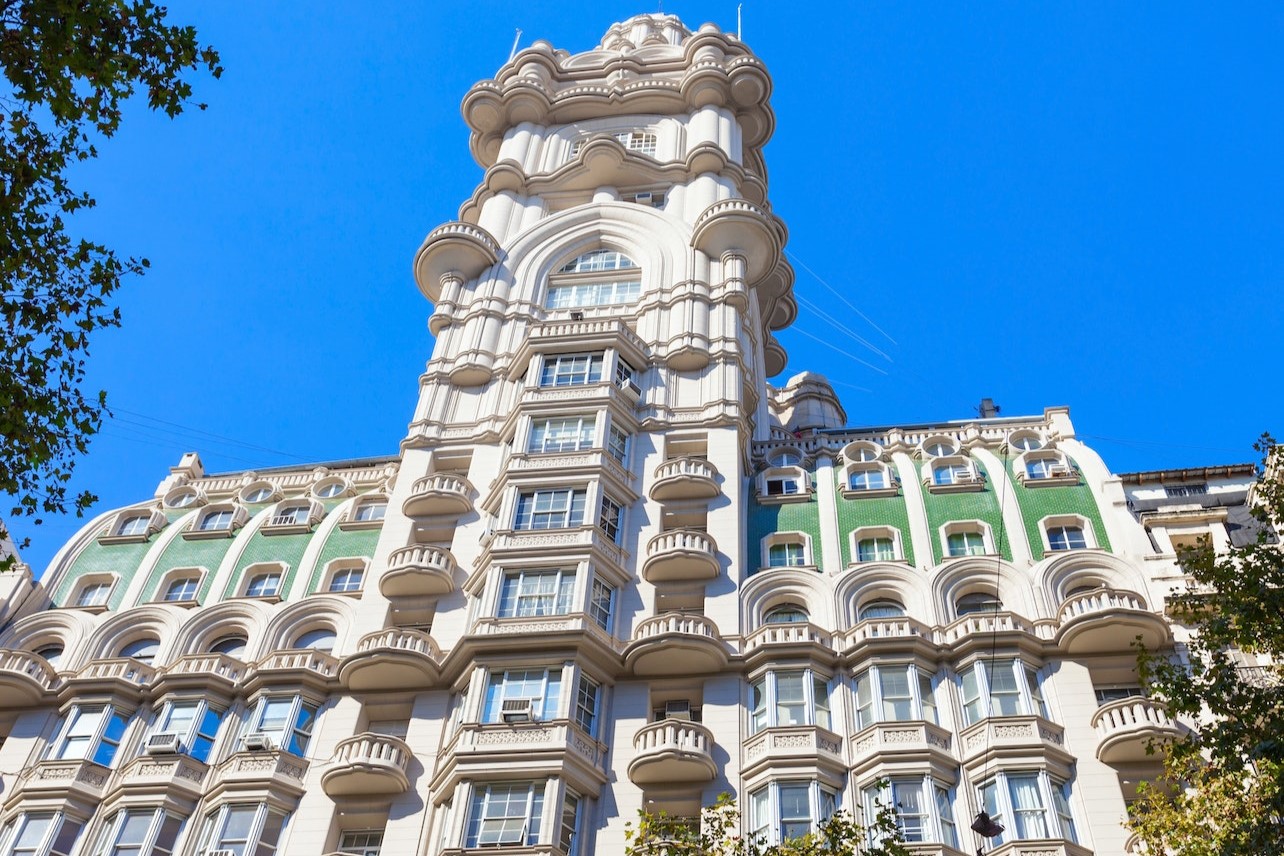
The Barolo Palace, located in the Monserrat neighborhood, was built by the Italian architect Mario Palanti for businessman Luigi Barolo. At that time, it was the tallest building in South America, until the Kavanagh was built in 1935.
The Barolo was the first reinforced concrete building of almost 100 meters. of height and is topped by a revolving headlight of 300,000 spark plugs on the 22nd floor that, in 1923, transmitted with its lights the result of the fight for the world boxing title between Luis Angel Firpo and Jack Dempsey in New York.
In 2010, the city government promoted the restoration of the magnificent lighthouse to participate, with its glimmer, of the Argentine bicentennial festivities. Both Palanti and Barolo were admirers of Dante Alighieri and in the building there are references to the Divine Comedy, as the general division of the project into three parts, which correspond to the hell, purgatory and heaven of the work. In addition, the building is reminiscent of the architecture of India, as Palanti took references from the Palace of the Winds in Jaipur and the Rajarani temple in Bhubaneshvar.
2
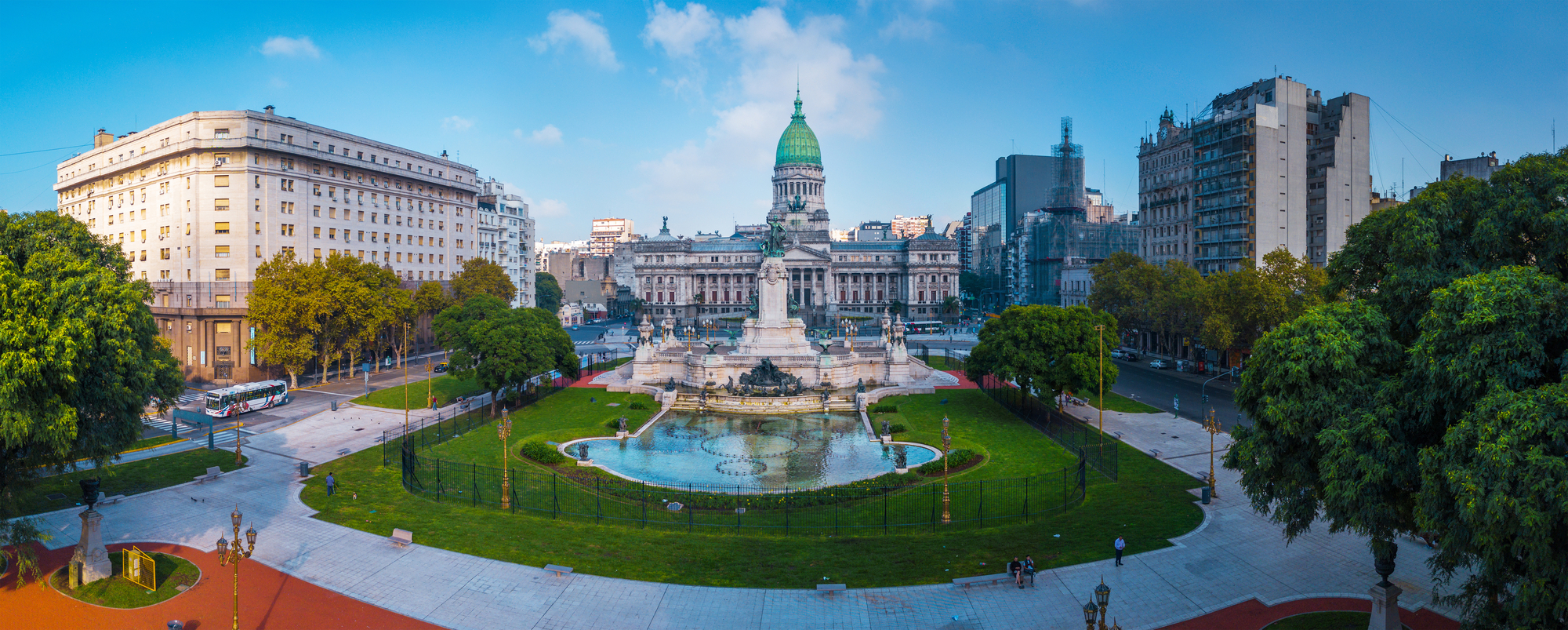
The Palace of the Congress of the Argentine Nation is a neo clasical building where the Congress of the Argentine Nation develops its activities, it is one of the largest congresses in the world and it is located in the City of Buenos Aires, in a block of 12 079.6 m² of surface, limited by the Rivadavia, Combate de los Pozos, Entre Rios and Hipólito Yrigoyen Avenues.
3
Stop 3
The Colon Theater in the city of Buenos Aires is considered one of the best theaters in the world. Recognized for its acoustics and the artistic value of its construction, its current building turned 100 years old in 2008.
The building has an eclectic style of the early twentieth century.
The construction of the new building took around 20 years, its foundation stone was placed on May 25, 1890, with the intention of inaugurating it before October 12, 1892 coinciding with the fourth centenary of the discovery of America.
It´s located between the streets of Cerrito, Viamonte, Tucumán and Libertad, in the heart of the city of Buenos Aires, and was inaugurated in 1908 with the opera Aida by Giuseppe Verdi.
4
The "Palacio de Aguas Corrientes" is an emblematic building of the city of Buenos Aires. It was built to house the water supply tanks of the growing city in the late nineteenth century, wrapped in a sumptuous exterior of imported materials whose architect was the Norwegian Olaf Boye, who arrived in Buenos Aires in 1885 and worked with renowned local architects such as Juan Antonio Buschiazzo, Adolfo Büttner and Carlos Altgelt.
The building is one of the most exuberant of Buenos Aires, and a sample of the eclectic architecture that enchanted the upper classes that ruled Argentina until 1916. The style can be framed within the tax in the Second French Empire, and highlights the pieces of polychrome ceramic and the abundant ornaments in the façade.
5
Stop 5
Palacio Paz was the largest and one of the most luxurious residences in the city of Buenos Aires, Argentina, owned by José C. Paz and the faithful reflection of the Beaux-Arts architecture of the early twentieth century. Its main entrance is located on Avenida Santa Fe 750, in front of Plaza San Martín. Since 1938, it has been the headquarters of the Military Circle.
6
The San Martin Palace is the ceremonial seat of the Foreign Ministry of the Argentine Republic, under the Ministry of Foreign Affairs, and is located across from Plaza San Martín in the Retiro neighborhood of Buenos Aires.
The Palace, of fine arts style, was designed for Mercedes Castellanos de Anchorena member of one of the most representative families of the Buenos Aires aristocracy, by the architect Alejandro Christophersen in 1905. It was inaugurated by the Anchorena family to commemorate the centenary of the declaration of the Argentine Independence. The palace was known as the Anchorena Palace until 1936, when it was acquired by the Argentine government and became the headquarters of the Ministry of Foreign Affairs, calling itself "Palacio San Martin".
7
The house that belonged to Ortiz Basualdo-Zapiola is today the headquarters of the Embassy of France. Built between 1912 and 1918, it is considered one of the buildings that best represents the architecture of French academicism. It keeps a great variety of styles that reflect the artistic value
8
Stop 8
The General Güemes Gallery, also known as Pasaje Güemes, is an art nouveau style building with an interior pedestrian passage that joins the streets of Florida and San Martin, with shops on two levels. It is located in the heart of the city of Buenos Aires, and is the first building in the country built entirely of reinforced concrete and is also considered by many as its first skyscraper.
It was inaugurated in 1915 and its name recalls General Martín Miguel de Güemes, hero of the Argentine War of Independence and driver of the so-called gaucho war.
9
In a bustling commercial street in the elegant Recoleta neighborhood, you can visit a serene temple of books. The lighting is soft, with details that show the best craftsmanship of the early twentieth century. The description corresponds to the Grand Splendid Athenaeum, and belongs to a National Geographic article that points to the bookstore as "the most beautiful in the world".
From Santa Fe Avenue, the Grand Splendid Athenaeum is a striking building. A large stained-glass window with books, a sign with his name and the folds of an architecture of the beginning of the 20th century.
Before being filled with books, the Athenaeum was the National North Theater until, in 1917, the Grand Splendid was built as an immense avant-garde theater.
What's not included
Gratuities
Food and drinks
Attraction Entrance Fees (Where necessary)
Available languages
Guide guide
DE
RU
PT
EN
IT
FR
ES
Reviews breakdown
Viator
5.0
9 reviews
5★
9
4★
0
3★
0
2★
0
1★
0
Tripadvisor
4.6
9 reviews
5★
7
4★
1
3★
0
2★
1
1★
0
Important information
Specialized infant seats are available
Suitable for all physical fitness levels
This is a kid-friendly tour
Important notes
Minimum numbers apply.
There is a possibility of cancellation after confirmation if there is not enough passengers to meet requirements. In the event of this occurring, you will be offered an alternative or full refund
Hotel pickups commence prior to this time, you must contact the local service provider to verify your exact pickup time.
About Buenos Aires and The Pampas
Buenos Aires, the vibrant capital of Argentina, is known for its European-influenced architecture, rich cultural scene, and passionate tango. The Pampas, a vast fertile plain, offers a glimpse into Argentina's gaucho (cowboy) culture and stunning landscapes. Together, they provide a unique blend of urban sophistication and rural charm.
Top Attractions
Recoleta Cemetery
A famous cemetery where Eva Perón is buried, featuring ornate mausoleums and a rich history.
Historical
1-2 hours
Free
La Boca
A colorful neighborhood known for its vibrant street art, tango performances, and the famous Caminito street.
Cultural
2-3 hours
Free to explore, paid shows
The Pampas
A vast fertile plain offering a glimpse into Argentina's gaucho culture, with estancias (ranches) and beautiful landscapes.
Nature
Full day or overnight
Varies by estancia (ARS 1,000-5,000 approx. USD 13-65)
Teatro Colón
One of the world's most famous opera houses, known for its stunning architecture and acoustics.
Cultural
1-2 hours (tour), longer for performances
Tour: ARS 1,200 (approx. USD 16), Performances: ARS 500-5,000 (approx. USD 6.50-65)
San Telmo Market
A historic market offering antiques, collectibles, and local crafts, with a lively Sunday market atmosphere.
Market
1-3 hours
Free to explore, varies for purchases
Must-Try Local Dishes
Asado
Argentine barbecue featuring various cuts of beef, sausages, and other meats, cooked over an open fire.
Dinner
Not vegetarian or vegan
Empanadas
Savory pastries filled with various ingredients like beef, chicken, or cheese.
Snack or Lunch
Can be vegetarian or vegan
Milanesa
Breaded and fried meat cutlet, similar to schnitzel, often served with mashed potatoes or salad.
Lunch or Dinner
Not vegetarian or vegan
Dulce de Leche
A sweet, caramel-like spread made from milk and sugar, used in various desserts.
Dessert
Vegetarian
Popular Activities
Horseback riding in The Pampas
Kayaking in Tigre Delta
Hiking in Sierra de la Ventana
Wine tasting in Palermo
Spa day in Recoleta
Strolling through Bosques de Palermo
Tango shows in La Boca
Visiting museums in Recoleta
Best Time to Visit
Spring (September to November) and Fall (March to May)
Pleasant weather, fewer crowds, and vibrant city life. Ideal for outdoor activities and exploring both the city and the Pampas.
15-25°C
59-77°F
Practical Information
Language
- Official: Spanish
- Widely spoken: English, Italian, French
- English: Moderately spoken in tourist areas, limited elsewhere
Currency
Argentine Peso (ARS)
Time Zone
GMT-3
Electricity
220VV, 50HzHz
Safety Information
Overall Safety Rating: Exercise caution
Buenos Aires is generally safe for tourists, but petty crime like pickpocketing and scams can occur, especially in crowded areas. Be aware of your surroundings and take precautions.
Important Precautions:
- • Keep valuables secure
- • Avoid flashing expensive items
- • Use reputable taxi services or app-based taxis
Getting there
By air
- Ministro Pistarini International Airport • 35 km from city center
- Aeroparque Jorge Newbery • 4 km from city center
By train
Retiro Station
By bus
Retiro Bus Terminal, Constitución Bus Terminal
Getting around
Public transport
Efficient and affordable, with six lines connecting major neighborhoods.
Taxis
Available • Apps: Uber, Cabify
Rentals
Car, Bike, Scooter
Neighborhoods
Palermo
Recoleta
La Boca
San Telmo
Day trips
Estancia Santa Susana
100 km from Buenos Aires • Full day
A traditional estancia offering horseback riding, gaucho shows, and authentic Argentine asado.
Colonia del Sacramento
100 km from Buenos Aires (by ferry) • Full day
A charming colonial town in Uruguay with cobblestone streets, historic buildings, and a relaxed atmosphere.
Tigre Delta
35 km from Buenos Aires • Half day to full day
A network of islands and waterways offering boat tours, kayaking, and nature walks.
Festivals
Carnaval de Buenos Aires • February or March (dates vary)
Festival Internacional de Cine Independiente de Buenos Aires (BAFICI) • April (dates vary)
La Noche de los Museos • November (dates vary)
Pro tips
- Use the SUBE card for convenient and discounted public transport
- Learn a few basic Spanish phrases to enhance your experience and connect with locals
- Explore beyond the tourist hotspots to discover the city's hidden gems
- Try local specialties like empanadas, milanesa, and dulce de leche
- Visit during the shoulder seasons (spring and fall) for pleasant weather and fewer crowds
From $25
per person
Price varies by option
Secure booking
Free cancellation available
Instant confirmation