Full day Christian tour following Paul In Athens and Corinth
Active
8h
For a full refund, cancel at least 24 hours before the scheduled departure time.
Instant confirmation
Mobile or paper ticket accepted
About this experience
Highlights of original Christian shore excursion on Paul's footsteps in Athens and ancient Corinth
• A visit to the Acropolis and the Parthenon of Athens
• A visit to the picturesque quarter of ancient agora
• Take impressive photos at the Corinth Canal
• The archaeological site of Ancient Corinth
• An experienced and skilled English speaking driver for a safe and comfortable private tour
• The Mars hill
• Travelers can customize the tour within the itinerary!
Available options
Group 12-15 persons
PERSONAL AND PRIVATE: This is a personal shore excursion and private tour just for you, your family, and your friends!<br/>ROUTE PLANNER: We will pick you up from your hotel or accommodation in Athens where your tour starts and we will drop you off back.<br/>TRAVEL WITH STYLE: Groups of 1-3 Mercedes sedan or similar, 4-7 Luxury Mercedes Benz Minivan, 8-15 Mercedes-Benz Sprinter. A/C<br/>Group 12 to 15 persons: Group for 12 to 15 persons in a luxurious Mercedes-Benz minibus fully air-conditioned and with leather interior.<br/>Pickup included
Group 1 to 3 persons
Group for 1 to 3 persons in a luxurious Mercedes-Benz sedan or similar fully air-conditioned and with leather interior.<br/>PERSONAL AND PRIVATE: This is a personal shore excursion and private tour just for you, your family, and your friends!<br/>ROUTE PLANNER: We will pick you up from your hotel or accommodation in Athens where your tour starts and we will drop you off back.<br/>TRAVEL WITH STYLE: Groups of 1-3 Mercedes sedan or similar, 4-7 Luxury Mercedes Benz Minivan, 8-15 Mercedes-Benz Sprinter. A/C<br/>Pickup included
Group 4-7 persons
PERSONAL AND PRIVATE: This is a personal shore excursion and private tour just for you, your family, and your friends!<br/>ROUTE PLANNER: We will pick you up from your hotel or accommodation in Athens where your tour starts and we will drop you off back.<br/>TRAVEL WITH STYLE: Groups of 1-3 Mercedes sedan or similar, 4-7 Luxury Mercedes Benz Minivan, 8-15 Mercedes-Benz Sprinter. A/C<br/>Group 4 to 7 persons: Group for 4 to 7 persons in a luxurious Mercedes-Benz minivan fully air-conditioned and with leather interior.<br/>Pickup included
Group 8-11 persons
PERSONAL AND PRIVATE: This is a personal shore excursion and private tour just for you, your family, and your friends!<br/>ROUTE PLANNER: We will pick you up from your hotel or accommodation in Athens where your tour starts and we will drop you off back.<br/>TRAVEL WITH STYLE: Groups of 1-3 Mercedes sedan or similar, 4-7 Luxury Mercedes Benz Minivan, 8-15 Mercedes-Benz Sprinter. A/C<br/>Group 8 to 11 persons: Group for 8 to 11 persons in a luxurious Mercedes-Benz minibus fully air-conditioned and with leather interior.<br/>Pickup included
What's included
Bottled water
A professional English speaking driver with good knowledge in history and culture of Greece, to guide you till you enter archaeological sites and museums. Tour drivers are not licensed to companion you inside the archaeological sites and museums. If you'd like to have a licensed by the state tour guide to escort you inside the sites and museums, we can arrange it for you with an additional cost. Licenced by the state tour guides are freelance and it is subject of availability on bookings day!
Pick-up from the cruise ship pier at Port of Piraeus Road tolls and local taxes
Transport by air-conditioned vehicle appropriate for the size of your group
Fuel surcharge
Hotel pickup and drop-off in Athens
Detailed itinerary
1
Pick up from your accommodation in Athens, or your cruise ship pier at Piraeus port. We will drive along the coastal road of Saronic Gulf to enjoy the Piraeus and Athens riviera.
2
Stop 2
Pass by
The greatest and finest sanctuary of ancient Athens, dedicated primarily to its patron, the goddess Athena, dominates the centre of the modern city from the rocky crag known as the Acropolis. The most celebrated myths of ancient Athens, its greatest religious festivals, earliest cults and several decisive events in the city's history are all connected to this sacred precinct. The monuments of the Acropolis stand in harmony with their natural setting. These unique masterpieces of ancient architecture combine different orders and styles of Classical art in a most innovative manner and have influenced art and culture for many centuries. The Acropolis of the fifth century BC is the most accurate reflection of the splendor, power and wealth of Athens at its greatest peak, the golden age of Pericles.
3
Stop 3
It is located just to the right of the exit of the Acropolis. Also known as the “Hill of Ares”. In classical times, this was the site of the Council of Nobles and the Judicial Court, which mainly dealt with homicide. It is said that Ares was tried here by the Gods for the murder of Alirrothios, one of the sons of Poseidon. Another trial said to have taken place here was that of Orestes who was alleged to have killed his mother Clytemnestra, and her lover.
In preclassical times, the Areopagus was where the council of the elders of the city would meet. The members were actually those who were held in high regard in public office. In 480 BC, the hill was used as a campsite by the Persians, when they were undertaking their siege of the Acropolis. It was also at the Areopagus that Saint Paul preached the famous “Sermon on an Unknown God”, apparently after seeing an altar to the “Unknown God”. This speech is commemorated with a bronze plaque that you can see at the foot of the rock.
4
Stop 4
The Propylaea of the Athenian Acropolis were built on the west side of the hill, where the gate of the Mycenaean fortification once stood. The first propylon, or gate, was constructed in the age of Peisistratos (mid-sixth century BC), after the Acropolis had become a sanctuary dedicated to Athena.
A new propylon, built in 510-480 BC, was destroyed by the Persians in 480 BC and repaired after the end of the Persian Wars, during the fortification of the Acropolis by Themistokles and Kimon. The monumental Propylaia admired by modern visitors were part of the great Periklean building program. They were erected in 437-432 BC, after the completion of the Parthenon, by architect Mnesikles. The original building plan was particularly daring both in architectural and artistic terms, but was never completed.
5
Stop 5
The temple of Athena Nike, designed by the architect Kallikrates, was built between 426 and 421 BC on a bastion at the southwestern edge of the Acropolis. The small Ionic temple had a relief-carved frieze with different thematic representations on each side. On the east was shown a gathering of gods around the enthroned Zeus, while the other sides presented scenes of war between Greeks and Persians or Greeks with other Greeks. The south side depicted the victorious battle of the Greeks against the Persians at Marathon in 490 BC, led by the Athenians.
Few sculptural remains are preserved from the temple’s pediments. It is believed the west pediment depicted the victory of the Olympian gods against the Giants (Gigantomachy), while the east depicted the victory of the Athenians against the Amazons (Amazonomachy).
Around 410 BC, a marble parapet, adorned with carved reliefs, was installed around the dangerous edge of the temple’s bastion for the protection of visitors.
6
Stop 6
Parthenon; Temple that dominates the hill of the Acropolis at Athens. Built in the mid-5th century BCE and dedicated to the Greek goddess Athena Parthenos. The temple is generally considered to be the culmination of the development of the Doric order, the simplest of the three Classical Greek architectural orders. It was part of a magnificent rebuilding program directed by the Athenian statesman Pericles, following the sack of the Acropolis during the Greco-Persian Wars (492–449 BCE). The project was to include, among other things, the Propylaea, the gateway to the sacred precinct; the Erechtheum, a shrine to the agricultural deities, especially Erichthonius; and the Temple of Athena Nike, an architectural symbol of the harmony with which the Dorian and Ionian peoples lived under the government of Athens.The Parthenon was to be the chief shrine to Athena and also the treasury of the Delian League, a confederacy of ancient Greek states under the leadership of Athens, founded in 478 BCE.
7
Stop 7
On the high stylobate of the south porch of the Erechtheion are six maidens, who take the place of columns in supporting the entablature. Now severely weathered and affected by pollution, five of the caryatids were removed to the Acropolis Museum in 1978 and replaced with replicas.
The other figure (the second from the left in the first row of four) was appropriated by Lord Elgin, who, between 1801 and 1805, removed about half of the surviving sculptures from the fallen ruins of the Acropolis and from the Parthenon, itself. They were acquired by the British Museum in 1816 and put on public display the following year.
Between 1937 and 1938, even the caryatid you can find in the British Museum in London, which certainly is in better condition than its sisters, was damaged when masons abraded the surface (as well as that of some of the Parthenon sculptures) in a misguided and unauthorized attempt to brighten them for the opening of the new gallery in which they were to be displayed.
8
Stop 8
After our visit at Acropolis ,you will visit the Ancient Agora, 20 min travel. The ancient Agora of Athens is the best-known example of an ancient Greek agora, located to the northwest of the Acropolis and bounded on the south by the hill of the Areopagus and on the west by the hill known as the Agoraios Kolonos, also called Market Hill.
The word "agora" applies to an assembly of people and by extension marks the gathering place. In modern Greek, the term means "marketplace".
Just about every ancient and modern city includes a place for an agora, and the Agora of Athens is located at the heart of the city, remaining in use either as an assembly, as a commercial, or as a residential area for about 5000 years.
Consequently, the area has undergone countless building, destruction, and rebuilding cycles. Today these strata of history have been distilled through excavations to expose the Agora's important functions from Archaic to Greco-Roman and Byzantine times.
9
Admire the travel along the coastal road of the Saronic golf till we will arrive at the famous Corinth canal in Peloponnese. The Peloponnese is a peninsula and geographic region in southern Greece. It is connected to the central part of the country by the Isthmus of Corinth land bridge which separates the Gulf of Corinth from the Saronic Gulf. Peloponnese grape varieties have a very special place in the treasure of native Greek grape varieties. Τhe Peloponnese Wine Roads take you on a journey to a modern, sometimes rare and definitely unknown to many wine world, full of authenticity and history. Native Peloponnese grape varieties do not only reflect the diversity of Greek and Peloponnesian wine, but also the significance of some very special Greek varieties. Among them are two of the four most renowned varieties of the Greek vineyard in the world’s best markets: the exotic Moschofilero-Mantinia and the captivating Agiorgitiko-Nemea. Moreover, Mavrodafni is known for the popular dessert
10
Stop 10
The Corinth Canal is a waterway that crosses the narrow isthmus of Corinth to link the Gulf of Corinth to the Saronic Gulf. As such, the canal separates the Greek mainland from the Peloponnese, turning it into an island. It is an important navigational route that once allowed ships to enter the Aegean Sea. Dug through the isthmus at sea level, the canal is 6.4 kilometers long with a width of only 25 meters. The canal, though executed in the late 19th century, has been a 2000-year-old dream. Before that, ships in the Aegean Sea that wanted to cross to the Adriatic or anchor in Corinth, a rich shipping city, had to circle the Peloponnese, which would prolong their journey an extra 185 nautical miles. It is believed that Periander, the tyrant of Corinth (602 BC), was the first to conceive of the idea of digging the Corinth Canal. As the project was too complicated, Periander constructed the diolkós, a stone road that allowed ships to be transferred on wheeled platforms.
11
It is time now for lunch. Free time for lunch in a traditional restaurant in Ancient Corinth to experience a food tour in the Greek cusine.Not included in the prise.
12
After our visit at Corinth canal we will be traveling approx 20 min to reach ancient Corinth. Ancient Corinth was first inhabited in the Neolithic period (6500-3250 B.C.) Its fertile soil but mainly its strategic location at the intersection of land routes from the Balkan peninsula of Aimos and mainland Greece on towards the Peloponnese and waterways that connect the western Mediterranean to its Eastern counterpart, to Asia Minor and to Syro-Palestine, offered the region from very early on enormous potential for communication, growth and prosperity. The city, known since the Mycenaean period. The tremendous output of agricultural products, already in earlier historical periods, favored intense expansion in trade activities mainly towards the Western Mediterranean, while in the 8th century BC Corinthian colonies were founded, like Corfu in the Ionian Sea, Syracuse in Sicily, with an important role in the history of the ancient Mediterranean world.
13
Our tour ends by dropping you off at the same spot we have picked you up in Athens or at Piraeus cruise port.
What's not included
Entrance fees to the archaeological sites and museum
Gratuities
Food and drinks
A licensed by the state tour guide. (We can arrange it for you with an additional cost)
Available languages
Guide guide
EN
Reviews breakdown
Viator
5.0
5 reviews
5★
5
4★
0
3★
0
2★
0
1★
0
Important information
Public transportation options are available nearby
Specialized infant seats are available
Travelers should have at least a moderate level of physical fitness
Dress code is formal
At time of booking, Cruise ship passengers must provide the following information at time of booking: ship name, docking time, disembarkation time and re-boarding time
Athens International Airport transfers can be arranged on request at an extra cost!
Important note: You will have a professional English-speaking driver with good knowledge of the history and culture of Greece, to guide you till you enter archaeological sites and museums according to the program. Tour drivers are not licensed to companion you inside the archaeological sites and museums. If you'd like to have one, we can arrange it for you at an additional cost. Licensed by the state tour guides are freelance and it is subject to availability on bookings day!
We suggest that you have your admission tickets pre-purchased as there is a chance not to find availability, please note that we can buy the tickets for you in advance -under a small service fee.
Important notes
Local supplier telephone number: +30 21 0451 6106
HOTEL MEETING INSTRUCTIONS: We will meet you at the main entrance of your hotel. Please inform the porter that you are expecting your tour driver to call for you. If you are staying in a small hotel, please inform the receptionist instead.
CRUISE PORT MEETING INSTRUCTIONS: Please disembark and walk outside the terminal exit door, where our driver/guide will be waiting for you holding a sign with your name on it.
• Comfortable walking shoes are recommended
• Please note: This voucher will not be accepted if presented directly at the venue.
• Dress code is smart - no casual clothes (i.e. jeans, sportswear, joggers or sneakers)
• If you have not already specified, you MUST advise supplier as soon as possible your Ship name, docking time, disembarkation time and departure time so that appropriate arrangements can be made
Times are subject to change due to local traffic conditions.
About Athens
Athens, the capital of Greece, is a city rich in history and culture, often considered the cradle of Western civilization. It is home to iconic ancient landmarks, vibrant neighborhoods, and a thriving modern scene.
Top Attractions
Acropolis of Athens
The Acropolis is the most iconic landmark in Athens, featuring ancient ruins and temples, including the Parthenon.
Historical
2-3 hours
€20 (combined ticket for multiple sites)
Ancient Agora of Athens
The heart of ancient Athens, featuring the Temple of Hephaestus and the Stoa of Attalos.
Historical
1-2 hours
€8 (included in the combined ticket)
Plaka
A charming, historic neighborhood with narrow streets, neoclassical houses, and vibrant nightlife.
Cultural
2-3 hours
Free to explore
Acropolis Museum
A modern museum showcasing artifacts from the Acropolis and its surroundings.
Museum
1-2 hours
€10
Temple of Olympian Zeus
An ancient temple dedicated to Zeus, once the largest temple in Greece.
Historical
30 minutes to 1 hour
€6 (included in the combined ticket)
Must-Try Local Dishes
Moussaka
A baked dish with layers of eggplant, minced meat, and béchamel sauce.
Dinner
Vegetarian versions available
Souvlaki
Grilled meat skewers, often served with pita bread and tzatziki.
Snack
Can be made with chicken, pork, or vegetarian options
Tzatziki
A yogurt-based dip with cucumber, garlic, and herbs.
Snack
Vegetarian and vegan options available
Baklava
A sweet pastry made with layers of filo, nuts, and honey syrup.
Dessert
Vegetarian
Popular Activities
Hiking in the mountains
Rock climbing
Scuba diving
Beach visits
Spa treatments
Café hopping
Museum visits
Theater performances
Best Time to Visit
April to June, September to October
The best time to visit Athens is during the spring and autumn months when the weather is pleasant and the tourist crowds are smaller.
18°C to 32°C
64°F to 90°F
Practical Information
Language
- Official: Greek
- Widely spoken: English, French, German
- English: Moderately spoken
Currency
Euro (EUR)
Time Zone
GMT+2 (EET)
Electricity
230VV, 50HzHz
Safety Information
Overall Safety Rating: Generally safe
Athens is generally safe for travelers, but petty crime and pickpocketing can occur in tourist areas. Be cautious with your belongings and avoid poorly lit areas at night.
Important Precautions:
- • Keep valuables secure
- • Use licensed taxis or ride-sharing apps
- • Be cautious with ATMs and credit cards
Getting there
By air
- Eleftherios Venizelos International Airport • 30 km from city center
By train
Athens Central Railway Station
By bus
KTEL Bus Station
Getting around
Public transport
Clean, efficient, and air-conditioned. Easy to navigate with clear signage in English.
Taxis
Available • Apps: Beat, Uber
Rentals
Car, Bike, Scooter
Neighborhoods
Plaka
Monastiraki
Psiri
Koukaki
Kolonaki
Day trips
Cape Sounion
65 km from Athens • Half day to full day
A scenic coastal area featuring the Temple of Poseidon with stunning views of the Aegean Sea.
Delphi
180 km from Athens • Full day
An ancient archaeological site and home to the famous Oracle of Delphi.
Meteora
350 km from Athens • Overnight
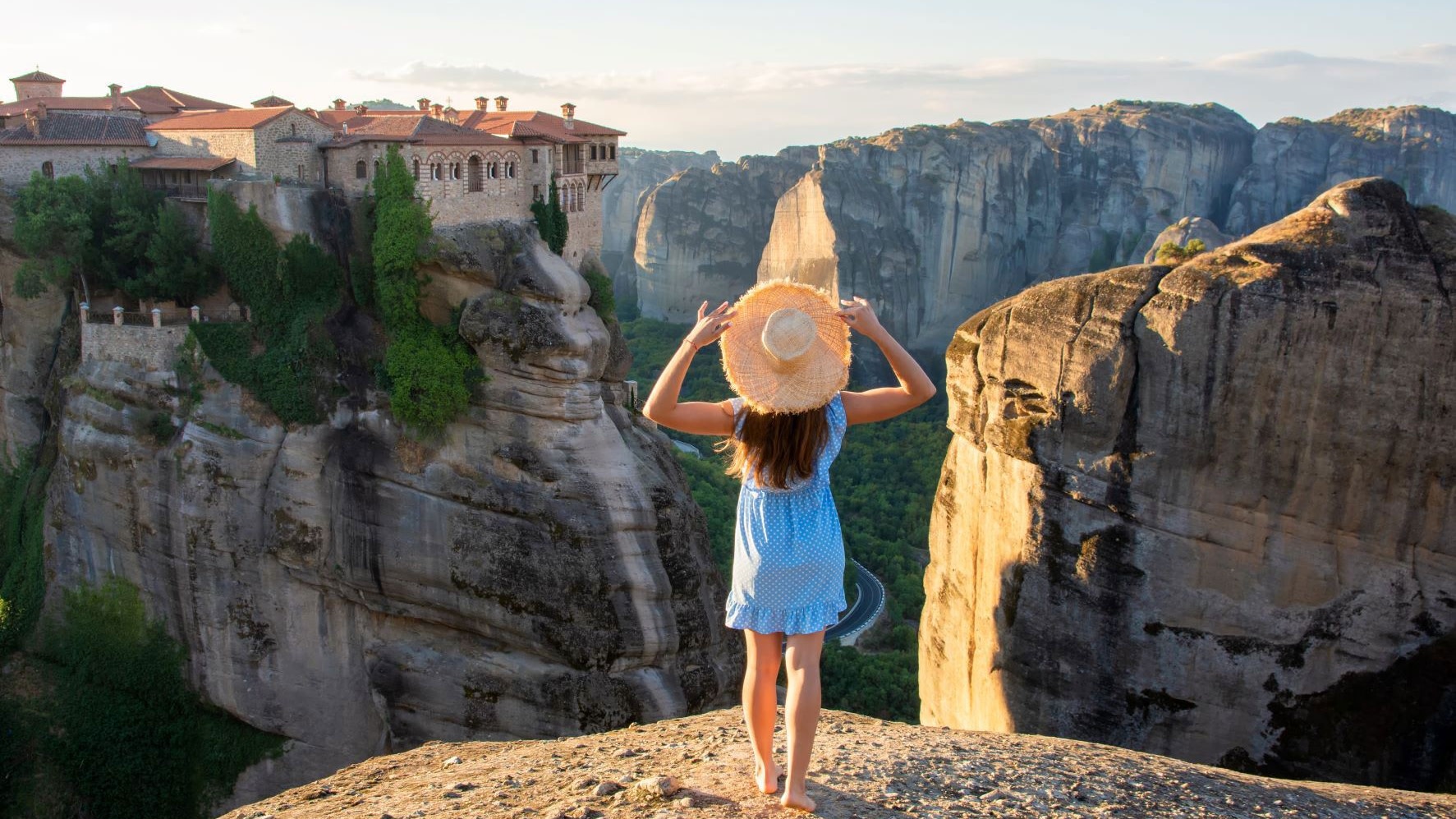
A unique landscape featuring rock formations and medieval monasteries perched atop cliffs.
Festivals
Athens Festival • May to October
Athens Epidaurus Festival • June to August
Athens International Film Festival • October
Pro tips
- Visit major attractions early in the morning or late in the afternoon to avoid crowds and heat
- Use the metro for easy and efficient travel around the city
- Explore local neighborhoods for an authentic Greek experience
- Try local street food for a quick and delicious meal
- Learn a few basic Greek phrases to enhance your experience and connect with locals
From $25
per person
Price varies by option
Secure booking
Free cancellation available
Instant confirmation